




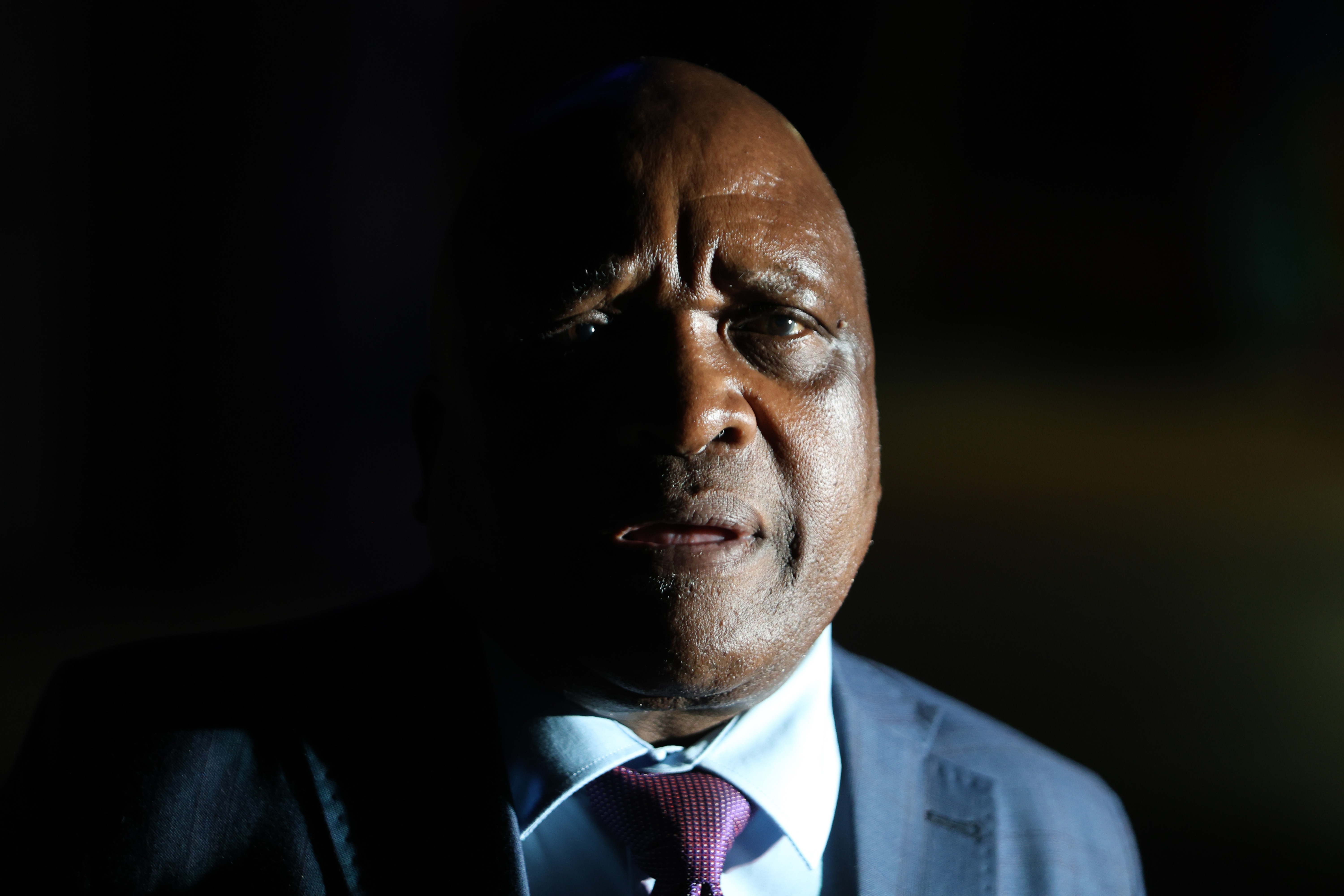
 Deputy minister of health Dr Joe Phaahla at Constitution Hill as it is illuminated in blue during an awareness event marking World Parkinson's Day, highlighting solidarity with people living with parkinson’s disease and the global call for improved care and support. (Photo: Felix Dlangamandla)
 /file/dailymaverick/wp-content/uploads/2025/10/label-Op-Ed.jpg)
Imagine you have just been told you have Parkinson’s disease. You are 54 years old. You are still working. You have a medical aid. You assume you are covered.
Your neurologist starts you on levodopa. Your medical aid covers it. So far, so good.
Then your gait starts to change. You shuffle. You freeze in doorways. You fall. Your neurologist refers you to a physiotherapist – not as a nice-to-have, but because physiotherapy is one of the most evidence-backed interventions for slowing Parkinson’s disease progression. You call your medical aid. They tell you physiotherapy is covered from your day-to-day benefits. You have R8,000 in your savings account. A physio session costs R600. By April, your savings are gone. By May, you are no longer going to physio.
This is not a story. This is what happens to the majority of South Africans with Parkinson’s disease who belong to medical schemes.
The gap nobody talks about
Parkinson’s disease is listed on South Africa’s Chronic Disease List. This means medical schemes must fund its diagnosis and medication – the levodopa, the dopamine agonists, the neurologist consultations. That is the foundation, and it matters.
But the Chronic Disease List treatment basket does not expressly mandate funding for physiotherapy, occupational therapy or speech and language therapy as standalone, unlimited chronic entitlements. These therapies instead fall into day-to-day savings benefits – capped, finite and exhausted quickly by anyone managing a progressive neurological condition. For members on lower-tier plans, they may not exist at all.
This is the gap. And it has a cost.
Without regular physiotherapy, people with Parkinson’s disease fall more. Falls in this population are a leading cause of hospital admissions, fracture and death. Without occupational therapy, people lose independence in daily tasks faster – dressing, cooking, working – increasing their reliance on family carers and eventually on the state. Without speech and language therapy, swallowing difficulties worsen, leading to aspiration pneumonia, one of the most common causes of death in advanced Parkinson’s disease.
Medication alone does not prevent these outcomes. The international evidence on this is unambiguous.
What the rest of the world already knows
In the UK, NICE Guideline NG71 makes physiotherapy, occupational therapy and speech therapy mandatory for people with Parkinson’s disease – offered, not requested; funded, not rationed. The American Academy of Neurology lists rehabilitative therapy access as a quality measure: a health system that fails to provide it is, by definition, delivering substandard care. The Parkinson’s Foundation’s 2024 international consensus statement concluded that multidisciplinary rehabilitation should begin at diagnosis and continue across all stages of the disease.
South Africa’s own 2024 Adult Hospital Level Standard Treatment Guidelines acknowledge that physiotherapy and occupational therapy are part of Parkinson’s disease management. The Department of Health already knows this is right. The Chronic Disease List treatment basket simply has not caught up.
What Parkinson’s ZA does – and why it is not enough
Parkinson’s ZA runs free weekly multidisciplinary workshops in Johannesburg, Cape Town and Durban. Every week, we bring physiotherapists, occupational therapists, speech therapists, neurologists, counsellors and peer supporters together in one room, at no cost, for people who could not otherwise access this care.
The results are visible. People who have stopped walking without assistance begin to walk again. People whose speech has deteriorated regain clarity. People who have been isolated find a community. Carers who were burning out find support.
But we cannot be the national solution. We are a nonprofit organisation sustained by donations and the generosity of healthcare professionals who give their time. We can reach hundreds. The Parkinson’s disease community in South Africa numbers in the tens of thousands. Policy is the only intervention that can reach all of them.
#SparktheNight Constitution Hill
Between 9 and 11 April, Constitution Hill will be lit in blue as part of the #SparktheNight campaign – a global call to light up landmarks in blue so that a condition often unseen is made visible and those impacted by Parkinson’s disease are no longer overlooked. The symbolism cannot be understated and is an affirmation that those living with Parkinson’s deserve to be seen, supported and cared for – with the dignity, equality and justice embodied in our Constitution. It is here that we will release an open letter to the Department of Health, demanding a call to action.
A specific, achievable change
We are asking for one specific regulatory change: an amendment to the Chronic Disease List treatment basket for Parkinson’s disease (ICD-10: G20) to expressly include physiotherapy, occupational therapy and speech and language therapy as prescribed minimum benefits – funded in full, at all plan tiers, without co-payments or annual caps.
This does not require an act of Parliament. It requires a ministerial amendment to the regulations under the Medical Schemes Act – the same mechanism that has been used to update treatment algorithms for other conditions. It is procedurally straightforward. The clinical evidence base is overwhelming. The constitutional foundation – section 27, the right of access to healthcare services – is explicit.
We are not asking for the impossible. We are asking that the health system treat Parkinson’s disease the way the evidence says it should be treated: not with medication alone, but with the full team of care that makes the difference between decline and dignity. DM
Rakesh Harribhai is the founding director of Parkinson’s ZA, a registered nonprofit organisation dedicated to expanding multidisciplinary care for people impacted by Parkinson’s disease in South Africa.