




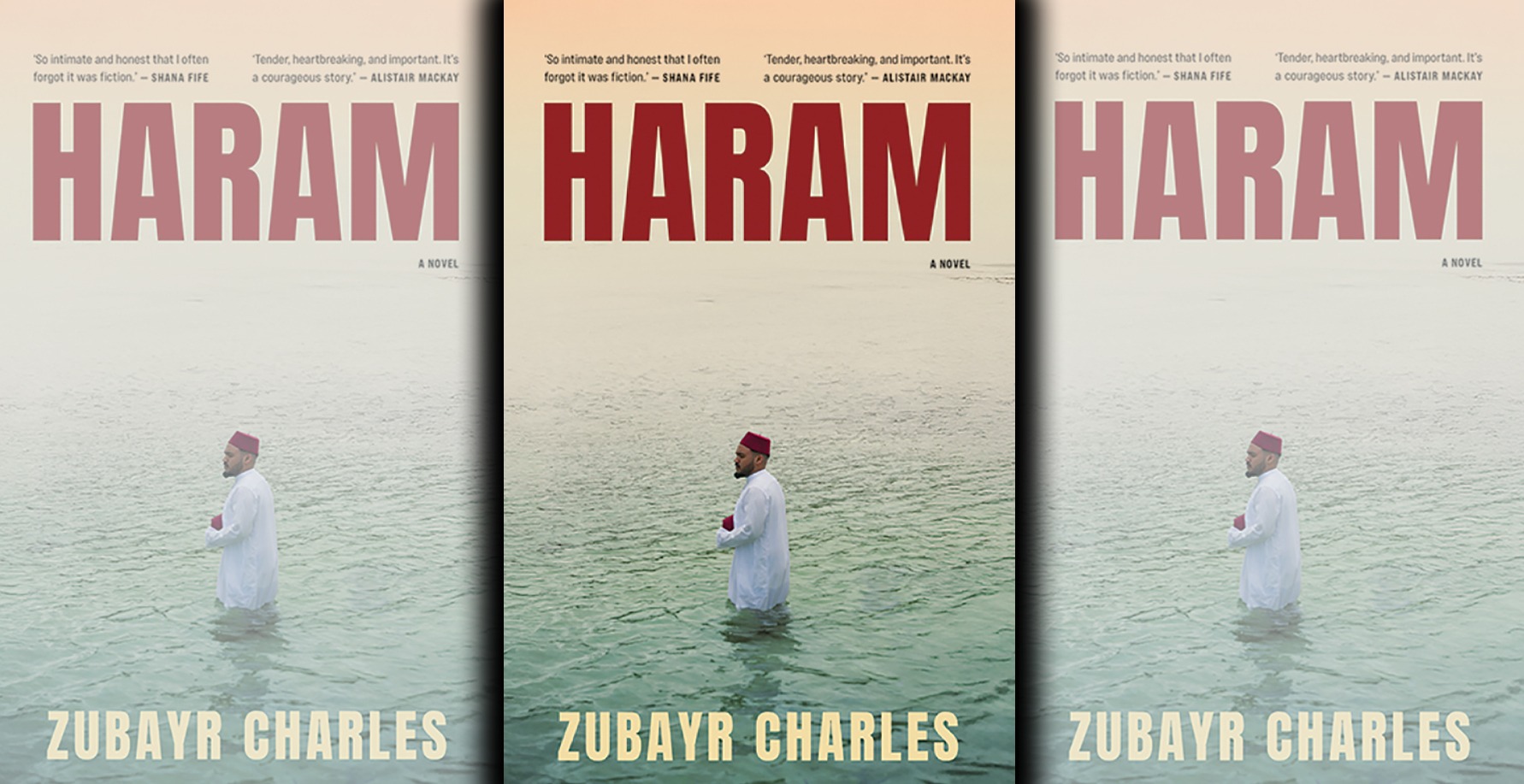
 Zubayr Charles’ debut novel Haram captures the complexities of adolescence by following a young Muslim character’s struggle between cultural expectations and personal identity. (Photo: Kwela)
 Set in 2011, Haram, the debut novel by Zubayr Charles, unfolds as a nostalgic chronicle of firsts: first dates, first kisses and first nights in a club. Like many coming-of-age stories, it centres on identity and self-discovery, tracing the protagonist’s gradual evolution from adolescence into adulthood.
Through the eyes of a teenager, the novel also explores themes of sexuality and alcohol addiction, subjects largely considered haram or forbidden in many highly religious communities.
Therefore, the novel offers space for introspection and interrogation. It asks readers how much our faith plays a part in developing our world view while trying to discover our individuality.
Set against the rich tapestry of Cape Malay culture, Haram follows Muhammad’s journey of self-discovery. Coming from a close-knit Muslim community, 17-year-old Muhammad prays five times a day, follows the rules, and lives up to his devout mother Zaynab’s expectations.
Beneath this carefully constructed façade, however, he feels suffocated by the tension between his true self and the role he is expected to fulfil. The first-person narration gives a front seat to a teenager’s battle between his faith, identity and what defines forbidden desires.
In his late teens and early twenties, the author became immersed in Cape Town’s intense nightlife while grappling with depression. His diary and laptop became a private refuge, where he recorded the darker moments and regrets that marked that period.
A tender tale grounded in real experiences
Taking his supervisor’s advice during the second year of his Master’s in Creative Writing at the University of Cape Town, Charles dug up his diary to produce a tender tale grounded in real experiences.
“My supervisor encouraged me to scrap the diary-style format, as it did not have proper storytelling elements. I started all over and created a fictionalised story, which took me about two years to write.”
As a result, the book carries the feel of autofiction, though Charles resists that label.
“People assume Haram is non-fiction and based on my life, but it is not.”
The debut author strived to make the protagonist as different as possible to separate himself completely from the story for better “honesty, insight, and rigorous self-scrutiny”.
While the distinction between fact and fiction becomes blurred, the story gives readers a glimpse into a teenager’s decisions and the consequences that come with them.
The author, who is also a playwright and poet, explains that he is “drawn to complex characters,” and that he didn’t want his main character “to be a goody-two-shoes who stays static and does not evolve or change”.
“I like characters that make mistakes and that get the reader to still root for them despite all the messed-up things that they do,” he says.
Charles originally wanted to foreground the Cape Malay vernacular, the mix of English, Kaaps, and Arabic as part of the novel’s texture. But as he developed the story, he felt that wasn’t enough on its own. Because the main character is anxious and highly detail-oriented, the narrative needed a more fully realised world. So, he expanded beyond just language, building out the character’s cultural and social environment in greater depth.
Rich with insights into the Islamic faith
The novel is rich with insights into the Islamic faith. Where this reviewer comes from, phrases like “Allahu Akbar” (God is the greatest) and “halaal” (meaning permissible) are among the few aspects of Islam that are widely recognised. Growing up in a township, mosques and the daily adhan, the call to prayer, felt distant, experienced only as unfamiliar buildings and sounds.
The added glossary at the end of the book helps ground the cultural context, offering a useful point of orientation for readers less familiar with it.
While many have approached the book with curiosity since its release in January this year, Charles notes that some readers have mistakenly interpreted it as being intentionally created for shock value.
“They see the title Haram and assume the book sensationalises the main character’s experiences with the various “haram” or “sinful acts”. And while the novel deals with taboo topics such as sexuality and alcohol addiction, Charles argues that “readers need to understand that this is a fictionalised story to showcase the difficulties teenagers face in society”.
Social anxiety and isolation
As a former high school teacher, Charles, for instance, witnessed first hand how deeply social anxiety and isolation can affect teenagers, too often unseen and misunderstood by family and friends.
“So many of our youth are suffering in silence,” he says. “I want people to read the book and understand why people struggle. The book examines the implications of hiding parts of ourselves, the effect it has on our mental health, and why people turn to addiction.”
Similar to the themes explored in Onke Mazibuko’s debut novel, The Second Verse, which focuses on the struggles of adolescence, Haram uses the character of Muhammad to examine teenage angst.
“The protagonist in this novel is an introvert, feeling he cannot confide in anyone about the struggles he is going through, and he begins to spiral. A great deal of pressure is placed on teenagers in today’s society, and as adults we can sometimes be out of touch with what they are experiencing.”
Haram is a sensible exploration of identity, faith, family and forbidden desire, recommended for both young and old. DM
Haram is published by Kwela Books, R350.