




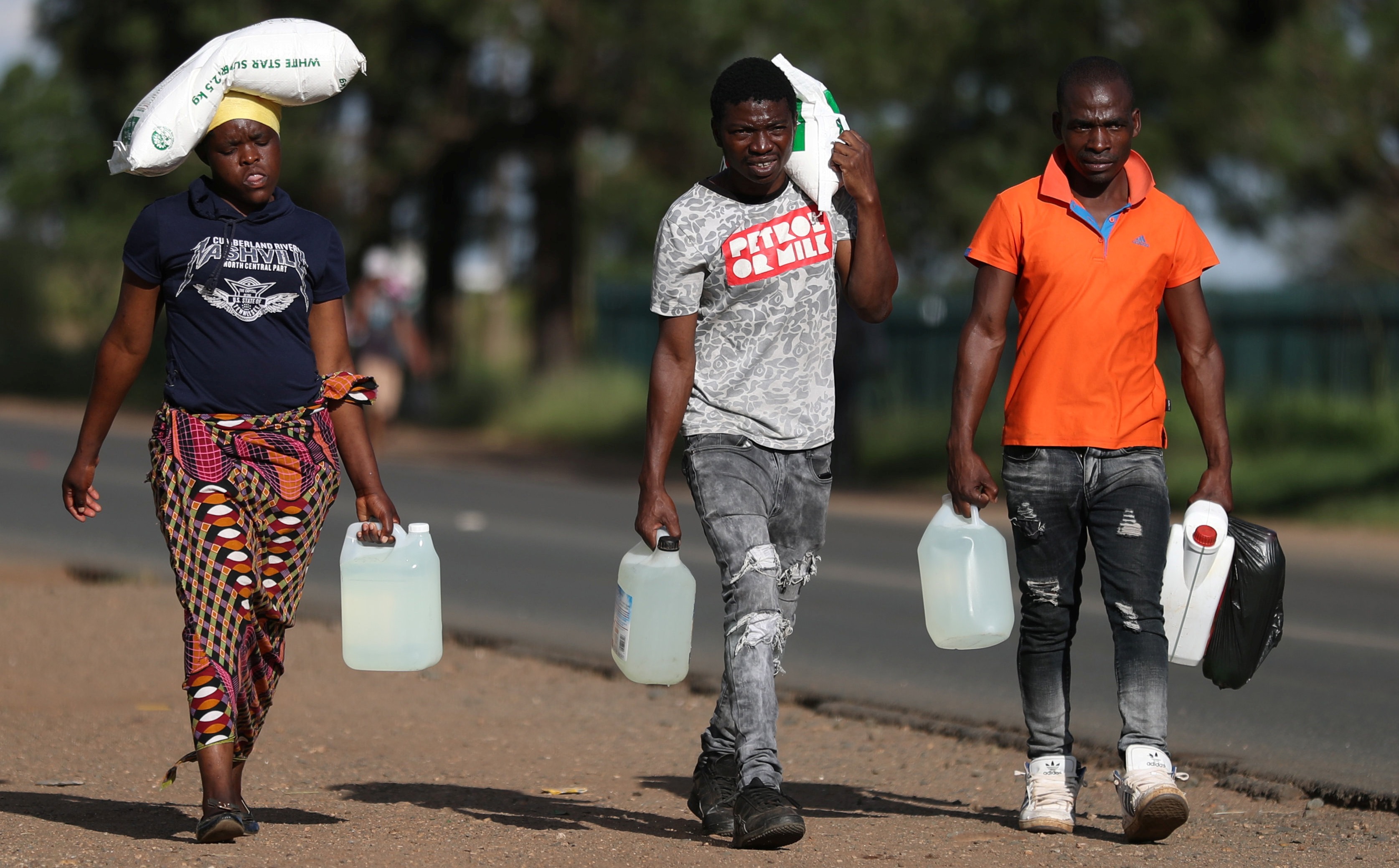
 People carry bags of maize and paraffin as they return from a store during the Covid-19 pandemic. (Photo: REUTERS/Siphiwe Sibeko)
 In the three years since 39-year-old Lerato Shabalala was last employed, she has learned to substitute her gas stove for her paraffin stove, depending on the prices. She’s come to rely on paraffin because she can buy smaller amounts when she can afford it.
When Daily Maverick visited Shabalala, who lives in Chiawelo, Soweto, and is a single mother of two boys, aged 11 and 16, she couldn’t speak right away because she had a pot on her neighbour’s stove.
“This is the life we have been used to,” said Shabalala, who didn’t want her picture taken.
More than 500,000 households in the country rely on paraffin for cooking, heating and lighting, according to Stats SA, and they’re often in low-income areas, informal settlements or areas without access to electricity.
The wholesale price of paraffin doubled from R11.52 to R23.19 per litre in the most recent fuel increases at the start of April, spurred by the US and Israel’s war on Iran, leaving the poorest of the poor cornered into making budgetary decisions where only essentials can be cut.
While the government announced a R3 cut in the fuel levy to buffer petrol and diesel consumers, no interventions have been announced to ease the burden on paraffin users facing the highest increases.
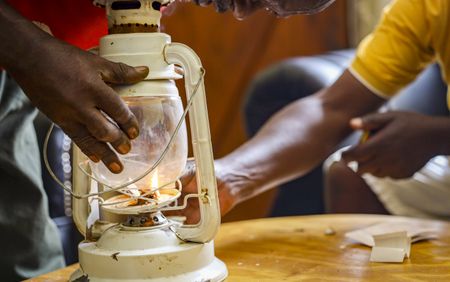
Shabalala, who uses her paraffin stove for everything from cooking to heating up water to bath, is now cutting back her spending on food.
“The price of paraffin was already priced beyond [my] means even before the latest price increase,” she said. “And, with the latest price hikes, it just got worse.”
“Paraffin is one household essential you cannot budget for,” said Shabalala.
“Each month I go over the set budget for paraffin by at least R300, and that for an unemployed single mother of two is a fortune.”
She added, “The paraffin prices are just insane. They are beyond means.”
“Other than the gas and paraffin stoves, I also have a gel stove which, like the gas stove, I hardly use,” said Shabalala, saying the gel fuel isn’t accessible.
Struggling consumers
A paraffin dealer who drives around selling paraffin from a tank at the back of his bakkie told Daily Maverick that he was very concerned about his customers.
“I know most of them are struggling because I pass many townships to come and deliver here in Soweto,” said the dealer, who didn’t want to be named.
“Unfortunately for them, I also have no choice but to increase the prices. I have already given notices to most of my Soweto customers. I will be charging them between R30 and R32 per litre.”
On 1 April, the Single Maximum National Retail Price for Illuminating Paraffin rose by R15.60 to R31.47 per litre.
Asked if, in his experience, he thinks there was a chance that the price of paraffin might go down again, he responded: “In my experience, the increases have much greater negative effect than a possible price drop. I am saying this because you find that, like now, they have hiked the price by more than R11, but should they drop it, it will be by a very small fraction of that, almost unrecognisable.”
/file/attachments/orphans/ED_233142_172123.jpeg "People queuing to buy paraffin at a wholesaler in Soweto during the Covid-19 pandemic. (Photo: Gallo Images/Fani Mahuntsi)")
Retailers are also sweating over paraffin prices, caught between customer complaints and competitors’ prices.
“My bosses were really concerned by the number of our customers complaining about the high price of paraffin,” said Musiuoa Mokhali, 63, a store assistant in Soweto.
Sent by his bosses to investigate garage paraffin prices, Mokhali found the nearby Total garage was charging R29 per litre. His store settled on R30. That extra rand, he explained, was to cover delivery costs.
Khensani Mabasa, a paraffin user from Protea, Soweto, said that spaza shops normally sell paraffin at the lowest price.
“You know things are really bad when even [they] charge the same as everyone else... The best option is the garage, to save the R1 per litre.”
No relief
While the government’s move to lower the fuel levy was widely welcomed, it has faced criticism for its lack of action on paraffin prices.
Cosatu spokesperson Zanele Sabela told TimesLive, “The fact that this relief does not even talk about paraffin is a real problem, considering that someone who uses paraffin probably doesn’t have electricity.
The publication also quoted Abahlali BaseMjondolo spokesperson Thapelo Mohapi: “We are approaching the winter season and there will be a high demand [for paraffin] and people in informal settlements will not afford this.”
Mohapi added, “They still need to cook, and not forgetting that the majority of the people are unemployed and they cannot afford paraffin as we speak.”
Paraffin usage for cooking plummeted from 21.6% of households in 1996 to just 2.7% in 2022. Yet 5.1% of households in Gauteng were still dependent on paraffin in 2022.
The Department of Mineral and Petroleum Resources did not respond to requests for comment, but its director of fuel pricing, Robert Maake, this week echoed President Cyril Ramaphosa’s comments that he was having sleepless nights over the fuel price increases.
Maake explained, “Paraffin is not taxed, so the relief measure was to reduce the fuel levy and there’s no fuel levy on paraffin. It is already zero-rated so the same cannot be applied to paraffin.”

He explained that the extreme price increases were linked to the demand for jet fuel and limitations at refineries. Paraffin, or kerosene, is also refined as jet fuel. Maake suggested refineries had prioritised jet fuel due to the high demand for air travel from Europe. At the same time, refineries had limited capacity.
“Unfortunately, because of the winter, some of the major refineries had closed down due to the very cold winter season where they could not operate. So there was a shortage of jet fuel and as a result, both the price of jet fuel and paraffin shot up,” Maake said.
“We are looking at what other mechanisms we can propose… Maybe we can look at the indigent framework where paraffin users register and get direct support from government.”
Unemployment the issue
Shabalala blames the government, not just for the paraffin price hike, but for unemployment and a general lack of service delivery.
“They are doing nothing… We put them in those high positions and that’s it – they forgot about us,” she said.
“The government must create and help people get jobs. What is happening in the country is not fair. These are the reasons why I said I will note vote because I don’t see the point. If I had a job, I would not be struggling with paraffin because I would use electricity,” Shabalala said.
“The one thing that the government can help us with is creating job opportunities. If this does not happen fast, I see a very rough road ahead, not just for me and my family, but for millions of other South Africans in my position.” DM