




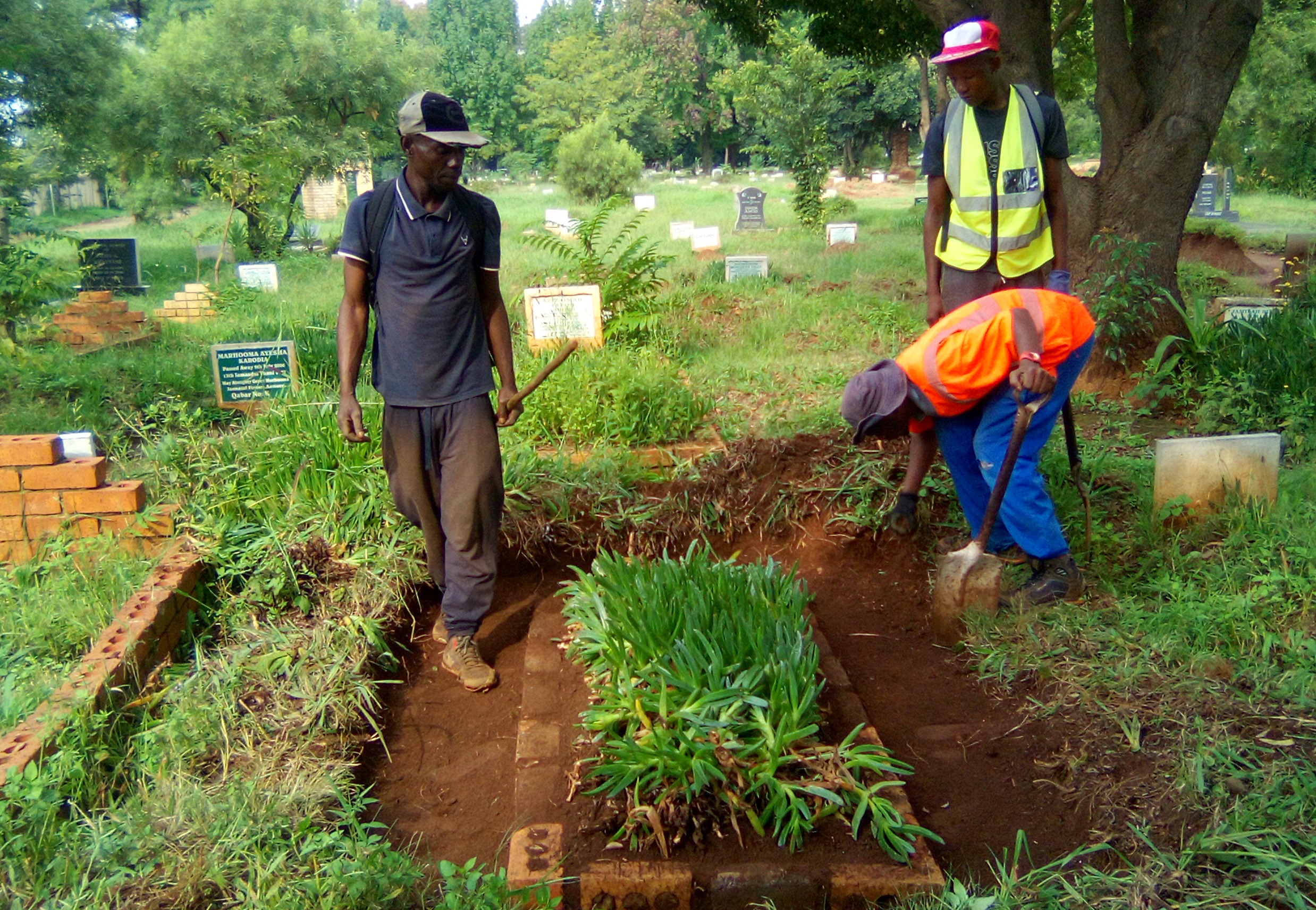
 Informal grave assistants at the Avalon Cemetery in Soweto look after graves daily. (Photo: Bheki Simelane)
 Among the rows of headstones in Avalon Cemetery, Surprise Theko spends his days ensuring that the graves are clean and that the grass is trimmed.
He is not alone.
In a city where unemployment crushes hope, the Avalon crew, a group of informal grave assistants, are cleaning up one of Soweto’s biggest cemeteries and they are surviving on the kindness of grieving families who share what they can.
“I have been unsuccessfully looking for work for many years,” says Theko, who has been cleaning graves for the past three years. “I decided to join the Avalon crew in 2024 because I could not bear the thought of sitting around in the township.”
Each day, they tend to graves – trimming grass, clearing rubbish and, as they describe it, restoring order to the resting grounds that might otherwise be forgotten.
“I found my way here after being convinced by my two friends,” Sibusiso Songwana (28), another grave assistant, says. “They felt that if I remained in the township another day, I’d make a lot of mistakes because I have pressing needs like having to provide for myself.”
Songwana has worked at the cemetery for a few months. He told Daily Maverick that he had found a livelihood and peace.
Avalon Cemetery
Located in the southwestern part of Soweto, the Avalon Cemetery, at 172 hectares, is regarded as the country’s largest. It is the resting place of Struggle stalwarts, famous soccer players, politicians, artists and many Soweto residents.
The cemetery was opened during the height of apartheid in 1972 and was then for black people. In 2022, Johannesburg City Parks organised an event to commemorate the cemetery’s 50th anniversary.

Before the Avalon Cemetery was opened, most Soweto residents were buried at the Nancefield Cemetery near the Maponya Mall.
Thabo Makgele (31) said he was lured to Avalon in the hope of staying out of trouble and earning some money.
“I’d also end up making mistakes because I need to survive,” Makgele says.
“I get to spend the entire day here and avoid the daily hustle and troubles of township life,” he adds.
At least one family that visits the cemetery told Daily Maverick that they feel safer with the informal grave assistants around.
“I think the problem arises when you cannot tell whether an individual is an informal grave assistant or a crook,” a family member who gave his name as Samir says.
“I think, even though they might not have any formal agreement with the Johannesburg City Parks and Zoo, the latter must ensure that they create name tags for the ‘legitimate’ informal grave assistants.”
/file/attachments/orphans/1000003001_711451.jpg "Informal grave assistants at the Avalon Cemetery in Soweto tend the graves daily. (Photo: Bheki Simelane)")
Employment opportunities
According to Ronald Maluleka, an informal grave assistant of many years, despite his vast experience, he hasn’t been able to land formal employment with Johannesburg City Parks and Zoo (JCPZ).
Daily Maverick asked JCPZ about offering employment to longstanding informal grave assistants, considering the vast experience many have.
JCPZ spokesperson Jenny Moodley said that while JCPZ recognises that some individuals have been offering informal assistance at the cemetery for many years, the entity was not able to appoint or absorb individuals directly without following prescribed and lawful recruitment processes.
Moodley said JCPZ is responsible for maintaining the overall environment at the cemetery, including landscaping, infrastructure and general upkeep.
“In terms of the by-laws, the responsibility for the maintenance of individual gravesites – including headstones and personal adornments – rests with the family or holder of the burial rights.
“Where graves are not actively maintained over time, JCPZ undertakes basic general upkeep to ensure that the cemetery remains respectful, safe and well kept for all visitors.”
/file/dailymaverick/wp-content/uploads/Bheki-avalon-cemetery1.jpg "The Avalon Cemetery in Soweto is the largest in South Africa. It was opened in 1972, during the height of apartheid, as a graveyard for black people. (Photo: Gallo Images / Fani Mahuntsi)")
The Avalon Cemetery is divided into several sections. Theko and his colleagues prefer to work in the section where the Indian community buries their dead.
“What happens is that I will work for a family and they will pay me cash for my services,” Theko explains. “But as time has gone on, my clients have handed me more responsibilities to look after multiple graves.”
The families even stopped paying him cash and now send him eWallet payments.
“I watch over all their graves and do whatever work that they require,” Theko says. “I then take pictures of the work as proof and send it to them. They will then pay me via eWallet on my phone.”
The grave assistants tend to the graves, regularly check them and document their condition. At month’s end, they send families a portfolio of photographs as evidence of their work. Sometimes they are asked to secure graves or even pour concrete around burial plots.
Moodley stresses that JCPZ does not have a formal agreement with the informal grave assistants.
“While some individuals assist families directly, this occurs informally and is not sanctioned, contracted or regulated by JCPZ.”
Cemetery crime
The informal grave assistants are facing a threat from nyaope and other drug addicts who often invade the cemetery and try to take work away from them.
“The addicts are becoming a huge problem, and they are steadily growing in number,” Maluleka adds.
“The sad thing about their presence is that we cannot do much about it as we are not formal staffers. Therefore, we have no right to determine who can enter and exit the cemetery,” another longstanding informal grave assistant, known as “Ozzy”, says.
Moodley confirmed to Daily Maverick that they have received isolated complaints of criminality at the Avalon Cemetery.
“Where complaints are received, they are recorded and addressed in line with JCPZ protocols, and, where necessary, matters are escalated to security services or the South African Police Service,” she adds, saying that JCPZ has deployed private security at key entrance points at the cemetery.
The problem, she admits, is the porous nature and size of the cemetery as well as limited security personnel.
JCPZ urges the public to remain vigilant and visit cemeteries in groups if possible.
“JCPZ remains committed to ensuring that cemeteries are treated as spaces of dignity, respect and safety for all visitors,” she says.
But for Theko, Songwana and Makgele and the rest of the Avalon crew, the cemetery is a place where they not only make an income but find fulfilment in providing solace to the bereaved. DM