



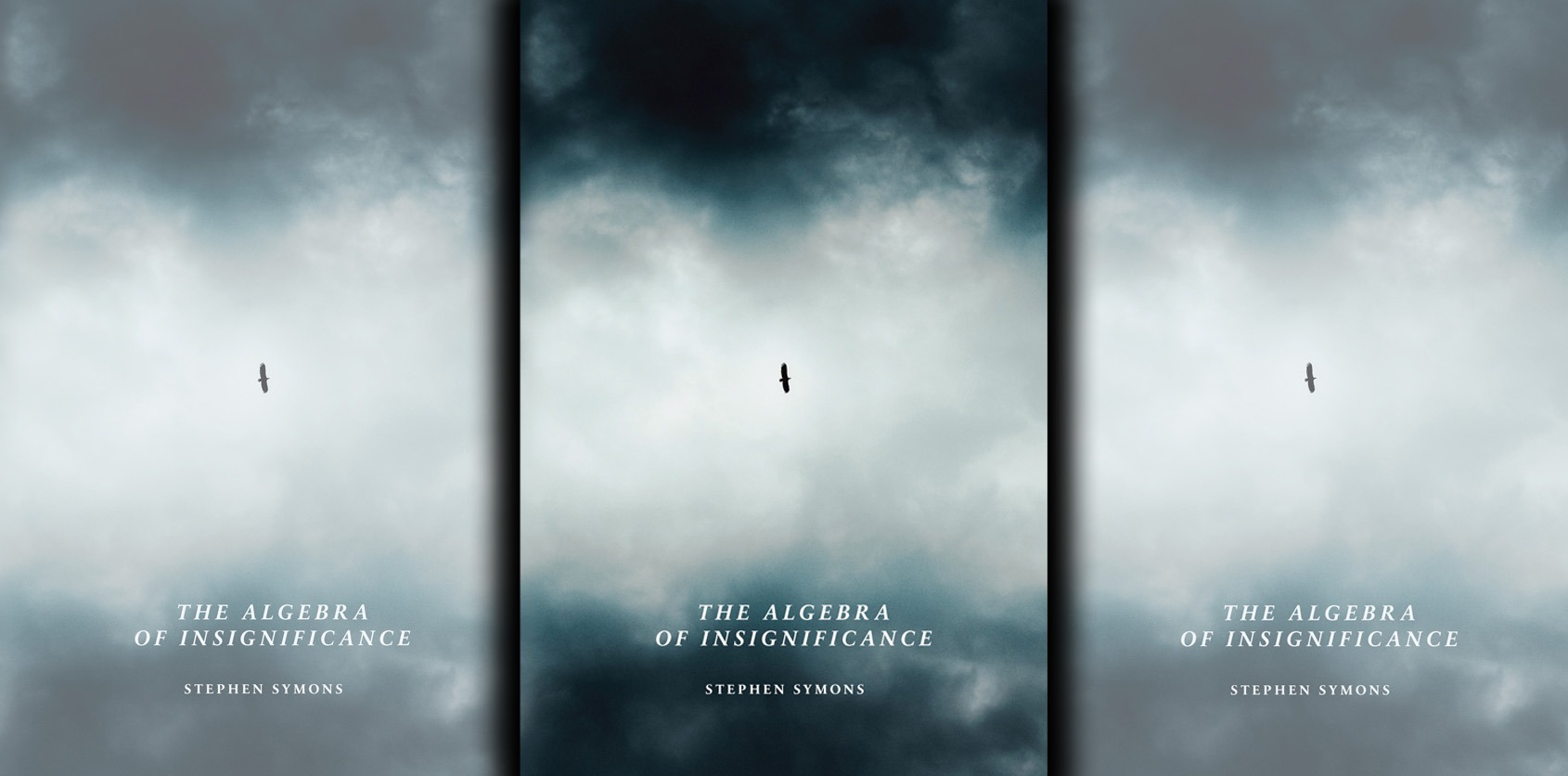
 The Algebra of Insignificance by Stephen Symons. (Publisher: Karavan Press)
 It was no prank at all. Symons had won the prestigious Olive Schreiner Award for his fifth collection of poetry, The Algebra of Insignificance.
Internationally, the Olive Schreiner Award is regarded as being on the same level as the T.S. Eliot Prize, and nationally it is equivalent to our Afrikaans Hertzog Prize. Previously, it’s been awarded to South African greats like the poet Antjie Krog and writers Njabulo Ndebele and Mongane Wally Serote.
Awarded by the English Academy of Southern Africa, it’s named after the late Victorian and early feminist writer Olive Schreiner. Schreiner is famous for The Story of an African Farm, a title many know but few have ever read, in which the author “challenged Victorian gender norms, social conservatism and imperialism”. Schreiner was the first internationally successful South African writer.
Considered to be the “thinking poet’s prize”, it’s not driven by popularity or mainstream fame. Instead, it requires the winner to meet the following qualities: literary excellence, a strong South African voice, boundary-pushing work and a contribution to the local literary landscape.
Symons’ poetry does all this and more.
I meet up with Symons at his house, in view of the stone stare of Table Mountain. I get another territorial stare from his Namibian Africanus along with a low growl, before she slinks off to her master’s side while keeping me in close check.
Symons is friendlier – and pretty unassuming, barefoot in his patterned board shorts and a well-loved T-shirt.
‘Not a poet’
From the beginning, Symons is very clear that he is not a poet. A strange claim for a poet who has just won a prestigious literary prize. He says: “I happen to be someone who writes poems, I don’t like the label (poet).
“Not labelling yourself a poet,” he explains, “gives you the latitude and longitude to explore beyond accepted norms.” Point taken.
Here’s a man who stays true to his own convictions and won’t be boxed.
“I don’t like swimming with the current,” he says.
Like most children, Symons was first attracted to the visuals in books.
“I became interested in poetry through illustration […] and eventually started reading the poems.”
At primary school, he wrote a poem about autumn leaves, which his teacher, Clive Barnett, praised, sparking an interest in poetry.
Though Symons read poetry, he came to writing poetry late. He starting writing poetry seriously from about 2012, initially encouraged by the poet Stephen Watson. Later he was supervised for his Master’s in Creative Writing by the poet Kelwyn Sole, which led to his first book being published in 2016.
He singles out the poem A Small Country by Anyone’s Standards as his favourite in the collection. Symons’ “zappy title” describes the poem as a play on duality – very much in keeping with his rejection of proselytising, philosophising, over-intellectualising and binary modes of thinking. All of which are absolute anathema to the poet’s thinking.
A Small Country by Anyone’s Standards concerns “the predicament we find ourselves in on a national scale”, Symons says. “You can read it and interpret it as our country, or interpret it as a completely different country.” The poem has “picked up on both sides of the fence”, he says.
Of influences and favourite poems
Symons doesn’t relate to the idea of influences so much as going back to the poets whose work he loves reading. These are primarily Middle Eastern poets like the Israeli Yehuda Amichai, Syrian Adonis, and Palestinian Mahmoud Darwish.
There’s the Czech poet and immunologist Miroslav Holub, Americans like James Wright, the Welsh poet and clergyman R.S. Thomas and Liverpudlian poet Brian Patten.
Although the poets are of different nationalities and have different voices, Symons is drawn to them because much of their poetry allow readers to enter a poetic landscape via seemingly “insignificant moments”.
One of Symons’ favourite poems is Yehuda Amichai’s short poem Forgetting Someone (from the 1980 collection From A Great Tranquillity), that employs the metaphor of leaving a backyard light on to describe the involuntary nature of memory. The poem highlights how the failure to forget (“the light that makes you remember”) brings back the person or memory one intended to forget, often with poignant clarity. “It’s actually a solid moment,” he says.
There is Holub’s poem, The Fly, that blends science and humanity, focusing on a fly observing the Battle of Crécy. The poem highlights the indifference of nature toward human conflict, the absurdity of war, mortality and the juxtaposition of immense destruction with the tiny, everyday life of a fly. Again, here “the poet looks at often overlooked details and its final, much like our lives are terminal too, so it resonates.”
There is Brian Patten’s poignant, beautiful poem The Bee’s Last Journey to the Rose and James Wright’s Lying in a hammock at William Duffy’s farm in Pine Island, Minnesota that ends “I lean back, as the evening darkens and comes on. / A chicken hawk floats over, looking for home. / I have wasted my life.” There is no pathos here; it’s just a hard fact that is not about eliciting empathy or sympathy.
A reader wrote to Symons once expressing how they had read his work at a particularly dark time and how it had really carried them through.
His response was not that poetry heals but rather that it offers clarity, which is no doubt part of the process. What Symons loves about poetry is that it avoids obvious answers. Rather, he regards poetry as a medium that occupies the interstitial spaces of our lives.
On the writing process
Symons has no writing schedule. Instead, he says he has “to carve out moments” which “come and go”.
Often, long after the house has gone to sleep, he is busy writing in his studio that lies quiet and cool beneath the house in the friendly presence of a library of thousands of books and CDs.
Inspiration comes from reading the work of other poets. He finds the most difficult part of the writing process is “stepping into the poem”.
Symons is currently taking a month’s break after completing his debut novel Starlorn, which is historically situated in WW2 and explores the relationship between an ace Luftwaffe pilot and a South African prisoner-of-war during the North African campaign, and beyond the war.
Symons considers current poetry trends as “centred around the I and the confessional”. But he’s a poet of details. He feels that, as a species, we often neglect or dismiss the detail instinctively, slip into a binary mode of thinking, and view the world in black and white.
Instead, what Symons likes doing is looking at the detail, and then looking outward, beyond the comfort zone of “self”. Interestingly for Symons, it’s the skilled use of language rather than the topic that is the most important part of a poem.
They say the key to novels and poetry is suggested in the titles. Symons’ prize-winning book The Algebra of Insignificance was born from his need “to look at the seemingly minor fraction of our lives in an attempt to locate them within the heavy mathematics of our time”. His previous book, For Everything That Is Perfect and Pointless, was, to a degree, informed by the Covid-19 pandemic.
Interestingly, Symons draws on mathematics, specifically algebra, for the title of his book.
Developed by Persian mathematician Muhammad ibn Musa al-Khwarizmi, it’s a branch of mathematics where symbols are used. The word comes from the Arabic term “al-jabr”, which roughly translated means a “reunion of broken parts” or “restoration”. It’s a process of solving equations and putting unknown pieces back together.
A perfect title fit for a poet who is moved by the poems of Middle Eastern poets and the language of mathematics.
Understanding patterns and the relationship of things
Poetry for Symons is “an exercise in close observation trying to understand how we carry the uncomfortable weight of the past into the fragility of the present”, and algebra, while it can be used in very practical ways to solve mathematical problems, it’s also about understanding patterns and the relationship of things, something which foregrounds Symons’ poetry.
It was Yehuda Amichai, a poet of the quotidian, love, war and death – who inspired Symons with “the details of our lived exigence’s are as monumental as any national border”.
Symons suggests “that there’s great meaning in those seemingly insignificant fractions that make up our daily lives, because our lives, for the most part, are routine and even mundane”.
The winning of the Olive Schreiner Award indicates that Stephen Symons is no longer an emerging poet, constantly being shortlisted for awards but never actually receiving them.
Of course, the award is important. He regards the award as an “immense and humbling honour”, but more important is that Symons no longer need “wonder if the small quiet frequencies you are trying to tune into are finally being heard”.
The award is surely proof that he’s finally being tuned into. Not that he believes it will change anything as he will continue as before – writing in snatched time in his studio. But to the world, he’s finally arrived and is placed firmly on the literary map, where he rightly belongs. DM