



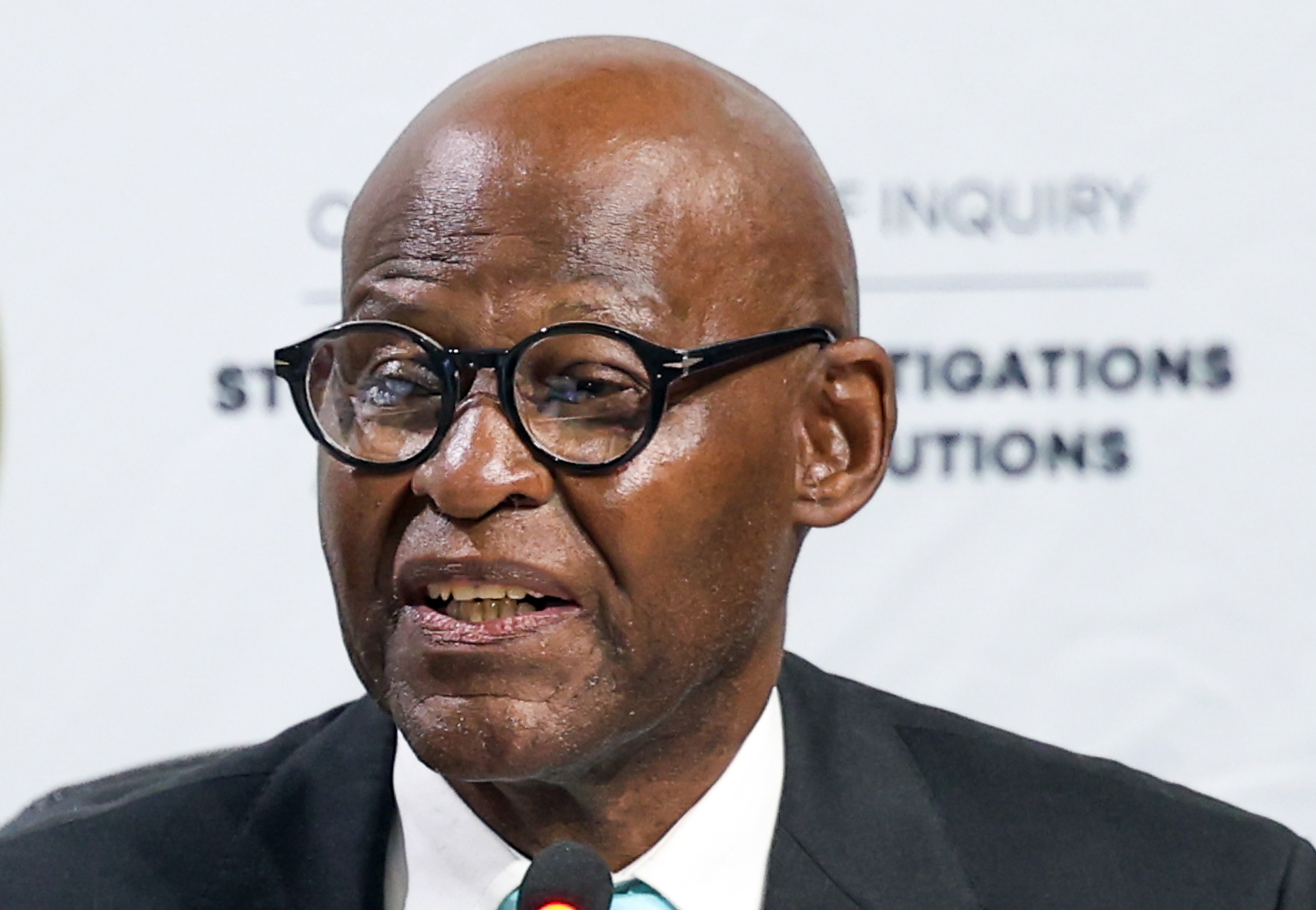
 Former NPA director Mokotedi Mpshe SC testifies at the Khampepe Commission Inquiry in Johannesburg on 7 April 2026. (Photo: Gallo Images/Luba Lesolle)
 Advocate Mokotedi Mpshe, former acting National Director of Public Prosecutions, parachuted in after Vusi Pikoli’s departure in 2007, has denied receiving political instructions to remove Priority Crimes Litigation Unit (PCLU) prosecutor, advocate Anton Ackermann, from TRC cases.
Appearing on Tuesday, 7 April 2026, at the Khampepe Commission of Inquiry into alleged political interference in Truth and Reconciliation Commission (TRC) prosecutions, Mpshe – who acted in the position between 2007 and 2009 – recalled how the intended arrest of those responsible for the attempted poisoning of Reverend Frank Chikane in 1981 had led to a deep rift with Ackermann.
/file/dailymaverick/wp-content/uploads/2023/12/sune-christians-bethlehem-Inset-1.jpg "Reverend Frank Chikane at a conference hosted by the Faculty of Theology at the University of Stellenbosch in South Africa on June 6, 2012. (Photo: Gallo Images / Foto24 / Denzil Maregele).")
Ackermann was determined to arrest then law and order minister Adriaan Vlok and police commissioner Johann van der Merwe, as well as senior security branch officers, for their role in the conspiracy, when a sudden “moratorium” on TRC cases was announced in 2004.
Chikane’s dilemma
On Tuesday, Mpshe cited a complaint by Chikane, then director-general in the office of president Thabo Mbeki, written to the NPA about Ackermann’s conduct in relation to the arrest of his alleged poisoners.
It suggests that Chikane was caught between the rule of law and Mbeki’s establishment, by regulation, of an alternative structure, the “Amnesty Task Team”, set up to determine cases where amnesty had not been asked for or granted.
The conflict of interest was glaring and Mpshe’s predecessor, Pikoli, told this to everyone before exiting the top job, refusing to take orders to remove Ackermann from TRC cases.
Chikane wrote that “instead of just consulting me, as the victim, he [Ackermann] entered into an acrimonious argument with me about the approach of the government on post-TRC and the guidelines. It was clear that he was radically opposed to the guidelines as agreed on by Parliament and the Cabinet of South Africa.”
He continued, “he seemed to be more interested in prosecution for the sake of it rather than the management of this difficult post-TRC process”.
Mpshe said on Tuesday that in hindsight, Ackermann had been correct, although the political climate at the time needed to be borne in mind.
/file/attachments/orphans/ED_603040_432559.jpg "Adv Mokotedi Mpshe SC testifies at the TRC Inquiry at Sci-Bono Discovery Centre on 7 April, 2026 in Johannesburg. (Photo: Gallo Images/Luba Lesolle)")
Ackermann, the first head of the NPA’s Priority Crimes Litigation Unit, said that while Mbeki had maintained the public persona of a “statesman” and “intellectual leader”, his administration had worked behind the scenes to orchestrate a “deeply unlawful” moratorium on TRC prosecutions.
This interference, Ackermann said, was driven by a desperate search for a “political solution” to protect security forces from facing the law. In the process, justice for the families and survivors had been delayed and denied.
It has been alleged that a “secret agreement” between apartheid-era generals and ANC leaders had been concluded.
Dr Silas Ramaite, Special Director of Public Prosecutions in the NPA since 2001, told the commission that then minister of justice and constitutional development Bridget Mabandla had informed him in 2004 that an “outside mechanism”, the Amnesty Task Team, had been established to investigate TRC prosecutions.
This task team, he said, consisted of senior officials from the NPA, the Department of Justice, the National Intelligence Agency (NIA), the South African Police Service (SAPS) and the South African National Defence Force. Mabandla had informed him to “await a mandate” from the task team about the prosecution of TRC cases.
Revolutionary culture
Former head of the National Prosecuting Authority advocate Menzi Simelane previously testified that former ANC senior leaders in exile, who had been members of its armed wing Umkhonto weSizwe, had brought a “revolutionary” culture to the forum of directors-general – part of the structure of the Amnesty Task Team.
He told the inquiry how discussions in this forum – convened to implement Mbeki’s April 2003 pronouncement on the “unfinished business” of the TRC – took place in a “politically laced” atmosphere.
“Discussion in that forum on TRC matters was always a political discussion,” Simelane told the inquiry.
Ackermann has testified that it was then national police commissioner Jackie Selebi, who was part of this intergovernmental platform, who had run with the false information that the PCLU and Ackermann were about to arrest ANC senior leaders, including Mbeki. The notion had been introduced by Jan Wagenaar, legal representative of the generals who had whispered this upwards to the ANC.
Despite numerous meetings with senior Cabinet members, this allegation served as the primary pretext for interfering with the NPA. Though never a member of MK, Selebi held a high-ranking position within the ANC’s leadership structures during exile.
Mpshe told the commission that Ackermann’s claim that he had been removed shortly after he [Mpshe] had taken office was untrue and that any action he had taken later had not been politically motivated. His involvement in TRC investigations had been limited, he said, as these had been dealt with by Ramaite.
He also set out how various government departments, including the SAPS and NIA, refused to cooperate with the PCLU and Ackermann. He had escalated the matter to Selebi, he said. DM