




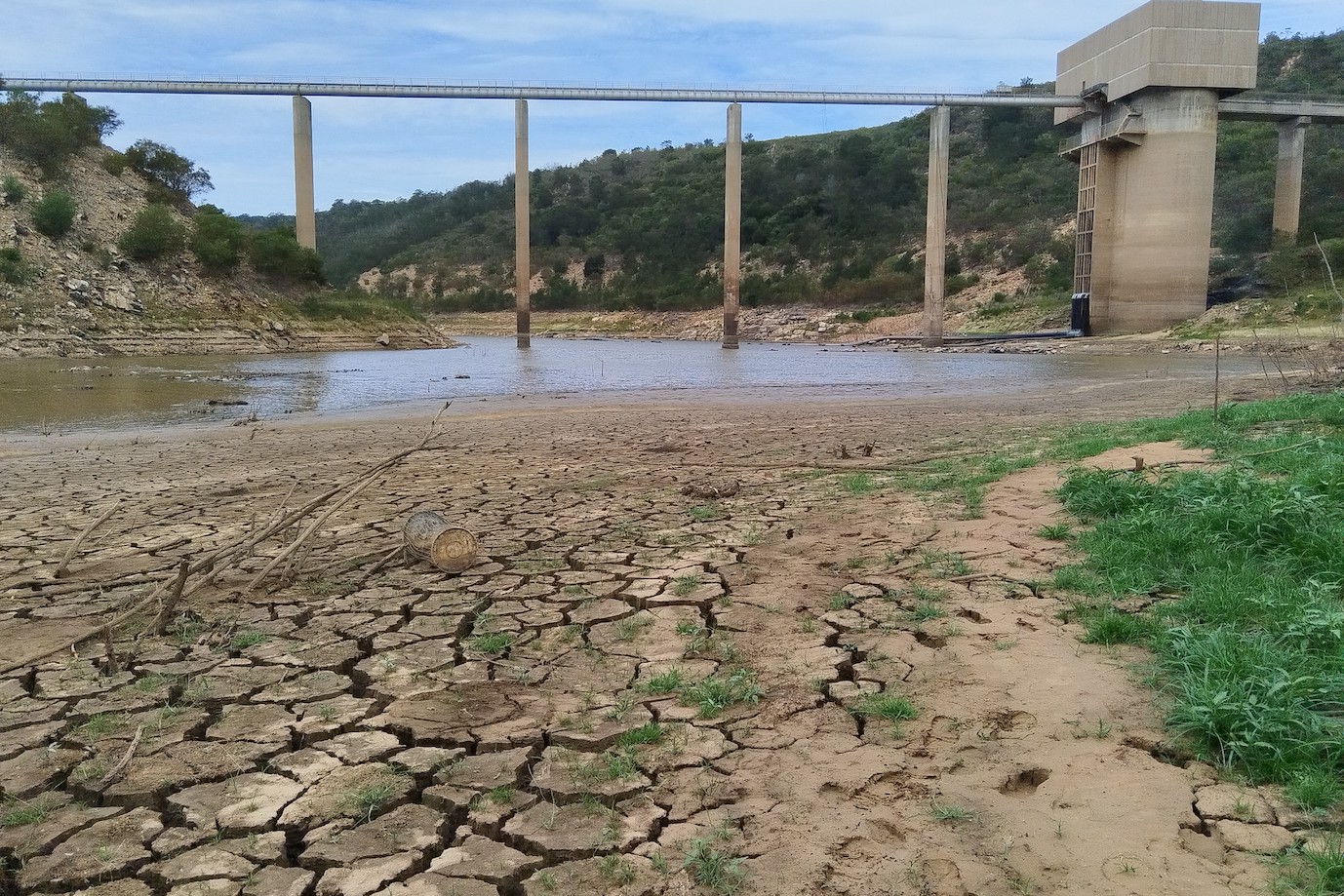
 The Impofu dam’s water levels have dropped. The Nelson Mandela Bay Municipality says the low levels are largely due to drought. (Photo: Mkhuseli Sizani)
 With Nelson Mandela Bay’s water infrastructure leaking and faltering, a neighbouring municipality is casting serious doubt on whether the metro remains competent and equipped to manage key water sources.
In March, Kouga Municipality mayor Hattingh Bornman asked Water and Sanitation Minister Pemmy Majodina to seriously consider transferring control of the Kromme bulk water system – including the Churchill and Impofu dams – from Nelson Mandela Bay to Gamtoos Water to improve operational efficiency.
As of 9 April, the current available water level for the Impofu dam was at 21.36 %. The Churchill dam was at 31.17 %. The combined available levels were at 28.86 %.
Bornman’s letter to Majodina comes amid Nelson Mandela Bay’s battle against escalating water losses, which hit a record 60.39% in the first half of the 2025/26 financial year, and the pressing need to replace about 4,700km of ageing water pipes.
More than 6,000 leaks have been reported across the system, while a severe shortage of plumbers in the metro’s water services unit means it can take seven to 10 days to fix a reported leak – more than three times the municipal standard.
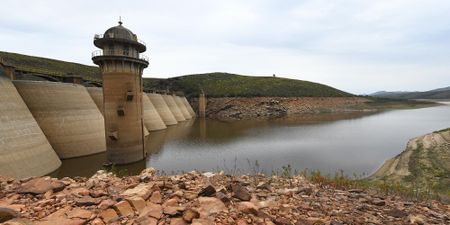
While the City has attributed the rapidly dwindling dam water levels to drought conditions, the Nelson Mandela Bay Business Chamber previously said systemic infrastructure failures were a major contributing factor.
In February, Dr Elias Sithole, head of the National Disaster Management Centre, formally declared the drought in the Eastern, Western, and Northern Cape a national disaster.
Kouga mayor calls for independent management
Speaking to Daily Maverick, Bornman has raised concerns about the management of key water resources in the region, questioning why dams located within the municipality’s catchment area are controlled by the Nelson Mandela Bay metro.
/file/attachments/orphans/DSC_6697copy_258989.jpg "Mayor of Kouga Municipality Hattingh Bornman has asked the Department of Water and Sanitation to place the management of the Impofu and Churchill dams under the management of Gamtoos Water, (Photo: Deon Ferreira)")
Bornman said the present arrangement, in which the metro effectively owns and manages the Impofu and Churchill dams, was both unfair and impractical.
“For many years, it just has not made sense to me that these dams are located in our catchment area and in our municipality, yet Nelson Mandela Bay ‘owns’ them,” he said.
“We are effectively paying for water that comes from our own area. That is not right, and I don’t think it is fair.”
He said Kouga municipality remained dependent on Nelson Mandela Bay for water supply, leaving it vulnerable to infrastructure and supply decisions beyond its control.
“If they do not upgrade the infrastructure, then Kouga suffers. If they need more water, they take it. If we need more water, we have to beg for it,” Bornman said.
Bornman also criticised the dual role played by the metro in managing and consuming water from the dams. “The fact that Nelson Mandela Bay is both the referee and the player is unfair,” he said.
He said Kouga municipality had invested significantly in recent years to improve its own water security.
“We have spent a lot of money over the past five years upgrading our own sources and trying to secure additional supply,” he said.
‘Poor results’
However, he warned that dam management remained a key concern, arguing that the present system was not delivering optimal results.
“The dams are not being managed as well as they should be,” Bornman said.
He suggested that control of the dams should be handed to an independent entity like Gamtoos Water with a proven track record in water management.
Bornman wrote in his letter to Majodina: “It is my view that serious consideration should be given to transferring the management and operational responsibility of the Churchill and Impofu Dams to Gamtoos Water, which has demonstrated strong institutional capacity in managing major water infrastructure, including the Kouga Dam.
“Gamtoos Water has proven its ability to manage water resources responsibly and efficiently, ensuring reliable supply to users while maintaining strong operational oversight and technical expertise. Their management of the Kouga Dam stands as an example of effective and responsible water governance.”
Bornman said that appointing Gamtoos Water as the caretaker of the two dams would not only strengthen operational efficiency but also improve oversight of bulk water infrastructure and support more sustainable regional water management.
Bornman wrote that the municipality received around 11 megalitres of water per day from the Kromme system.
He described this allocation as “insufficient,” particularly during periods of peak demand, such as the December 2025 festive season, when the strain on the municipality’s water supply became evident.
Bornman said the municipality, given its growth, should receive between 15 and 20 megalitres per day to “sustainably support” communities.
Gamtoos Water flags ‘over-abstraction’ by NMB metro
Gamtoos Water CEO Rienette Colesky says that if Nelson Mandela Bay Municipality continues its over-abstraction of the Impofu and Churchill dams, it will place renewed strain on the Kouga Dam.
“The metro has been over-abstracting Impofu and Churchill for many, many years,” she said.
Colesky said that despite some recovery in water sources in 2023 following a long drought period in the area, these two dams had failed to fully recover. Had the metro adhered to the imposed restrictions during the drought, the dams would probably have stabilised.
In contrast, she said the Kouga Dam – which Gamtoos Water manages – had shown consistent recovery due to strict enforcement of water restrictions. The dam provides water to towns and agricultural consumers.
“We manage Kouga very well. It recovers because restrictions are enforced. These measures are there to ensure the dam does not fail and can supply water year after year. Our agricultural consumers understand the system. When necessary, we turn off their supply, and they work with us to ensure sustainable use.”
However, she criticised the metro for what she described as a lack of accountability and cooperation with authorities.
“You now have a municipality that is delinquent. They don’t engage properly with the department and do not adhere to directives,” she said, referring to a directive reportedly issued last year on over-abstraction at the two dams.
Colesky said that there had been several calls for Gamtoos Water to take over the management of the Impofu and Churchill dams, following its success with the management of the Kouga Dam.
“There are calls for us to take over because we have demonstrated good management at Kouga. We are not afraid of a challenge, but what is most important is that water resources are managed correctly.”
Municipality pushes back
Municipal spokesperson Sithembiso Soyaya said the metro was operating under one of the most prolonged drought cycles recorded in the region, placing extreme strain on water systems.
“Characterisations of Nelson Mandela Bay as ‘incompetent’ in water management do not reflect the complexity of the drought conditions currently affecting the region, nor the scale of interventions already under way to stabilise the system,” Soyaya said.
/file/attachments/orphans/657257194_1545721007586085_8791677010888010228_n_182919.jpg "Nelson Mandela Bay Municipality spokesperson Sithembiso Soyaya. (Photo: Facebook / Nelson Mandela Bay Municipality)<br>")
Soyaya said water resource management fell under the authority of the Department of Water and Sanitation, with abstraction from key dams such as Churchill and Impofu regulated through national licensing conditions.
On proposals to shift management of the Kromme bulk water system from the municipality, Soyaya said such decisions fell within national regulatory frameworks and had to consider broader regional water security in the Eastern Cape.
The Department of Water and Sanitation did not respond to requests for comment by the time of publication. If received, it will be added.
Addressing claims that the metro loses up to 60% of its water, Soyaya said such figures had to be understood in the broader context of non-revenue water across municipal systems nationally. Losses stemmed from ageing infrastructure, historical network design, meter inaccuracies, illegal connections and operational pressures linked to prolonged drought.
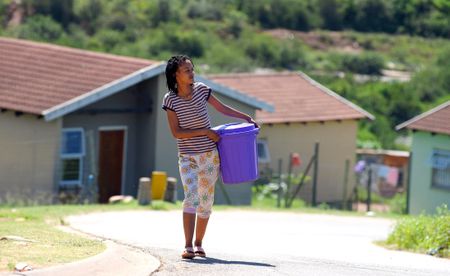
He said aggressive pressure management and network reconfiguration – necessary to preserve dam levels – had placed additional strain on older pipelines, often exposing hidden weaknesses.
“This does not represent institutional inaction. On the contrary, Nelson Mandela Bay has intensified operational interventions across the system to address leaks and stabilise supply.”
Soyaya said between July 2025 and February 2026, the municipality received 25,427 water leak reports across the metro. Of these, 18,657 leaks had already been repaired, representing a clearance rate of about 73%.
Plummeting dam levels ‘now an emergency’
Meanwhile, Denise van Huyssteen, Chief Executive Officer of the Nelson Mandela Bay Business Chamber, said the plummeting dam levels were no longer an early warning, but an unfolding crisis, and that the scale of the water management crisis demanded immediate and practical action.
“The reality is stark: we are running out of water, and the system is failing to safeguard what remains. Businesses cannot afford to wait for ideal conditions or perfect policy responses. The time to act is now.

“This is an emergency. We need the municipality to take urgent action to rein in the water losses by addressing infrastructure backlogs, such as fixing leaks, proactively maintaining the reticulation system, dealing with meter tampering and incorrect billing issues, and also properly securing pump stations to prevent vandalism,” Van Huyssteen said.
Meanwhile, the chamber has called on businesses in the metro to take decisive steps within their control, which include taking proactive measures such as fixing leaks on their premises, reducing water consumption and investing in reuse and recycling measures, adopting a school to support water-saving initiatives and awareness, and putting back-up water systems in place, as they would for power outages.
The chamber cautions that without urgent intervention, both at a system level and by all water users, the metro risks moving rapidly towards severe water shedding events, with significant consequences for the local economy and placing additional strain on already vulnerable communities. DM