




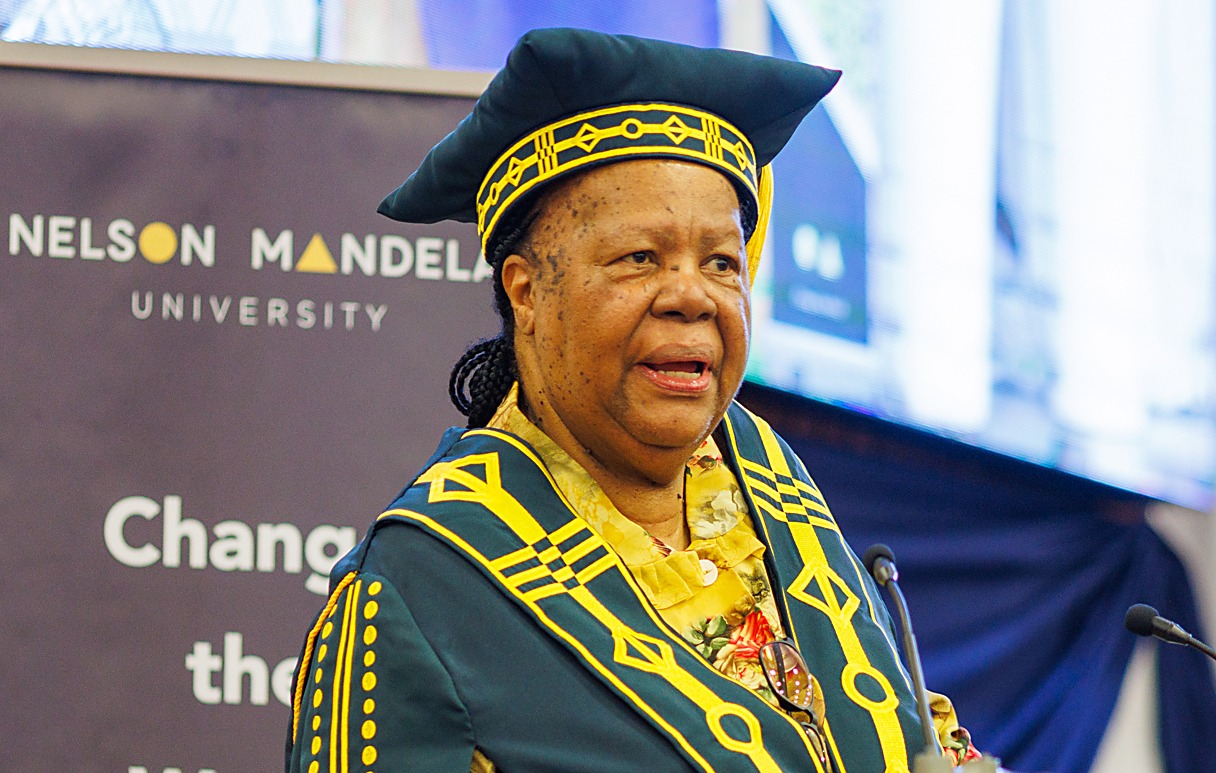
 Nelson Mandela University Chancellor Naledi Pandor. (Photo: Andisa Bonani)
 The appointment of former education minister Naledi Pandor as Nelson Mandela University’s chancellor has been praised as a vote of confidence in her leadership, but it also comes with the important task of advancing youth development in the Eastern Cape.
Speaking on behalf of Premier Oscar Mabuyane, Eastern Cape Legislature chair of committees Tony Duba urged Pandor to draw on the expertise she cultivated in her previous roles in South Africa to drive this work.
“Nelson Mandela University continues to play a pivotal role within the economic hub of our province, and remains a critical partner in advancing inclusive economic growth and development,” Duba said.
Duba said Pandor’s appointment came at a time of “renewed vigour” in the province. He said that, in his view, the Eastern Cape government had made deliberate moves on infrastructure development and industrial expansion, with a drive to attract direct investment to the region.
“The appointment of [a person of ] Chancellor Dr Pandor’s calibre, a former minister of international relations and cooperation and SA’s diplomat-in-chief, could not be more fitting.
/file/attachments/orphans/Standing_637424.jpeg "Nelson Mandela University council chair Judge Nambita Dambuza, newly installed Chancellor Naledi Pandor and Vice-Chancellor Professor Sibongile Muthwa at the institution’s South Campus in Gqeberha, Eastern Cape on 8 April 2026. (Photo: Andisa Bonani)")
“It is therefore our considered view that institutions of higher learning such as NMU, working with TVET colleges, carry a profound responsibility of developing a skills-based institutional capacity required for digital technological advancements.”
Duba said the province had to produce graduates who were not only employable, but also equipped to drive industrialisation, support technological innovation, and lead in sectors that would shape the province’s economic future.
“This is about building the value chain in our economy and ensuring that production happens here and opportunities reach the youth. Central to this is human capital, particularly the youth who remain our greatest assets.
“We must therefore align education, skills development and economic policy in a manner that unlocks their potential … ensuring that the youth of the province are not passive participants, but active drivers of growth, innovation and development,” he said.
Pandor was appointed at the beginning of April, with her formal installation held at Nelson Mandela University’s South Campus in Gqeberha on Wednesday.
As chairperson of the Nelson Mandela Foundation, she is regarded in many quarters as one of South Africa’s foremost intellectual leaders and public servants of the democratic era.
Born into a family shaped by the struggle for justice and equality, Pandor’s early life was infused with the values of service, courage and intellectual freedom.
These formative influences have guided a distinguished career spanning education, governance, diplomacy and national leadership.
Before entering public office, she taught English and later lectured at the University of Bophuthatswana and the University of Cape Town.
Her academic achievements include two master’s degrees — one in education from the University of London (1979) and another in linguistics from Stellenbosch University (1997) — through which she contributed to scholarly inquiry and helped shape democratic consciousness during a turbulent period in South Africa’s history.
Pandor obtained a PhD in education from the University of Pretoria in 2019 and also received honorary doctorates from the Cape Peninsula University of Technology, Stellenbosch University, the University of Lisbon in Portugal and University College in Dublin in Ireland.
On 28 February 2025, she was appointed honorary professor in education at the University of Pretoria.
Embrace ‘good trouble’
At her installation ceremony on Wednesday, Pandor urged the audience to embrace the practice of “making good trouble” amid rising geopolitical tensions that threatened universities. She noted that the university carried the name of South Africa’s first democratically elected president, Nelson Mandela.
She said Mandela was renowned as a leader who called on all people to make every effort to be people who made “good trouble”.
“He was referring to us utilising our active conscience to make good trouble by contributing to changing the negative conditions of millions across the world. He believed the condition of harm experienced by many should persuade us to make good trouble for change.”
Pandor said Mandela would have agreed that we were living in a deeply troubled geopolitical environment, full of confused leaders who sought to make “bad trouble and to impose malevolent unipolarity on a weakened global community”.
She said the ideological dominance of might, exemplified primarily by the United States, poses a worrying and significant threat to the higher education sector.
“All of you are aware that in the genocide against Gaza, all universities in Gaza were bombed; in the current Israel/America war against Iran, universities are being bombed. In addition, in an America that seeks to erase equity, efforts at gender equality and initiatives to respond to the legacies of slavery and race discrimination, universities are denied research funding, are told what to teach and who they may admit.”
Pandor said the growing threats to academic freedom and free expression should prompt Nelson Mandela University to articulate its perspective on these fast-evolving challenges and reaffirm its commitment to freedom, justice and the pursuit of new knowledge through untrammelled scientific inquiry.
“One of the most worrying observations of the polycrisis of the current period is the near silence and invisibility of the South, and of Africa in particular. This seeming absence of the South in articulating a progressive, humane, global agenda must encourage our university to increase efforts at achieving Africa-wide academic excellence and enhanced African investment in leadership in research and innovation.”
/file/attachments/orphans/ED_502028_793956.jpg "Former Nelson Mandela University chancellor Geraldine Fraser-Moleketi. (Photo: Frennie Shivambu/Gallo Images)<br>")
Outgoing chancellor Dr Geraldine Fraser Moleketi said that during her tenure, she witnessed the resilience of students, the dedication of staff and the unwavering commitment of council and management to institutional progress.
“During the transition of the office to Dr Pandor, I do so with great joy, pride and full of confidence that she will guide this university along its chosen path.” DM