




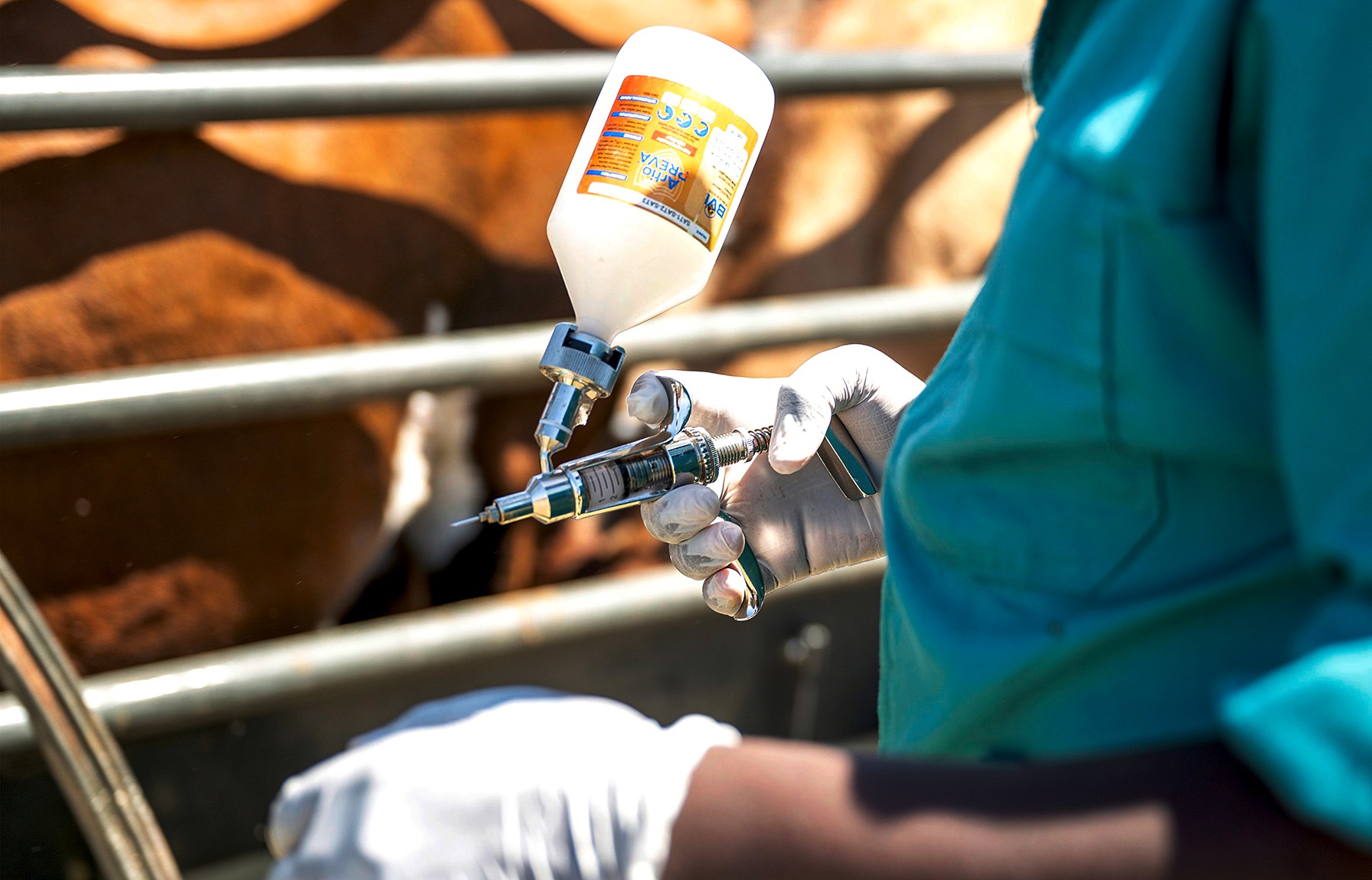
 The vaccination process for cattle against foot-and-mouth disease in Fisantekraal, Cape Town, on 15 February 2026. The process was aimed at vaccinating cattle in the informal and traditional farming sector. (Photo: Gallo Images / Die Burger / Jaco Marais)
 As millions of foot-and-mouth disease (FMD) vaccinations are being distributed across South Africa, veterinary experts have been inundated with queries about which of the imported medicines are most effective.
While there seem to be no wrong answers – drugs coming from Argentina and Turkey, as well as those produced locally, have proven effective – vets have warned against complacency and urged farmers, particularly those in the meat and dairy industries, to maintain biosecurity and responsible animal movement protocols.
Earlier this month, the Department of Agriculture, Forestry and Fisheries announced that the Agricultural Research Council (ARC) had released 20,000 doses of its locally produced FMD vaccination following the 12,900 doses distributed in February.
These vaccinations further bolster the one million Biogénesis Bagó vaccines and 1.5 million Dollvet vaccines, imported from Argentina and Turkey respectively, earlier this year.
The influx of vaccines comes after the South African Health Products Regulatory Authority approved the importation of these treatments, ensuring their safety and compliance with national regulations.
“The restoration of production capacity at the ARC is well under way with an additional investment into expanding the existing capacity over the medium term already afoot. Over time, this will progressively reduce reliance on imports and ensure sustainability of vaccine supply in line with the national disease management strategy,” Minister of Agriculture John Steenhuisen said.
He said the goal was to have 80% of cattle herds in SA vaccinated against FMD by the end of the year, and a reliable supply of vaccines was a crucial part of this strategy.
/file/dailymaverick/wp-content/uploads/2025/10/ED_562014.jpg "Karan beef cattle at the Karan Beef Feedlot during an official visit to foot-and-mouth disease vaccination sites in June 2025 in Heidelberg, Gauteng. The visit formed part of efforts to strengthen biosecurity and disease management protocols in partnership with provincial authorities and the private sector. (Photo: Gallo Images / OJ Koloti)")
According to a statement by the ministry, more than 1.7 million animals had been vaccinated by 26 March. This number is set to increase exponentially as an additional 3.5-million doses of imported vaccine are expected in South Africa during the course of April.
FMD is a highly contagious disease that affects cloven-hoofed animals.
Symptoms include hypersalivation, loss of appetite, ulcers and lesions on the tongue and around the hooves, lameness and a drop in milk production.
Fatalities are rare if animals are treated quickly. Younger animals are more susceptible, and most fatalities are among newborn livestock or due to culling to prevent the spread of the disease. People cannot contract FMD.
Disease mapping done by the Red Meat Industry Services (RMIS) shows the largest concentration of FMD outbreaks is still in KwaZulu-Natal, along the Mozambique border, and a large number of isolated cases in the Free State, Gauteng and North West are being monitored closely.
The northwestern region of the Eastern Cape remains a source of concern, while singular cases in the Kouga Municipality are still active. Most of the Eastern Cape, Western Cape and Northern Cape is under control with minimal or no cases being reported.
‘All vaccines are effective’
With the availability of vaccines from various sources, and with different strains of FMD doing the rounds, questions have been raised about which treatments are most effective.
A panel of veterinary experts released a document last month aimed at answering the concerns they encountered most frequently, and the conclusion was simply that any of the available products were effective, and using more than one further improved livestock’s resistance to FMD.
Milk SA veterinary adviser Dr Mark Chimes, who was on the panel, explained that while some of the vaccines were more effective in building resistance against specific strains of FMD, it was worthwhile for farmers to use whatever vaccine they could get hold of.
“Using multiple vaccines increases protection against multiple antigenic profiles and improves the overall immunity of the entire population.
“If a specific vaccine is not readily available to you, get your hands on any of the others to prevent interruptions in the vaccination programme,” Chimes said.
/file/attachments/orphans/FMD10_444042.jpg "Cattle graze on a farm in Limpopo. (Photo: Leano Larona)")
The expert panel said that certain water-based vaccines should be administered every three to four months to remain effective. Oil-based vaccines, such as the ones produced by ARC Dollvet and Biogénesis Bagó, can be administered over six-month intervals.
Response to treatment differs from one animal to the next, but generally, vaccines are effective after 28 days. It is recommended that cattle in areas where FMD occurs more frequently should be vaccinated every four to six months.
The goal for each farm, and ultimately the entire country, is to achieve herd immunity, which will drastically reduce the chances of isolated instances of FMD and prevent widespread outbreaks.
While high-potency, oil-based FMD vaccines are generally very safe, certain side effects can occur. Milder symptoms include swelling or lumps where the injection was administered, as well as a slight increase in body temperature over a 72-hour period after treatment.
Vaccinations are not foolproof, and Chimes said it was still important that farmers did not become complacent and neglect other protocols to reduce the spread of FMD.
“Vaccination does not always ensure that infections will not occur, but it does reduce the viral load and severity of symptoms. That is why it is crucial that everyone still adheres to strict biosecurity measures and ensures that animal movement is strictly regulated from one farm to the next.” DM