




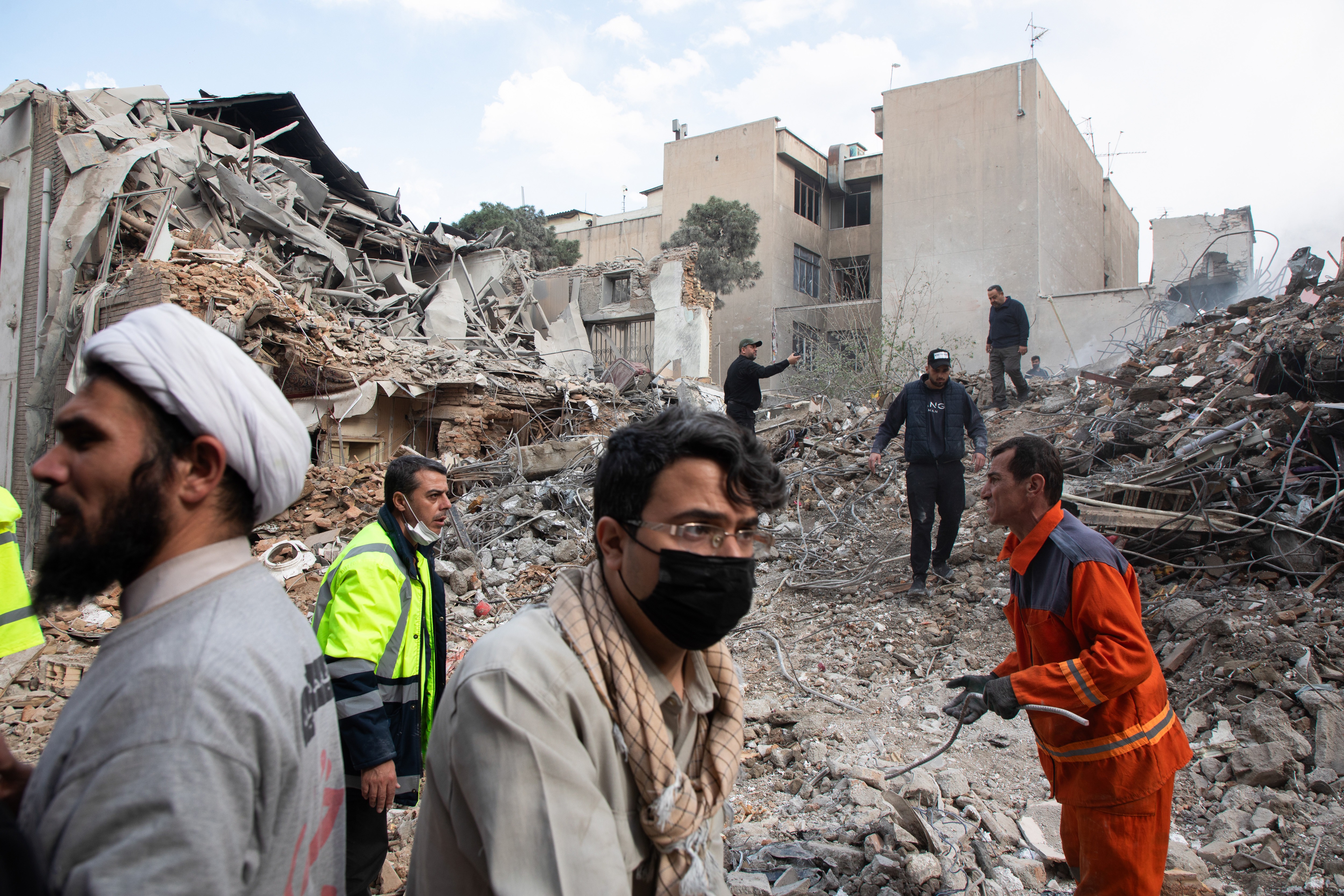
 Emergency crews work at the site of a US-Israeli strike on a residential building in Tehran that also destroyed the adjacent Rafi-Nia Synagogue on 7 April. (Photo: Majid Saeedi/Getty Images)
 /file/dailymaverick/wp-content/uploads/2025/10/label-Op-Ed.jpg)
The US–Israel strikes on Iran are best understood as an assertion of power that proceeded despite — and in ways that are destroying — the very mechanisms meant to uphold international peace and security. Diplomacy was active, mediation was functioning, and the legal prohibition on the use of force was clear, yet none operated as meaningful constraints.
The global impacts of the US and Israel’s aggression against Iran, and Iran’s subsequent retaliation against regional neighbours, are many. They range from the closure of key shipping lanes and the skyrocketing of global energy costs, with profound human security impacts on average citizens. The manner in which the war began, however, carries serious, far-reaching consequences: it suggests a dismantling of the systems meant to prevent or resolve conflict not only in West Asia, but anywhere in the world.
/file/attachments/2989/13822892_796832.jpg "The Thai-flagged cargo ship Mayuree Naree on fire after being hit by Iranian missiles in the Strait of Hormuz on 11 March. (Photo: Royal Thai Navy / EPA)")
In the days preceding the Israeli-US strikes across Iran, during which Supreme Leader Ayatollah Ali Khamenei and several key officials were killed, Omani Foreign Affairs Minister Badr bin Hamad Al Busaidi, acting as mediator in US-Iranian nuclear talks, told the media that “a peace deal is within our reach”. Iran’s minister of foreign affairs, Abbas Araghchi, insisted a few days earlier that such a deal was only possible “if diplomacy is given priority”. The joint US-Israeli air strikes shattered Iranian trust in their US negotiating partners and, with it, diplomacy’s capacity to prevent violent escalations in the region.
Legal prohibitions ignored
Within hours of the outbreak of war, South African President Cyril Ramaphosa released a statement affirming that “anticipatory self-defence” — Israel’s pretext for striking Iran — had no basis in international law. The attacks did not fall under Article 51 of the UN Charter permitting the use of force in self-defence, but under Article 2(4), which prohibits the use of force against another state without UN Security Council authorisation — a foundational pillar of the post-World War 2 international order.
The aggression also violated US domestic law, requiring congressional approval for such an escalation. Yet Congress tacitly accepted the secretary of defence, Pete Hegseth’s principle of “no rules”, rendering US law, like international law, toothless and of marginal relevance.
/file/attachments/2990/GettyImages-2267370596_714869.jpg "The US secretary of defence, Pete Hegseth. (Photo: Win McNamee / Getty Images)")
In stark contrast, the vast majority of European states – typically backing US interests – have refused to join the war or a US-led coalition to secure the Straits of Hormuz, citing international law. Several states, such as Japan and South Africa, similarly adherent to international legal principles, have managed to mitigate the effects of acute energy crises by securing safe passage for their ships through diplomatic means alone.
International and domestic legal frameworks are unambiguous on the illegality of the US-Israeli aggression. Their weakness, however, lies in the absence of enforcement mechanisms when powerful states are the transgressors — a weakness further exacerbated by measures deliberately designed to undermine the limited avenues of recourse that remain.
The US sanctioning of judges at the International Criminal Court and UN Special Rapporteur on the Occupied Palestinian Territories Francesca Albanese sends clear signals that international law may be disregarded with impunity and that those endeavouring to hold both states to account for the ongoing genocide in Gaza will be punished.
/file/dailymaverick/wp-content/uploads/2025/10/Francesca-Albanese-Groote-Kerk-DH-7940-copy-1.jpg "Francesca Albanese addresses a packed interfaith audience in the Groote Kerk in Cape Town on 26 October 2025. (Photo: David Harrison)")
Replacing diplomacy with bombs
The damage done to institutions and frameworks is compounded by a deeper breakdown of norms and trust. The positive negotiations described by ministers Al Busaidi and Araghchi were foiled by air strikes; mechanisms meant to constrain the outbreak of war were overpowered by the unwanted outcome, destroying trust in both the process and involved parties.
This was not the first evidence of untrustworthiness; Israel had routinely violated negotiated ceasefires with Hamas and with Hezbollah by carrying out regular strikes in Gaza and Lebanon. The US, for its part, had reneged on the Joint Comprehensive Plan of Action (JCPOA), the Obama-era agreement between Iran, the P5+1, and the European Union, during President Donald Trump’s first term in 2018.
Trump also authorised strikes against Iran in June 2025, while both states were in the process of negotiating a new nuclear agreement. Currently, as another set of talks are taking place between the US and Iran, mediated by Pakistan, Trump’s latest, expletive-laden threat to Iran only exacerbates this sense of American untrustworthiness and unwillingness to pursue diplomacy in good faith.
Given this history, one cannot begrudge Lebanon, Iran, or Palestinian factions for approaching negotiations with the US or Israel with profound suspicion. What makes the current moment especially damaging is that the US-Iran talks did appear to be arriving at a genuine settlement.
Minister Al Busaidi reported that Iran had been willing to go beyond the terms of the JCPOA — an agreement already considered unpopular by hardline Iranian political figures. The US-Israel escalation therefore marks a dangerous precedent: negotiations as a prelude to violent confrontation, rather than a preventative mechanism.
The interests driving war, and the absence of restraint
The long-compromised rules-based order is not collapsing from external pressure; it is being dismantled by the states that designed it. Under Trump and Israeli Prime Minister Benjamin Netanyahu, US exceptionalism and Zionist expansionism have dispensed entirely with working within a broken system and are willing to sacrifice all efforts to advance collective security at a global level. Their foreign policy strategies gesture instead towards the pursuit of unconstrained self-interest.
/file/dailymaverick/wp-content/uploads/2025/10/GettyImages-2240405492.jpg "US President Donald Trump talks with Israel's Prime Minister Benjamin Netanyahu in the Knesset, Israel's parliament, on 13 October 2025 in Jerusalem. (Photo: Evan Vucci - Pool/Getty Images)")
Trump’s desire to gain control over the Strait of Hormuz, through which around 20% of all global oil and gas exports are shipped, led to the assassination of nearly every Iranian official willing to negotiate. The US has long coveted the region’s energy resources, but no previous administration adopted so heavy-handed an approach, precisely because of the risk of spiralling out of control — as has now happened.
Previous US regimes have empowered Israel in exchange for supporting broader US interests in the region: containing democratic movements and maintaining military dominance in exchange for near-unconditional backing of the world’s strongest military power. Under Trump and Netanyahu, this arrangement has collapsed into something more volatile — a relationship in which expansionist ambition and domestic political imperatives have overridden any strategic caution.
Hegseth articulated the logic plainly, announcing that the US seeks to engage “all on our terms, with maximum authorities, no stupid rules of engagement, no nation-building quagmire, no democracy-building exercise, no politically correct wars.” This is not foreign policy, but the explicit rejection that US power should be constrained by rules, alliances or consequences.
Who defends the architecture when the powerful will not?
The global architecture of peace — resting on multilateral institutions, diplomatic norms, and international law — has not collapsed but is being hollowed from within by the very states that built it and have benefited from it most. The question of who defends what remains and crafts alternatives is urgent. The roles of emerging and middle powers who never designed this system but now depend on it most, are paramount.
Countries like South Africa, Oman, and Qatar — committed to advancing such peace norms and practices — are in an extraordinarily difficult position. Oman and Qatar, both seasoned mediators in Middle East-US tensions, have advanced peace through discretion rather than pressure — qualities that made their mediation credible. This channel may now be bombed shut.
South Africa has placed itself squarely above the parapet, bringing cases before the ICJ, forging legal coalitions, upholding norms that powerful states have abandoned — while facing profound economic and diplomatic backlash for doing so. Gulf states face impossible calculations: dependent on US security guarantees while economically exposed through Hormuz, and increasingly aware that guarantees come with conditions at odds with their long-term regional interests - and deep costs for allying with the US.
/file/dailymaverick/wp-content/uploads/2024/12/15-11939628.jpg "From left: Professor of International Law John Dugard, lawyer Tembeka Ngcukaitobi and lawyer Adila Hassim during South Africa’s genocide case against Israel at the International Court of Justice in The Hague on 12 January 2024. (Photo: Remko de Wall / EPA-EFE)")
The stakes extend beyond governments, as citizens globally bear the consequences yet are less heard in power-driven international relations. Africans are disproportionately affected, exposed to the energy shocks, trade disruptions, and diplomatic instability when major powers act without restraint.
Dirco Director-General Zane Dangor reminded us in a recent DM interview that if the norms and laws that constitute the global architecture of peace do not protect everyone, then “we are all at risk”. Every state, and every person, has a stake in how we move forward. DM
Erin McCandless is a professor of politics and international relations, the director of the Qatar-South Africa Centre for Peace and Intercultural Understanding at the University of Johannesburg and a non-resident fellow at the Centre for Conflict and Humanitarian Studies, Doha. Abdulla Moaswes is a researcher at the Qatar-South Africa Centre for Peace and Intercultural Understanding at the University of Johannesburg, and a research fellow at the Afro-Middle East Centre.