Sony World Competition — Outstanding wildlife and nature photography from around the world
The Sony World Competition announced the finalists and shortlists for their 2026 professional awards. The Awards spotlights photographers telling the stories of our time. Here is the selection of images from the professional competition in the wildlife and nature categories.
On the sea ice off Baffin Island, Nunavut, Canada, a polar bear mother leads her newborn cubs from the safety of their snow den onto seasonal ice that grows smaller every year. For close to a month, the photographer worked with Inuit guides, travelling by sled and using long lenses at a respectful distance as the family rested, played, learned to hunt and crossed the fractured floes. Their movements trace a simple story of life on a foundation that is slowly melting away — a quiet choreography of survival. (Photo: Sunita Mandal, United States, Shortlist, Professional Competition, Wildlife & Nature, Sony World Photography Awards 2026)
On the sea ice off Baffin Island, Nunavut, Canada, a polar bear mother leads her newborn cubs from the safety of their snow den onto seasonal ice that grows smaller every year. For close to a month, the photographer worked with Inuit guides, travelling by sled and using long lenses at a respectful distance as the family rested, played, learned to hunt and crossed the fractured floes. Their movements trace a simple story of life on a foundation that is slowly melting away — a quiet choreography of survival. (Photo: Sunita Mandal, United States, Shortlist, Professional Competition, Wildlife & Nature, Sony World Photography Awards 2026) South Sudan is the world’s youngest nation state, born out of decades of civil war. It is also home to a 20-million hectare wilderness area, and the world’s largest terrestrial migration: the Great Nile Migration. Each year, up to six-million antelope move across this vast landscape, which is populated primarily by semi-nomadic pastoralists. With no road infrastructure, all of the photographs in this series were taken from the air, either from helicopters, aeroplanes or with a drone. (Photo: Marcus Westberg, Sweden, Shortlist, Professional Competition, Wildlife & Nature, Sony World Photography Awards 2026) Another photograph by Marcus Westberg capturing landscapes in South Sudan. (Photo: Marcus Westberg, Sweden, Shortlist, Professional Competition, Wildlife & Nature, Sony World Photography Awards 2026) Coyotes were widespread throughout the city of San Francisco in the early 1900s. However, a government-sponsored campaign that encouraged residents to poison or shoot this native species led to them vanishing from the area. More than 75 years passed before they re-emerged in the city in the early 2000s, a testament to their resilience and adaptability. There is now a steady population estimated at around 100 individuals, but co-existence between an apex predator and city-dwelling people is not without its challenges. Generally speaking, though, scientists say it is not the coyotes of San Francisco that are the problem, but humans. Fishermen leave bait on piers, picnickers leave scraps in parks, rubbish bins spill over with detritus that the coyotes relish and some locals break the law and intentionally feed them. (Photo: Loren Elliott, United States, Shortlist, Professional Competition, Wildlife & Nature, Sony World Photography Awards 2026) Part of Loren Elliott's photos of coyotes in San Francisco. (Photo: Loren Elliott, United States, Shortlist, Professional Competition, Wildlife & Nature, Sony World Photography Awards 2026) The Crows. North East UK coastline. (Photo: James Ross, United Kingdom, Shortlist, Professional Competition, Wildlife & Nature, Sony World Photography Awards 2026) Another photo from James Ross's series The Crows. (Photo: James Ross, United Kingdom, Shortlist, Professional Competition, Wildlife & Nature, Sony World Photography Awards 2026) The photographs in this series were taken by a wildlife camera. Exposures were made when animals activated the camera via motion sensors, in the absence of the photographer and without his intervention. He was responsible for the preparation and follow-up work; installing the wildlife cameras in carefully selected locations and evaluating and processing the images that were generated over a period of months. The finished work is thus a co-production with the wild animals, whose decisive part the moment the image is created was not chosen by the photographer. (Photo: Wolfgang Duerr, Germany, Finalist, Professional Competition, Wildlife & Nature, Sony World Photography Awards 2026) Part of Duerr's series taken by a wildlife camera. (Photo: Wolfgang Duerr, Germany, Finalist, Professional Competition, Wildlife & Nature, Sony World Photography Awards 2026) Gazing at animals in a zoo, they can sometimes appear far less ‘animal like’ than we imagine. There may be a sense of authenticity and freedom, but ‘there’s no escaping the fact that this is a designed haven where they want for nothing.’ The photographer compares the zoo to a ‘landscaped theatre of life.’ (Photo: Fei Xin, China Mainland, Shortlist, Professional Competition, Wildlife & Nature, Sony World Photography Awards 2026) Another image by Fei Xin. (Photo: Fei Xin, China Mainland, Shortlist, Professional Competition, Wildlife & Nature, Sony World Photography Awards 2026) Nordelta is one of the best-known private developments in Buenos Aires, Argentina. It was built on a wetland, an ecosystem in which the land is covered by water, which is the main factor controlling plant and animal life. In recent years, the development’s 45,000 upper-class residents have seen numerous capybaras enter the neighbourhood. Social media has been flooded with videos and photographs of the area’s original inhabitants in swimming pools, crossing the street, or, more tragically, run over or trapped in drains or sewers. In a little over three years, the capybara population tripled to 1,000, leading the Buenos Aires government to approve population control plans that include selective sterilisation and contraception. At the same time, the presence of capybaras has divided the community, with neighbours arguing for and against the capybaras; for the rights of nature and against uncontrolled urban growth on natural land. (Photo: Anita Pouchard Serra, Argentina, Finalist, Professional Competition, Wildlife & Nature, Sony World Photography Awards 2026) Part of Anita Pouchard Serra's photographs of Nordelta. (Photo: Anita Pouchard Serra, Argentina, Finalist, Professional Competition, Wildlife & Nature, Sony World Photography Awards 2026) The sporulation of mushrooms is a subtle and fascinating phenomenon that occurs when they reach maturity. As billions of spores take to the air, a carefully placed backlight reveals shimmering clouds of iridescent swirls. Each spore is wrapped in a droplet of water, creating shimmering colours through light diffraction. The photographer has been working on this subject for more than three years, taking every image in a natural environment, without any intervention on the mushroom itself. Magical, scientific and highly technical, this series reveals mushrooms in a completely different light and shows that even these small living beings are capable of putting on a spectacular show. (Photo: Benjamin Pawlica, France, Shortlist, Professional Competition, Wildlife & Nature, Sony World Photography Awards 2026) Another photo capturing the sporulation of mushrooms. (Photo: Benjamin Pawlica, France, Shortlist, Professional Competition, Wildlife & Nature, Sony World Photography Awards 2026) This series explores two encounters with wild western lowland gorillas in the Congo Basin: the same species, the same forest, but two different realities. The first encounter, in Cameroon, involved tracking a group that was still fearful of humans, making each glimpse a rare, fleeting moment. The second encounter, in Gabon, was with a habituated group that was more tolerant of human presence. These images reflect the fragile, complex relationship slowly forming between humans and one of our closest relatives; an evolving story of fear, patience and trust. (Photo: Hugo Hebbe, France, Shortlist, Professional Competition, Wildlife & Nature, Sony World Photography Awards 2026) Another image from the series by Hugo Hebbe. (Photo: Hugo Hebbe, France, Shortlist, Professional Competition, Wildlife & Nature, Sony World Photography Awards 2026) This series was produced using a remote camera trap installed at a forested river crossing in Kenya’s Maasai Mara National Reserve. The camera was set up in collaboration with rhino rangers to monitor endangered black rhinoceroses moving through a key corridor and was left running continuously for three months. While its primary purpose was conservation monitoring, the system also allowed nocturnal scenes to be lit creatively, revealing the wildlife and habitat in dramatic ways that are rarely seen. The location was chosen for its striking scenery, enabling the images to document both animal movements and the ecological diversity and beauty of an area largely closed to tourism. (Photo: Will Burrard-Lucas, United Kingdom, Finalist, Professional Competition, Wildlife & Nature, Sony World Photography Awards 2026) Part of Burrard-Lucas's series. (Photo: Will Burrard-Lucas, United Kingdom, Finalist, Professional Competition, Wildlife & Nature, Sony World Photography Awards 2026)





/file/attachments/orphans/3981_11135_SunitaMandal_UnitedStates_Professional_WildlifeNature_2026_812577.jpg "On the sea ice off Baffin Island, Nunavut, Canada, a polar bear mother leads her newborn cubs from the safety of their snow den onto seasonal ice that grows smaller every year. For close to a month, the photographer worked with Inuit guides, travelling by sled and using long lenses at a respectful distance as the family rested, played, learned to hunt and crossed the fractured floes. Their movements trace a simple story of life on a foundation that is slowly melting away — a quiet choreography of survival. (Photo: Sunita Mandal, United States, Shortlist, Professional Competition, Wildlife & Nature, Sony World Photography Awards 2026)")
/file/attachments/orphans/3987_11187_MarcusWestberg_Portugal_Professional_WildlifeNature_2026_882094.jpg "South Sudan is the world’s youngest nation state, born out of decades of civil war. It is also home to a 20-million hectare wilderness area, and the world’s largest terrestrial migration: the Great Nile Migration. Each year, up to six-million antelope move across this vast landscape, which is populated primarily by semi-nomadic pastoralists. With no road infrastructure, all of the photographs in this series were taken from the air, either from helicopters, aeroplanes or with a drone. (Photo: Marcus Westberg, Sweden, Shortlist, Professional Competition, Wildlife & Nature, Sony World Photography Awards 2026)")
/file/attachments/orphans/3987_11181_MarcusWestberg_Portugal_Professional_WildlifeNature_2026_452364.jpg "Another photograph by Marcus Westberg capturing landscapes in South Sudan. (Photo: Marcus Westberg, Sweden, Shortlist, Professional Competition, Wildlife & Nature, Sony World Photography Awards 2026)")
/file/attachments/orphans/3983_11145_LorenElliott_UnitedStates_Professional_WildlifeNature_2026_138039.jpg "Coyotes were widespread throughout the city of San Francisco in the early 1900s. However, a government-sponsored campaign that encouraged residents to poison or shoot this native species led to them vanishing from the area. More than 75 years passed before they re-emerged in the city in the early 2000s, a testament to their resilience and adaptability. There is now a steady population estimated at around 100 individuals, but co-existence between an apex predator and city-dwelling people is not without its challenges. Generally speaking, though, scientists say it is not the coyotes of San Francisco that are the problem, but humans. Fishermen leave bait on piers, picnickers leave scraps in parks, rubbish bins spill over with detritus that the coyotes relish and some locals break the law and intentionally feed them. (Photo: Loren Elliott, United States, Shortlist, Professional Competition, Wildlife & Nature, Sony World Photography Awards 2026)")
/file/attachments/orphans/3983_11157_LorenElliott_UnitedStates_Professional_WildlifeNature_2026_819873.jpg "Part of Loren Elliott's photos of coyotes in San Francisco. (Photo: Loren Elliott, United States, Shortlist, Professional Competition, Wildlife & Nature, Sony World Photography Awards 2026)")
/file/attachments/orphans/3979_11121_JamesRoss_UnitedKingdom_Professional_WildlifeNature_2026_465186.jpg "The Crows. North East UK coastline. (Photo: James Ross, United Kingdom, Shortlist, Professional Competition, Wildlife & Nature, Sony World Photography Awards 2026)")
/file/attachments/orphans/3979_11113_JamesRoss_UnitedKingdom_Professional_WildlifeNature_2026_562928.jpg "Another photo from James Ross's series The Crows. (Photo: James Ross, United Kingdom, Shortlist, Professional Competition, Wildlife & Nature, Sony World Photography Awards 2026)")
/file/attachments/orphans/3977_11111_WolfgangDuerr_Germany_Professional_WildlifeNature_2026_613476.jpg "The photographs in this series were taken by a wildlife camera. Exposures were made when animals activated the camera via motion sensors, in the absence of the photographer and without his intervention. He was responsible for the preparation and follow-up work; installing the wildlife cameras in carefully selected locations and evaluating and processing the images that were generated over a period of months. The finished work is thus a co-production with the wild animals, whose decisive part the moment the image is created was not chosen by the photographer. (Photo: Wolfgang Duerr, Germany, Finalist, Professional Competition, Wildlife & Nature, Sony World Photography Awards 2026)")
/file/attachments/orphans/3977_11109_WolfgangDuerr_Germany_Professional_WildlifeNature_2026_907027.jpg "Part of Duerr's series taken by a wildlife camera. (Photo: Wolfgang Duerr, Germany, Finalist, Professional Competition, Wildlife & Nature, Sony World Photography Awards 2026)")
/file/attachments/orphans/3975_11091_FeiXin_ChinaMainland_Professional_WildlifeNature_2026_827086.jpg "Gazing at animals in a zoo, they can sometimes appear far less ‘animal like’ than we imagine. There may be a sense of authenticity and freedom, but ‘there’s no escaping the fact that this is a designed haven where they want for nothing.’ The photographer compares the zoo to a ‘landscaped theatre of life.’ (Photo: Fei Xin, China Mainland, Shortlist, Professional Competition, Wildlife & Nature, Sony World Photography Awards 2026)")
/file/attachments/orphans/3975_11083_FeiXin_ChinaMainland_Professional_WildlifeNature_2026_757130.jpg "Another image by Fei Xin. (Photo: Fei Xin, China Mainland, Shortlist, Professional Competition, Wildlife & Nature, Sony World Photography Awards 2026)")
/file/attachments/orphans/3973_11081_AnitaPouchardSerra_Argentina_Professional_WildlifeNature_2026_557801.jpg "Nordelta is one of the best-known private developments in Buenos Aires, Argentina. It was built on a wetland, an ecosystem in which the land is covered by water, which is the main factor controlling plant and animal life. In recent years, the development’s 45,000 upper-class residents have seen numerous capybaras enter the neighbourhood. Social media has been flooded with videos and photographs of the area’s original inhabitants in swimming pools, crossing the street, or, more tragically, run over or trapped in drains or sewers. In a little over three years, the capybara population tripled to 1,000, leading the Buenos Aires government to approve population control plans that include selective sterilisation and contraception. At the same time, the presence of capybaras has divided the community, with neighbours arguing for and against the capybaras; for the rights of nature and against uncontrolled urban growth on natural land. (Photo: Anita Pouchard Serra, Argentina, Finalist, Professional Competition, Wildlife & Nature, Sony World Photography Awards 2026)")
/file/attachments/orphans/3973_11077_AnitaPouchardSerra_Argentina_Professional_WildlifeNature_2026_233140.jpg "Part of Anita Pouchard Serra's photographs of Nordelta. (Photo: Anita Pouchard Serra, Argentina, Finalist, Professional Competition, Wildlife & Nature, Sony World Photography Awards 2026)")
/file/attachments/orphans/3971_11057_BenjaminPawlica_France_Professional_WildlifeNature_2026_613158.jpg "The sporulation of mushrooms is a subtle and fascinating phenomenon that occurs when they reach maturity. As billions of spores take to the air, a carefully placed backlight reveals shimmering clouds of iridescent swirls. Each spore is wrapped in a droplet of water, creating shimmering colours through light diffraction. The photographer has been working on this subject for more than three years, taking every image in a natural environment, without any intervention on the mushroom itself. Magical, scientific and highly technical, this series reveals mushrooms in a completely different light and shows that even these small living beings are capable of putting on a spectacular show. (Photo: Benjamin Pawlica, France, Shortlist, Professional Competition, Wildlife & Nature, Sony World Photography Awards 2026)")
/file/attachments/orphans/3971_11049_BenjaminPawlica_France_Professional_WildlifeNature_2026_602475.jpg "Another photo capturing the sporulation of mushrooms. (Photo: Benjamin Pawlica, France, Shortlist, Professional Competition, Wildlife & Nature, Sony World Photography Awards 2026)")
/file/attachments/orphans/3969_11041_HugoHebbe_France_Professional_WildlifeNature_2026_489717.jpg "This series explores two encounters with wild western lowland gorillas in the Congo Basin: the same species, the same forest, but two different realities. The first encounter, in Cameroon, involved tracking a group that was still fearful of humans, making each glimpse a rare, fleeting moment. The second encounter, in Gabon, was with a habituated group that was more tolerant of human presence. These images reflect the fragile, complex relationship slowly forming between humans and one of our closest relatives; an evolving story of fear, patience and trust. (Photo: Hugo Hebbe, France, Shortlist, Professional Competition, Wildlife & Nature, Sony World Photography Awards 2026)")
/file/attachments/orphans/3969_11035_HugoHebbe_France_Professional_WildlifeNature_2026_464208.jpg "Another image from the series by Hugo Hebbe. (Photo: Hugo Hebbe, France, Shortlist, Professional Competition, Wildlife & Nature, Sony World Photography Awards 2026)")
/file/attachments/orphans/3967_11027_WillBurrard-Lucas_UnitedKingdom_Professional_WildlifeNature_2026_807398.png "This series was produced using a remote camera trap installed at a forested river crossing in Kenya’s Maasai Mara National Reserve. The camera was set up in collaboration with rhino rangers to monitor endangered black rhinoceroses moving through a key corridor and was left running continuously for three months. While its primary purpose was conservation monitoring, the system also allowed nocturnal scenes to be lit creatively, revealing the wildlife and habitat in dramatic ways that are rarely seen. The location was chosen for its striking scenery, enabling the images to document both animal movements and the ecological diversity and beauty of an area largely closed to tourism. (Photo: Will Burrard-Lucas, United Kingdom, Finalist, Professional Competition, Wildlife & Nature, Sony World Photography Awards 2026)")
/file/attachments/orphans/3967_11019_WillBurrard-Lucas_UnitedKingdom_Professional_WildlifeNature_2026_682049.png "Part of Burrard-Lucas's series. (Photo: Will Burrard-Lucas, United Kingdom, Finalist, Professional Competition, Wildlife & Nature, Sony World Photography Awards 2026)")
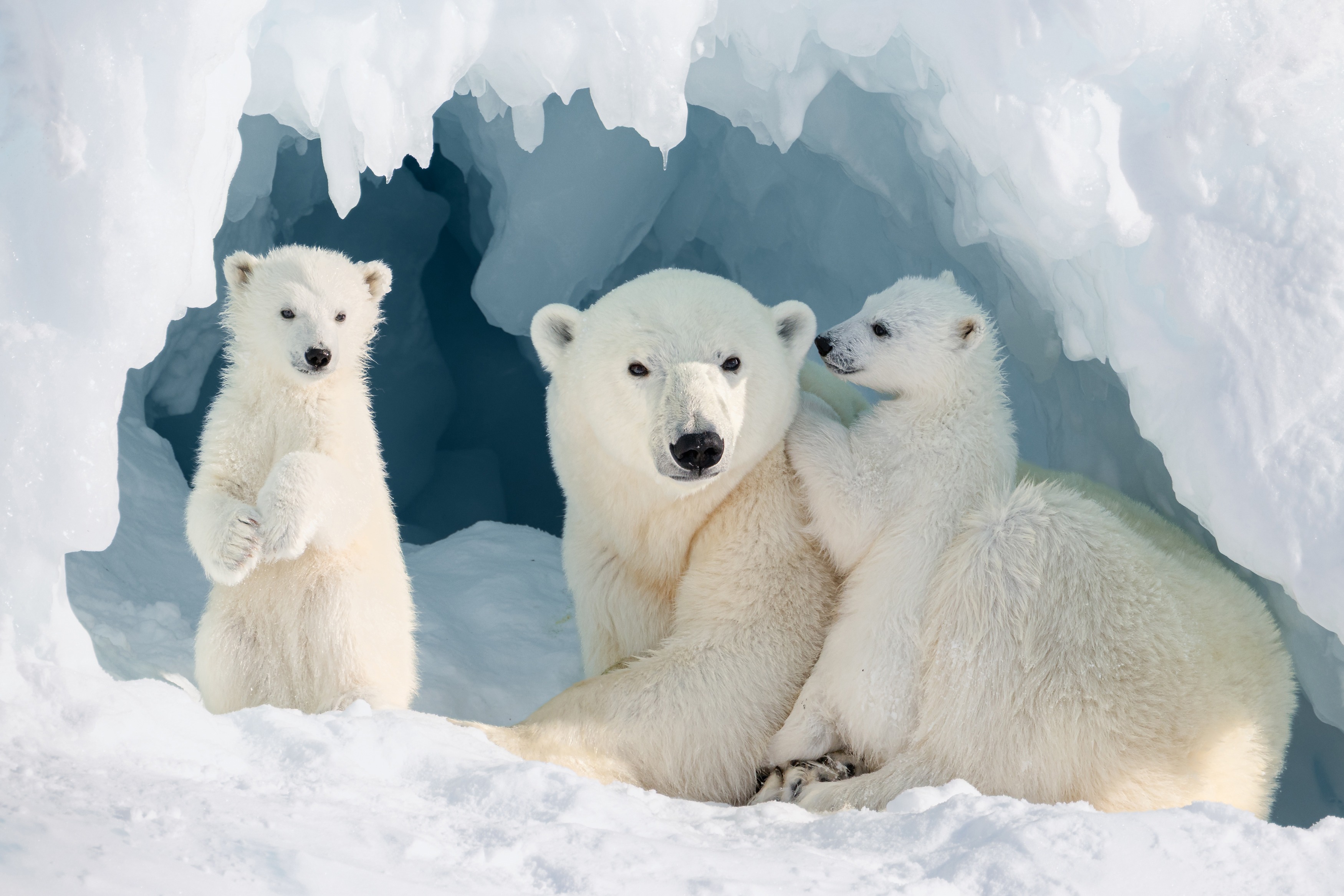 On the sea ice off Baffin Island, Nunavut, Canada, a polar bear mother leads her newborn cubs from the safety of their snow den onto seasonal ice that grows smaller every year. For close to a month, the photographer worked with Inuit guides, travelling by sled and using long lenses at a respectful distance as the family rested, played, learned to hunt and crossed the fractured floes. Their movements trace a simple story of life on a foundation that is slowly melting away — a quiet choreography of survival. (Photo: Sunita Mandal, United States, Shortlist, Professional Competition, Wildlife & Nature, Sony World Photography Awards 2026)