




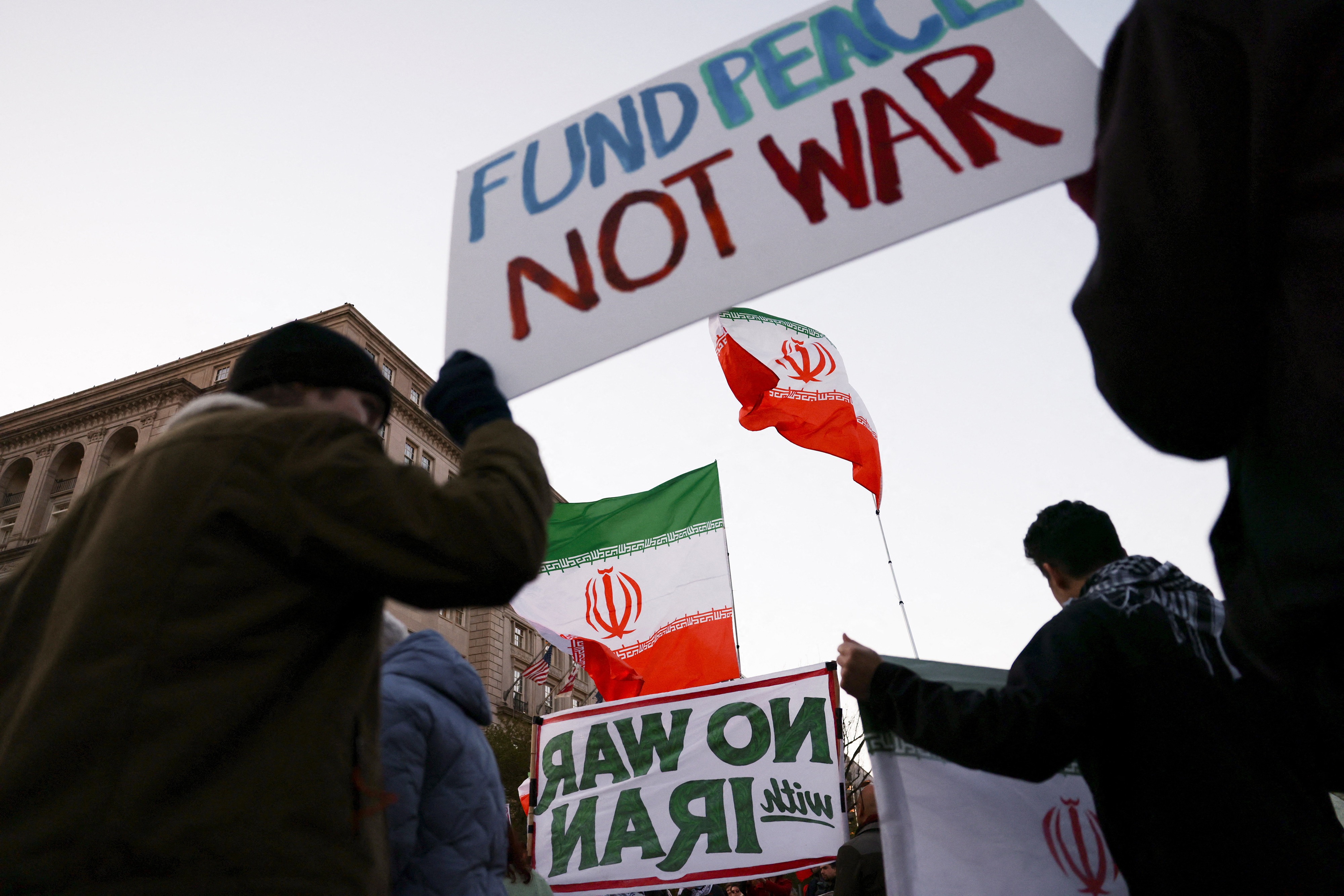
 Demonstrators protest against military action in Iran after US President Donald Trump said he had agreed to a two-week ceasefire with Iran, less than two hours before his deadline for Tehran to reopen the Strait of Hormuz or face widespread attacks on its civilian infrastructure, in Washington, DC, on 7 April 2026. (Photo: Reuters / Evelyn Hockstein)
/file/dailymaverick/wp-content/uploads/2025/10/label-analysis-2.jpg)
Late on Tuesday night South African time, like so many other people around the world, I was wondering if last-minute negotiations spearheaded by Pakistani officials (with the assistance of China and Egypt) had a chance to break the tension that seemed almost certain to unleash a furious American attack on Iran’s infrastructure.
That, inevitably, would have led to further Iranian missiles on the Gulf states and Israel. (Despite boasts by Americans that their attacks have destroyed most of Iran’s arsenal, that nation reportedly still has an unknown number of missiles and drones available.)
Further Israeli and American attacks would have followed, perhaps even including the use of US ground troops. Where – or how – this would have ended was impossible to predict, but it would clearly have worsened the situation, which has already claimed at least 1,900 lives in Iran, 1,400 in Lebanon, more than 100 in Iraq, almost 30 from Israel and 13 from the US since the attacks began on 28 February 2026.
On Tuesday night, it almost seemed as if we were on the cusp of an Armageddon.
That was certainly the case if our roadmap was to be found in the intemperate, expletive-laced, apocalyptic threats in Donald Trump’s social media postings. And then, improbably, as the clock inched forward, a two-week ceasefire was announced.
Opposing plans
Predictably, the US, Israel and Iran have all claimed victory. Going forward, there is the not insignificant matter of the duelling, proposed plans – the Americans with their 15 points and the Iranians with their 10 points, many of which seem mutually incompatible.
Iran’s demands reportedly include:
- Lifting all sanctions on Iran;
- Withdrawal of the US military from bases in the region;
- Iranian control of the Strait of Hormuz;
- Stopping attacks on Iran and its allies;
- Releasing frozen Iranian assets;
- Acceptance of Iran’s nuclear enrichment programme;
- Compensation for damages suffered by Iran during the war;
- UN Security Council endorsement of a peace deal.
US demands reportedly include:
- Iran’s commitment to not developing nuclear weapons;
- Handing over its highly enriched uranium to the IAEA;
- Limits on Iran’s defence capabilities, including missile stockpiles;
- Stopping support for regional proxy groups;
- Reopening of the Strait of Hormuz.
According to a statement from Pakistan, the ceasefire implicitly covers the parallel conflict between Israel and Hezbollah and Israel’s military campaign into southern Lebanon, which has displaced hundreds of thousands of residents, but Israel has said the deal doesn’t include Lebanon, while Hezbollah has yet to state its position. The Israel Defense Forces continued strikes in Lebanon on Wednesday.
With the greatest humility, I am pleased to announce that the Islamic Republic of Iran and the United States of America, along with their allies, have agreed to an immediate ceasefire everywhere including Lebanon and elsewhere, EFFECTIVE IMMEDIATELY.
— Shehbaz Sharif (@CMShehbaz) April 7, 2026
I warmly welcome the…
The Iranian government now says the ceasefire’s impact has been communicated throughout its military hierarchies, thereby ending further missile and drone launches.
In the hours before the ceasefire was declared, the US had also attacked military targets on Kharg Island, the place from where most of Iran’s oil is shipped, and Israel had attacked rail nodes in Iran, presumably offering a hint of what might be coming. But as of the time of this writing, the ceasefire holds.
Strait of Hormuz
Beyond the question of halting missile and drone attacks, or the more distant threat of a commitment of US ground forces to seize Kharg Island or other critically important spaces (all plans are now presumably on hold), there is the question of safe, unimpeded passage in the Persian Gulf and on through the Strait of Hormuz.
Until the outbreak of the most recent hostilities, that passage had seen something like 20% of the total global movement of oil and liquid natural gas from the petrostates and Iran onward to South and East Asia and elsewhere.
While the US is largely absent from those shipments, given its status as a net oil exporter, it is not immune from the global price implications of the interdiction of the flow of energy from the Gulf. Given growing discontent in the US from the precipitate rise in the price of petrol just as the summer vacation travel season is nearly at hand, that anger almost certainly has not gone unnoticed by the Trump administration.
It probably had something of an influence on a seemingly quixotic flip from the president’s appalling rhetoric of “bombing Iran back to the Stone Ages” and on to agreeing to a ceasefire instead. (It is crucial to remember there is always the domestic political dynamic with politicians like Donald Trump – as the US midterm election is just over six months in the future.)
Negotiating points
As actual negotiations under the rubric of the ceasefire proceed in Islamabad, Pakistan, beginning on 10 April – beyond efforts to prevent any resumption of bomb, missile and drone launches – foremost in the discussions will be ending US-enforced sanctions against Iran; questions of reparations for damages from the attacks; American demands for an end to any efforts by Iran to enrich uranium; or any hopes for a more general peace settlement for the region, as well as the future stability and circumstances of the gulf and the strait.
Following current demands for payment from some foreign-flagged tankers, one of the Iranian proposals is for some kind of regularised payment system for ships transiting the waters. Presumably, these payments would be split with Oman, the state on the opposite side of the strait. One problem with this idea is that those waters, while narrow, are international waters and demands for payments for such transits run counter to international maritime law and rights of innocent passage for shipping.
An odd variation on this theme comes from the Americans, who now seem to be arguing for their participation in managing the strait and policing the use of the waters. Accordingly, here are grounds for all manner of disagreements – but, paradoxically, some hope as well.
Taco
So, who won in this ceasefire? As noted above, both sides claim victory, although it is easy enough to argue that the Trump administration ultimately blinked first by backing away from its threats to level its opponent’s landscape. The acronym Taco (Trump always chickens out), will certainly be heard in the days ahead.
The Israelis, despite some missile damage, seem to have garnered something of a free hand to continue their strikes in Lebanon for the time being, as they will probably push harder against Hezbollah, especially if Iran is precluded from materially assisting that non-state actor.
And, of course, Iran can claim that despite the damage they have endured, they have brought the US to the negotiating table and have successfully advocated the right to regulate passage through the gulf and strait. Pakistan has gained the reputation of brokering a Middle East ceasefire, despite all odds, which will improve its international standing.
And for the rest of us? If the ceasefire holds, and especially if it can be extended more generally, the price of petroleum energy may slowly begin to recede from its stratospheric levels, to sighs of relief around the globe.
It is possible that this ceasefire, if it holds and extends, can give hope that even the nastiest international conflicts can eventually end in negotiations. That is something Ukrainians may take some heart from, given their painful resistance to the Russian onslaught.
As for America’s alliance system, however, it may have suffered a near-fatal wound as the US and its European allies have been deeply divided by America and Israel’s attack on Iran and the resultant unwillingness of European nations to join the American forces. In that sense, the notion of American decline and its inability to be a stable partner is growing due to this conflict. DM