




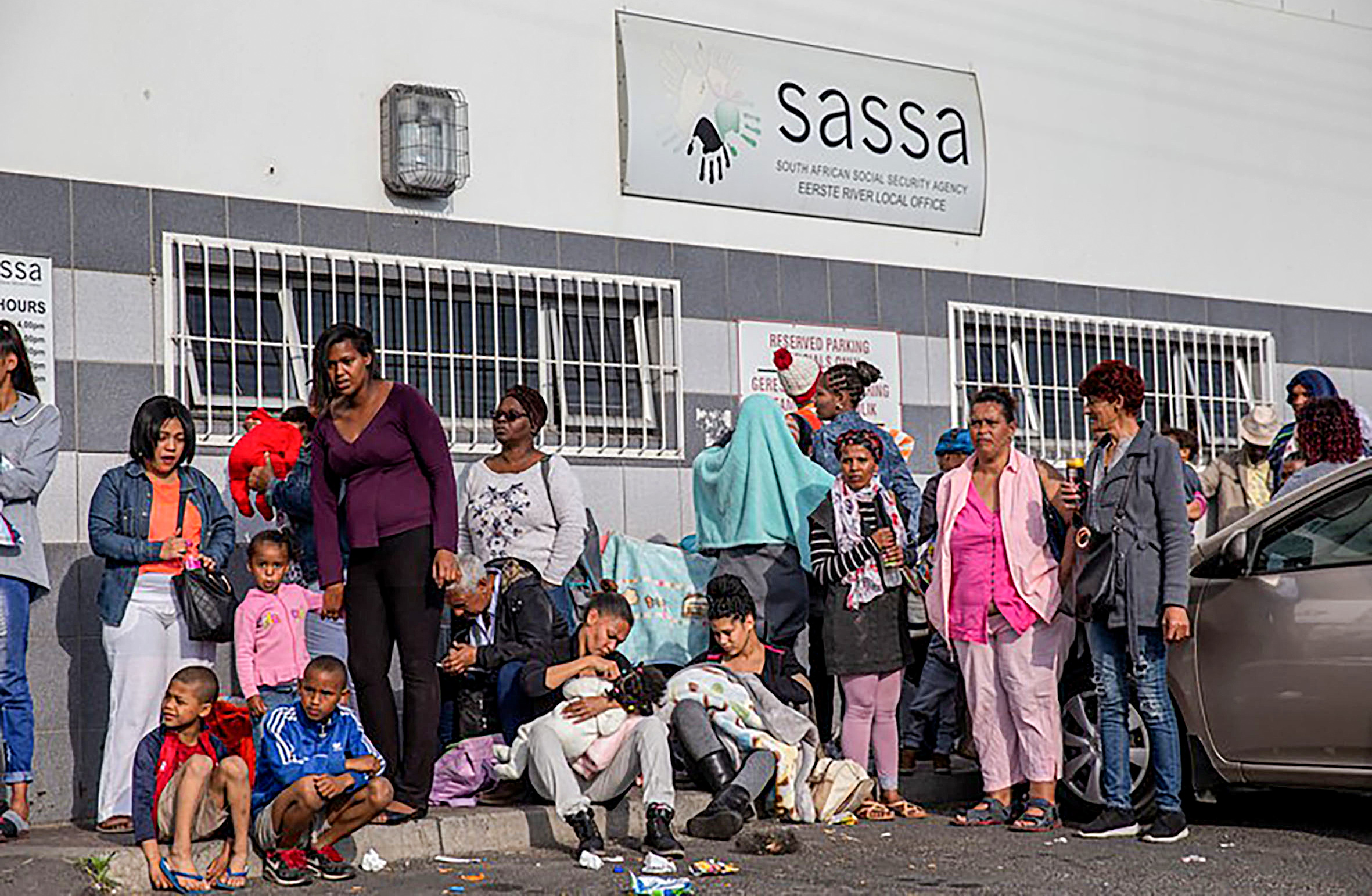
 The Constitutional Court is effectively saying that if you are carrying out a core public function, especially one as sensitive as paying social grants, you are not just another contractor chasing margin. You are operating in a constitutional space, with constitutional obligations. (Photo: Ashraf Hendricks)
In a ruling which wraps up years (literally) of to and fro over money owed to the South African Social Security Agency (Sassa) by Cash Paymaster Services (CPS), the Constitutional Court this week ordered that CPS is liable to pay Sassa R81.3-million.
Sassa may ultimately recover little, and perhaps nothing of that figure, but that is not yet a settled fact. The liquidator says concurrent creditors could receive a pro rata dividend, although that may fall away entirely if SARS succeeds in proving its claim.
That’s because CPS was placed in final liquidation on 16 October 2020, and Sassa will have to claim the R81.3-million as a creditor in CPS’s liquidation. CPS has a separate case where it is trying to get R316.4-million more from Sassa. If CPS wins that case (fully or partly), it does not have to repay that extra amount as profit — it can keep it.
Handing down the judgment, Justice Steven Majiedt noted that “regarding costs, there have been accusations and counter-accusations of lack of cooperation and failure of duty by various parties”.
“Twelve years and twelve court cases later, attitudes have plainly hardened. And the parties appear litigation-weary. In exercising this Court’s discretion on costs, the fairest and most balanced order would be one that each party bears their own costs,” he said.
/file/dailymaverick/wp-content/uploads/2025/05/ED_547280.jpg "People queue outside the SASSA office to exchange SASSA cards for the new Postbank Black Cards on 14 February 2025 in Bellville. (Photo: Gallo Images / Die Burger / Jaco Marais)")
The background
The nationwide payment tender awarded to CPS by Sassa was formally declared constitutionally invalid (unlawful) by the Constitutional Court in 2014.
However, to ensure continuity of grant payments, the Constitutional Court allowed CPS to continue operating. The central issue in the court case resolved this week was whether CPS should repay profits earned under that invalid contract.
The judgment found that this case was different from others involving innocent private contractors, in that CPS effectively acted as an organ of state performing a public function. That status carries constitutional obligations, including accountability for financial gains. The Constitutional Court reinforced the principle that while CPS should not suffer losses, it also had no right to profit from an unlawful contract, especially in a case involving public funds and vulnerable beneficiaries.
/file/dailymaverick/wp-content/uploads/2025/05/ED_542578.jpg "Residents queue in long lines at the SASSA Office in Eerste Rivier on January 10, 2025 in Cape Town. (Photo: Gallo Images / Die Burger / Theo Jeptha)")
The liquidator’s report
Assets: In a report dated 23 May 2025, the CPS liquidator said CPS had assets of about R51-million. She also listed disputed or uncertain assets. These included R52-million allegedly owed to CPS by a subsidiary that was itself in liquidation, and another R358-million that CPS is claiming from Sassa in a separate court case as an upward price adjustment for services it provided under earlier Constitutional Court orders. There was also a disputed claim by CPS against Sassa for a contribution to the costs of the liquidation enquiry.
Liabilities: On the liabilities side, the picture was much heavier. At the first meeting of creditors, proved claims totalled R779-million. Most of that came from Sassa. One Sassa claim was R633-million, another Sassa claim was R75-million for what was described as payment for services not rendered. On top of that, SARS submitted tax claims totalling R401-million based on assessments issued after CPS went into liquidation. CPS is challenging those assessments in review proceedings. If SARS succeeds, those tax claims would rank ahead of ordinary concurrent creditors under the Insolvency Act.
The assets minus liabilities picture painted by the liquidator points to a financial black hole that is unlikely to yield any financial joy for Sassa.
The liquidation inquiry itself ended in June 2023, but the commissioner had still not filed a final report. After the inquiry ended, the Master lifted its confidentiality, and on 18 October 2023, the full record and supporting documents were given electronically to the Treasury, Sassa, RAiN, Lesaka (Net1 was rebranded as Lesaka, of which CPS was a subsidiary) and the witnesses who had testified. The liquidator also said she had investigated whether money might be recovered from related parties or third parties because of voidable transactions or other irregularities, but found no such recovery prospects. Her bottom-line warning was stark: even on Sassa’s proved claims alone, creditors would receive only a pro rata dividend. If SARS’ claims are upheld, concurrent creditors, including Sassa, may receive nothing at all.
In other words, the Constitutional Court is dealing with a company whose finances were badly underwater: roughly R51-million in undisputed assets against R778.5-million in proved claims, before even taking account of the disputed R401.4-million Sars claim. That is why the liquidation report became so important. It showed that any order against CPS would not be playing out against a healthy, operating business, but against an insolvent company with too little money to cover the claims already stacked against it.
/file/dailymaverick/wp-content/uploads/2025/03/sune-sassa-5.jpg "A queue outside the Golden Acre, Cape Town, on Tuesday 4 March 2025 as people wait in line to be helped at a Postbank pop-up. (Photo: Suné Payne)")
Lesaka not liable for the money
“We welcome the Constitutional Court’s approach to bring a sensible solution to what the Court itself described as a ‘never-ending saga’. The Court reiterated that Lesaka was never party to any of the Court’s previous orders, and that the liquidator of CPS does not believe that CPS has any claims against Lesaka. The Constitutional Court’s judgment brings long-awaited closure and we are pleased to finally put this matter behind us,” Lincoln Mali, CEO of Lesaka Technologies, told Daily Maverick.
The judgment does hint at deeper financial plumbing between CPS and the wider Net1/Lesaka group, including disputed B-BBEE costs, service fees and retainer payments totalling roughly R437-million, some of which auditors said lacked supporting evidence or appeared to benefit the group rather than CPS itself. But despite flagging the possibility of cost- and profit-shifting, the judgment noted that the evidence did not go far enough to prove this — and the liquidator does not believe there are viable claims to claw anything back from Lesaka.
So, what’s the point?
Well, the ruling on paper awards Sassa the money, but what it really does is bring home the consequences for every outsourced public service contract in SA.
The Constitutional Court is effectively saying that if you are carrying out a core public function, especially one as sensitive as paying social grants, you are not just another contractor chasing margin. You are operating in a constitutional space, with constitutional obligations.
The principle is a sharp one: you may be paid for work done, but you do not get to quietly pocket profits from an unlawful arrangement and hope the paperwork swallows the problem.
In a country that increasingly relies on private companies to run parts of essential public service systems, this judgment should serve as a warning shot for every outsourced public service contract in South Africa, from Eskom contractors working on grid maintenance, emergency generation or billing systems, to SOE outsourcing more broadly, where private firms run critical back-office, logistics or infrastructure functions.
It also matters for future public-private partnerships, where the state may increasingly lean on private capital and expertise to deliver services it cannot efficiently provide on its own. The Constitutional Court is not saying private firms cannot make money from public work.
It is saying that where the underlying contract is unlawful, and where the contractor is effectively helping perform the state’s job, those gains will be open to public scrutiny and possible clawback.
In practical terms, that means any company bidding for major public-facing work, whether in energy, transport, water, grants administration or future PPP infrastructure deals, should read this ruling as a reminder that in South Africa’s constitutional order, public service outsourcing is not a profit free-for-all. DM
Comments
Scroll down to load comments...