




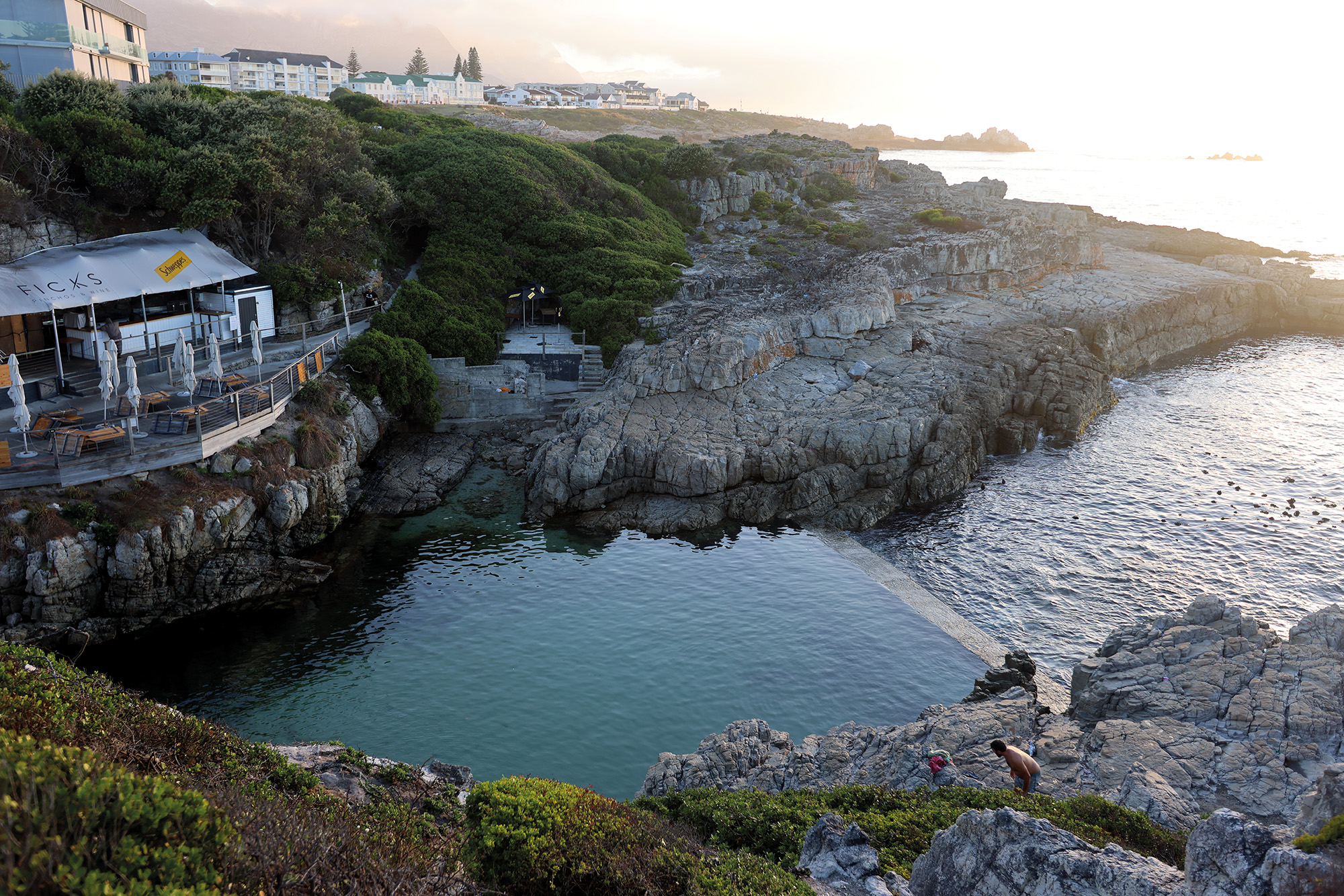
 Tidal pools in SA are vital public spaces that offer recreational access while promoting mental wellbeing in a nation grappling with inequality and a mental health crisis. (Photo: From the book A Guide to Tidal Pools of the Western Cape by Serai Dowling)
 South Africa is facing a deepening mental health crisis, one that is unevenly distributed and closely tied to inequality.
Globally, poor mental health is projected to cost the economy trillions annually by 2030, with the greatest burden falling on low- and middle-income countries. Locally, the picture is stark. Children growing up in conditions of multidimensional poverty experience levels of toxic stress that shape the trajectory of their lives long before adulthood.
Toxic stress is not simply “feeling stressed”. It is what happens when the body’s stress response remains switched on for too long without enough support to help it settle. Over time, it wears down the nervous system, affecting cognition, behaviour and long-term health.
In SA, where many live with sustained adversity, this is not the exception, it is the baseline.
At the same time, the systems designed to respond are under strain. Mental health remains underfunded, receiving only a small share of the national health budget.
Access to care is uneven, often out of reach for those who need it most. And so the question becomes not only how we treat mental illness, but how we design environments that reduce its likelihood in the first place.
This is where cities matter.
/file/dailymaverick/wp-content/uploads/2024/10/Camps-Bay-main-image_upscayl_4x_ultrasharp.jpg "Camps Bay in Cape Town. (Photo: From the book A Guide to Tidal Pools of the Western Cape by Serai Dowling)")
Urban form is not neutral. It shapes how people move, what they can access, where they feel safe, and whether there is space in their lives for rest, play and connection.
In SA, apartheid spatial planning continues to structure this reality. Access to green and blue spaces – parks, coastlines, places of leisure – remains uneven, mediated by transport, safety and inherited patterns of exclusion.
A large proportion of people in the Western Cape live within reach of the coastline. Yet proximity does not equal access. Trains do not run reliably, transport is costly, and public space is unevenly maintained. As cities densify and public services come under increasing pressure, the question of what constitutes meaningful, accessible public space becomes more urgent.
So too does the question of what kind of infrastructure we choose to invest in.
Much of urban planning continues to prioritise movement and efficiency: roads, housing and utilities. These are essential. But they are not sufficient. Cities are also lived environments, and the conditions they create shape wellbeing in ways that are often invisible until they begin to fail.
In this context, “third spaces” (places outside home and work) become critical. Yet many of these spaces are commercial or exclusionary, requiring money, time or cultural access to participate. Truly public, low-cost spaces that support both individual and collective wellbeing are increasingly rare.
And yet, along SA’s coastline, they already exist.
More than 100 tidal pools are built into the intertidal zone along SA’s coast, designed to hold seawater as the tide moves in and out. They are modest pieces of infrastructure, often overlooked, sometimes neglected. But they offer something increasingly valuable in contemporary cities: a point of access to water that is safe, shared and, in most cases, free.
/file/dailymaverick/wp-content/uploads/2024/10/Dalebrook.jpg "Dalebrook tidal pool. (Photo: From the book A Guide to Tidal Pools of the Western Cape by Serai Dowling)")
In urban planning terms, tidal pools are a form of hybrid infrastructure. They are engineered, but porous. Structured, but open to ecological systems. They sit at the intersection of design and nature, safety and exposure. And in doing so, they create conditions that are difficult to replicate elsewhere in the city.
They also respond, quietly, to history.
For much of SA’s past, access to the ocean was restricted and unequal. Beaches were segregated, leisure was policed, and swimming itself was not a universally accessible skill. The legacy of this exclusion persists not only in infrastructure, but in familiarity, confidence and belonging.
Tidal pools offer a gentler point of entry. A place to be held by water without the force of the open sea. In this sense, they are not only recreational spaces, but sites of re-entry into water and forms of embodiment that have not been equally available.
Their value, however, extends beyond the individual.
A growing body of research shows that time spent in natural environments is associated with improved mood, cognitive restoration and reduced stress. Blue spaces in particular are linked to lower levels of psychological distress and stronger feelings of wellbeing. These effects are not abstract. They are physiological, measurable and cumulative over time.
But perhaps just as important is what happens between people.
Shared outdoor environments increase opportunities for social interaction, helping to buffer against isolation.
In tidal pools, this interaction is rarely formal. It emerges in quieter, more unstructured ways: through proximity, shared rhythms, the simple act of being in water alongside others. In a society still marked by division, these moments of unengineered co-presence, across age, race and class, are rare.
They do not resolve inequality. But they do, briefly, interrupt it.
In this way, tidal pools function not only as spaces of individual regulation, but as sites of social possibility. They allow for participation without prescription and for encounters without obligation. And in doing so, they contribute to a thin but meaningful layer of shared public life.
/file/dailymaverick/wp-content/uploads/2024/10/ficks-2.jpg "Tidal pools, often overlooked, serve as hybrid infrastructure, balancing human needs with ecological systems, and fostering community interactions that break down social divisions. (Photo: From the book A Guide to Tidal Pools of the Western Cape by Serai Dowling)")
They are also ecological spaces.
Within their walls, small marine ecosystems take hold, offering moments of contact with biodiversity that are otherwise inaccessible in urban environments. At a time when oceans are under increasing pressure from pollution, warming and extraction, these encounters matter. They cultivate attention, and with it, care.
This is where the environmental and the social begin to converge.
SA’s coastal cities are facing multiple, overlapping pressures: rising mental health needs, persistent inequality and growing environmental strain, including plastic pollution and declining water quality. Addressing these challenges in isolation is no longer sufficient. The question is how we design urban systems that respond to them together.
Tidal pools offer one small but instructive example.
They show that infrastructure can be restorative, not only functional. That public space can be both ecological and social. That access to water, beauty and shared experience can be designed into the fabric of a city.
And they raise important questions. How are these spaces distributed? Who can reach them safely and consistently? How are they maintained, and by whom? What does it signal when they fall into disrepair, or when they are carefully looked after?
These are not minor considerations. They go to the heart of what cities value.
If tidal pools are treated as incidental they remain marginal. But if they are recognised as infrastructure they begin to take on a different role. Not as a substitute for formal services, but as a complementary layer: preventive, accessible and embedded in everyday life.
In a context where resources are limited and needs are urgent, this matters. The question is no longer whether tidal pools are valuable. It is whether we are willing to see them as such and to plan for them accordingly. DM