




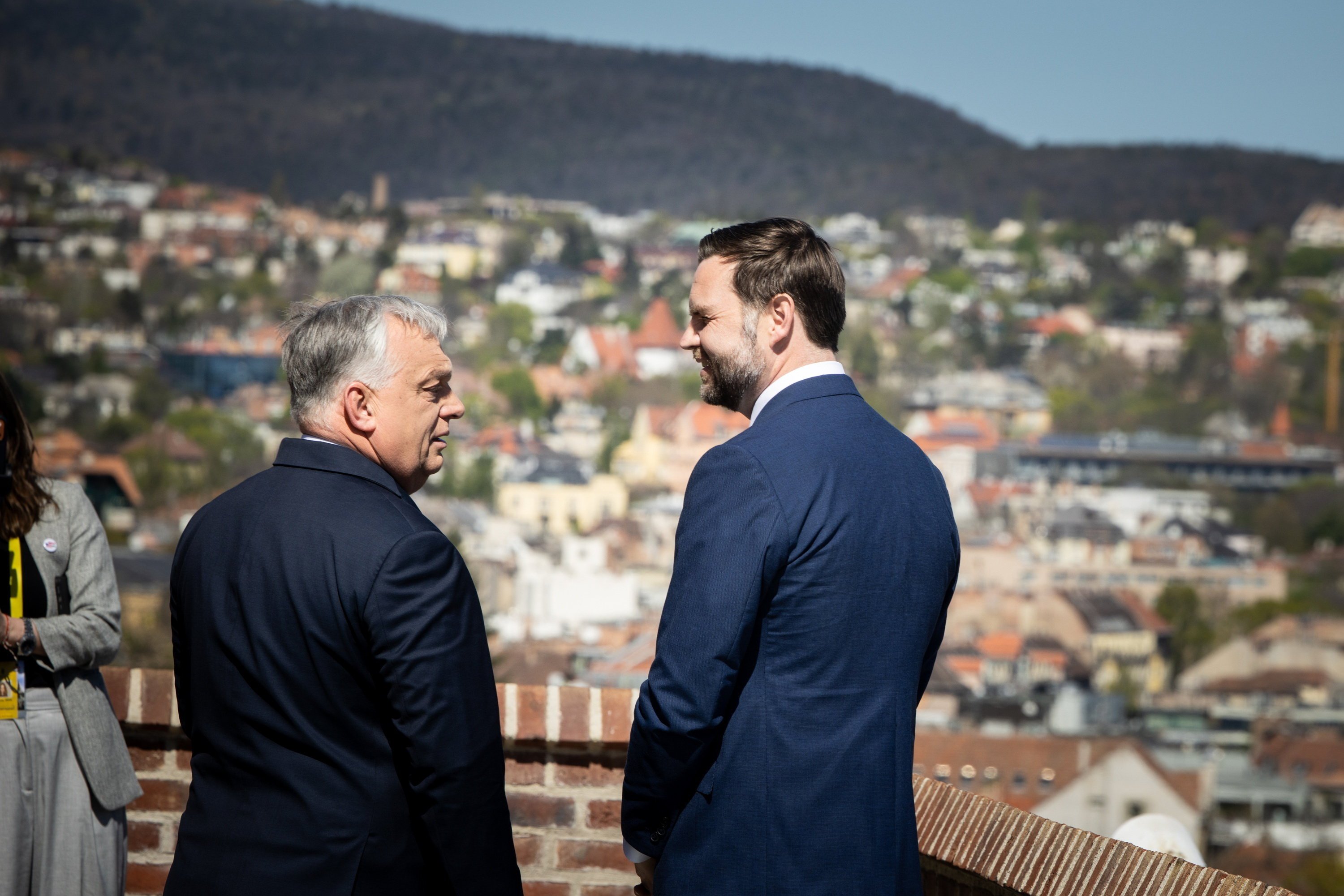
 A handout photo made available by the Hungarian PM's General Department of Communication, Hungarian Prime Minister Viktor Orban (L) and U.S. Vice President JD Vance talk on the terrace of Orban's office, the former Carmelite Monastery in Budapest, Hungary, 07 April 2026. Vance is on a two-day visit to Hungary. EPA/Zoltan Fischer HANDOUT HANDOUT - EDITORIAL USE ONLY - NO SALES HANDOUT EDITORIAL USE ONLY/NO SALES
 By Humeyra Pamuk and Anita Komuves
Vance's visit to Budapest came ahead of Sunday's election, which independent public opinion polls show Orban is likely to lose. The trip - and the rare endorsement by a sitting U.S. official - underscored how crucial Trump deems the veteran Hungarian nationalist's reelection.
The visit broke with the norms of prior U.S. presidential administrations of not openly campaigning in foreign elections, especially for a government that has maintained close ties with Putin. It was not immediately clear whether Vance's public support would strengthen Orban's candidacy.
Nonetheless, the trip cast Vance in what has become a familiar role - scolding Brussels at a time of increasing transatlantic tension over Trump's war on Iran, criticism of Ukraine, threats to withdraw from the NATO alliance and stated desire to take control of Greenland from Denmark.
"What has happened in the midst of this election campaign is one of the worst examples of foreign election interference that I've ever seen or ever even read about," Vance told a press conference.
"The bureaucrats in Brussels have tried to destroy the economy of Hungary. They have tried to make Hungary less energy-independent. They have tried to drive up costs for Hungarian consumers, and they've done it all because they hate this guy (Orban)."
Since Russia invaded Ukraine, the European Union has tried to drastically cut its use of Russian oil and gas, a shift Budapest has staunchly resisted.
A European Commission spokesperson said, "Going back to importing from Russia - a greatly unreliable supplier that is waging an atrocious war against Ukraine - would be a strategic mistake."
"Elections are the sole choice of the citizens," the spokesperson added.
Vance has previously drawn criticism in Europe, notably with a 2025 speech in Munich that accused many of the continent's governments of censoring free speech and failing to control immigration.
OPPOSITION WARNS OF 'FOREIGN INTERFERENCE'
Vance's visit drew a warning about "foreign interference" in Hungary from Orban's challenger, Peter Magyar, whose centre-right Tisza party is tipped by independent pollsters to defeat Orban's Fidesz.
"This is our country," Magyar wrote on X. "Hungarian history is not written in Washington, Moscow, or Brussels - it is written in Hungary's streets and squares."
Vance, who joined Orban at a campaign rally that opened with a performance of the U.S. national anthem, "The Star-Spangled Banner," telephoned Trump from the podium and reached him on the second try. Vance held his cellphone to the microphone as Trump endorsed Orban for doing "a fantastic job."
The U.S. vice president described the alliance between the two leaders as "moral cooperation" and told the audience that "we want you to make a decision about your future with no outside forces pressuring you or telling you what to do.”
Orban, fighting the toughest reelection bid of his career after 16 years in power, hailed what he called "a golden age" in relations between Hungary and the U.S. under Trump's leadership.
Vance at times appeared more confident in Orban's electoral chances than the Hungarian leader. At one moment during a joint press conference before the rally, Vance predicted Orban’s victory, but Orban waggled his hand and raised his eyebrows, appearing to acknowledge that he might lose.
ORBAN HAS LONG SUPPORTED TRUMP
Orban's self-described "illiberal democracy" mirrors key themes of Trump-era America: hardline anti-immigration policies, disdain for liberal norms, hostility toward global institutions, and attacks on the media, universities and nonprofit groups. He was the first European leader to endorse Trump during his 2016 presidential bid.
Orban has long been at loggerheads with the EU over a range of issues, including Ukraine. He has refused to send weapons to Ukraine, has blocked a 90-billion-euro loan package from the EU to Kyiv and says Ukraine can never join the bloc.
He has also accused the EU and Ukraine of seeking to meddle in Sunday's election and says Ukraine wants to disrupt Hungary's energy supply, something Kyiv denies.
Vance said on Tuesday that "elements within the Ukrainian intelligence services" were trying "to put their thumb on the scale" of U.S. and Hungarian elections, without providing evidence.
European officials and some governments have criticised what they say is Hungary’s erosion of democratic norms and suppression of nongovernmental organizations.
Orban has maintained cordial ties with Moscow despite the Ukraine war and says Russian energy is essential for Hungary.
(Reporting by Humeyra Pamuk, Anita Komuves, Krisztina Than, Gergely Szakacs, Lili Bayer in Budapest, Alan Charlish in Warsaw and Trevor Hunnicutt in Washington; Editing by Nia Williams, Alison Williams and Gareth Jones, Ross Colvin, Rod Nickel)