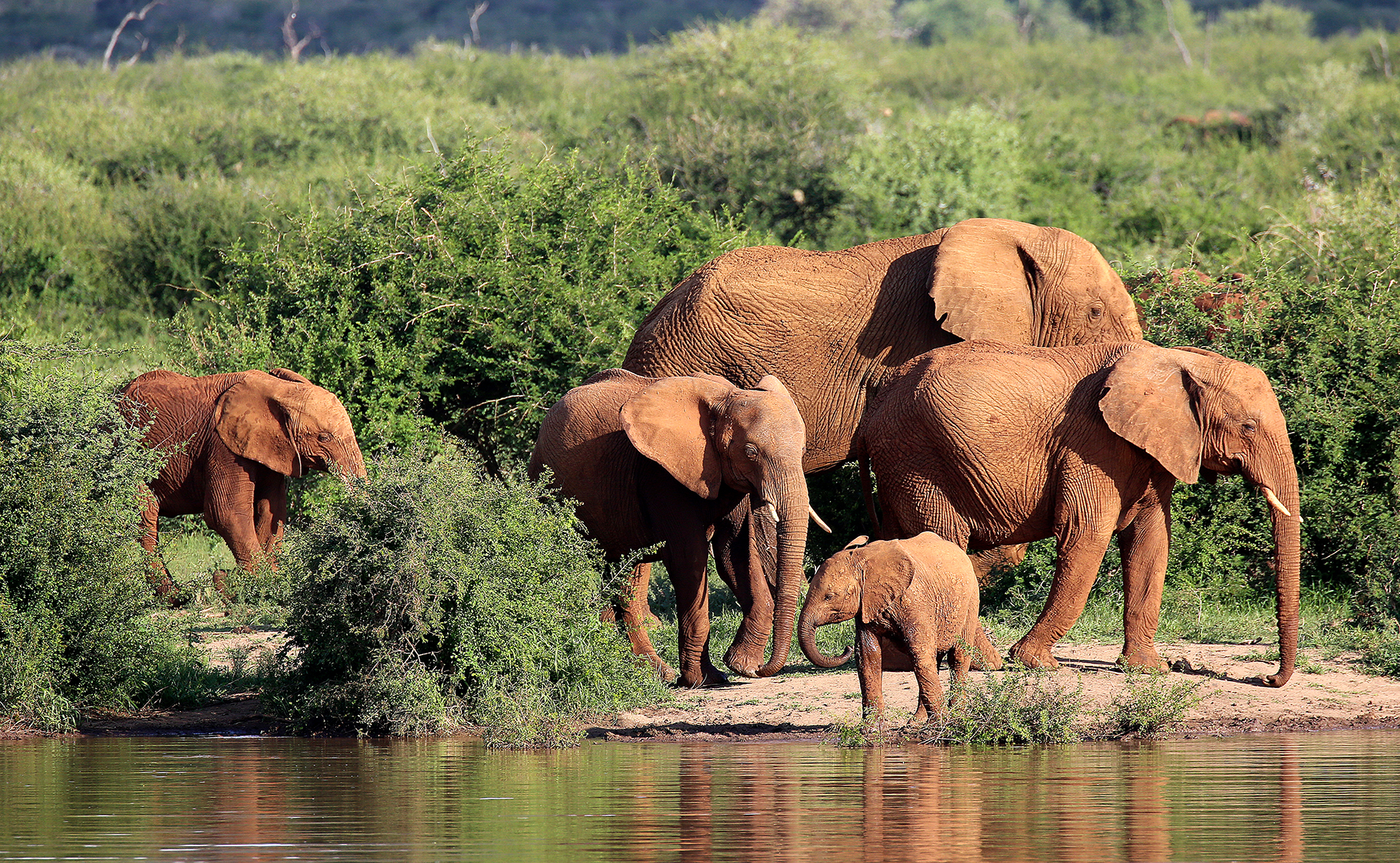
 Elephants in the Madikwe Game Reserve in North West. Fences in SA’s game reserves are crucial for wildlife conservation, but new research shows they also alter ecosystems by influencing species dynamics. (Photo: Wikipedia)
 A large-scale study of South Africa’s protected areas finds that conservation tools like fencing, roads and artificial waterholes are not neutral – they actively shape biodiversity and predator-prey dynamics.
In his PhD, “Evaluating the ecological impacts of fencing on wildlife diversity and dynamics in South African protected areas”, conservation scientist Dr Gert Botha examined how fencing and tourism infrastructure such as roads and artificial waterholes influence mammal diversity and predator-prey dynamics.
His supervisors were Professor Jan Venter and Professor Hervé Fritz, both based on the “green” George Campus of Nelson Mandela University.
“In an ideal world, you would not have fences at all,” said Botha. “But we don’t live in that. Fences serve a very important purpose in conserving wildlife. They are not just to protect wildlife, but also to protect people from wildlife.”
In SA, fences are required by law to manage dangerous game and prevent conflict with neighbours. However, Botha’s research shows that fences also act as ecological filters, influencing which species thrive and which retreat.
Most earlier studies focused on a single species or park. Botha instead analysed thousands of camera trap records collected through Snapshot Safari, a large-scale monitoring project developed by Venter.
The data span national parks including Pilanesberg National Park, Madikwe Game Reserve, Mountain Zebra National Park and Karoo National Park, as well as private reserves.
/file/dailymaverick/wp-content/uploads/2024/05/Julia-cheetahConservation-02.jpg "Thanks to the conservation efforts of farmers in the area when Mountain Zebra National Park was first proclaimed in 1937, a small herd of the endangered Cape mountain zebra survived, providing the founder population of zebra for which the park is now known. (Photo: Julia Evans)")
Overall, herbivores were less likely to use areas close to park boundaries.
“They tended to avoid getting too close to the fences,” Dr Botha said. “Human activity near those boundaries, including nearby villages, probably also influences their behaviour.”
Carnivores responded differently.
“Lions are often seen on roads, and fences don’t seem to discourage them. They use these clear paths to move around more easily, instead of going through dense vegetation.”
Predator space use was strongly associated with prey availability, supporting a bottom-up regulatory structure within fenced systems.
Artificial water sources, widely used to support tourism and buffer dry periods, also reshaped ecosystems.
“The goal of this research was to use science to support managers in maintaining healthy ecosystems. SA is experiencing a decline in biodiversity, and protected areas are one of our most important tools for conserving species and preventing further losses,” Botha said.
“What is the ecological impact of adding watering holes, roads, or fences, and how does it affect the species inside fenced protected areas?
“Watering holes and roads are essential, but they must be designed and managed in ways that protect wildlife and the ecosystem. We want to halt the ongoing loss of biodiversity, which is largely driven by human interventions.
/file/attachments/orphans/Dr-GS-Botha-bush2_792638.jpg "Dr Gert Botha studies wildlife in South Africa’s game reserves, examining how fences, roads and waterholes influence animal behaviour and ecosystems. (Photo: Supplied / Nelson Mandela University)")
“Tourism is important, and artificial water points can be a useful management tool. They make it easier for visitors to see wildlife. However, they must be implemented responsibly and managed sustainably. Similarly, species can adjust to landscapes that include roads.”
At the same time, he cautioned: “Too many water points can disrupt the balance of the ecosystem. Animals may concentrate in these areas, leading to overutilisation.”
Artificial water points were used by a wide range of species, while other, less water-dependent species tended to roam more widely across the reserve. Rainfall and reserve size also mattered, with larger protected areas generally supporting more balanced predator-prey systems than smaller fenced landscapes.
Professor Jan Venter said the real power of the study lay in the scale and continuity of data behind it.
“What makes this work particularly important is that it is built on a large, standardised, long-term dataset collected across multiple protected areas. In conservation science, scale matters.”
Botha’s research draws on thousands of camera trap records generated through the Snapshot Safari network, one of the largest coordinated wildlife monitoring initiatives in Africa.
“Large datasets allow us to separate signal from noise. Wildlife populations fluctuate naturally from year to year. Without long-term monitoring, it is very easy to misinterpret short-term changes as ecological crises, or to miss gradual but important trends,” said Venter.
Broader patterns
“When you monitor consistently over time and across space, you can begin to see broader patterns. That is essential if we want conservation decisions to be evidence-based rather than reactive.”
He added that SA was in a strong position internationally because of its structured monitoring programmes, as few countries had been able to generate this kind of standardised, multi-reserve dataset. Botha’s work added to this.
“A fenced protected area is a closed system that needs to be monitored and managed,” said Botha. “As a conservationist at heart, you want to protect. We want to conserve the environment, but you also want to do it in a sustainable way, where we can grow as a society. This protected area is not just for tomorrow or the day after, but forever.”
For Botha, who grew up visiting the Kruger National Park, the question is not whether SA should fence its reserves. It is how carefully those fences, roads and waterholes are used in landscapes that must remain both economically viable and ecologically intact. DM
Gillian McAinsh was contracted by Nelson Mandela University to write this article.