




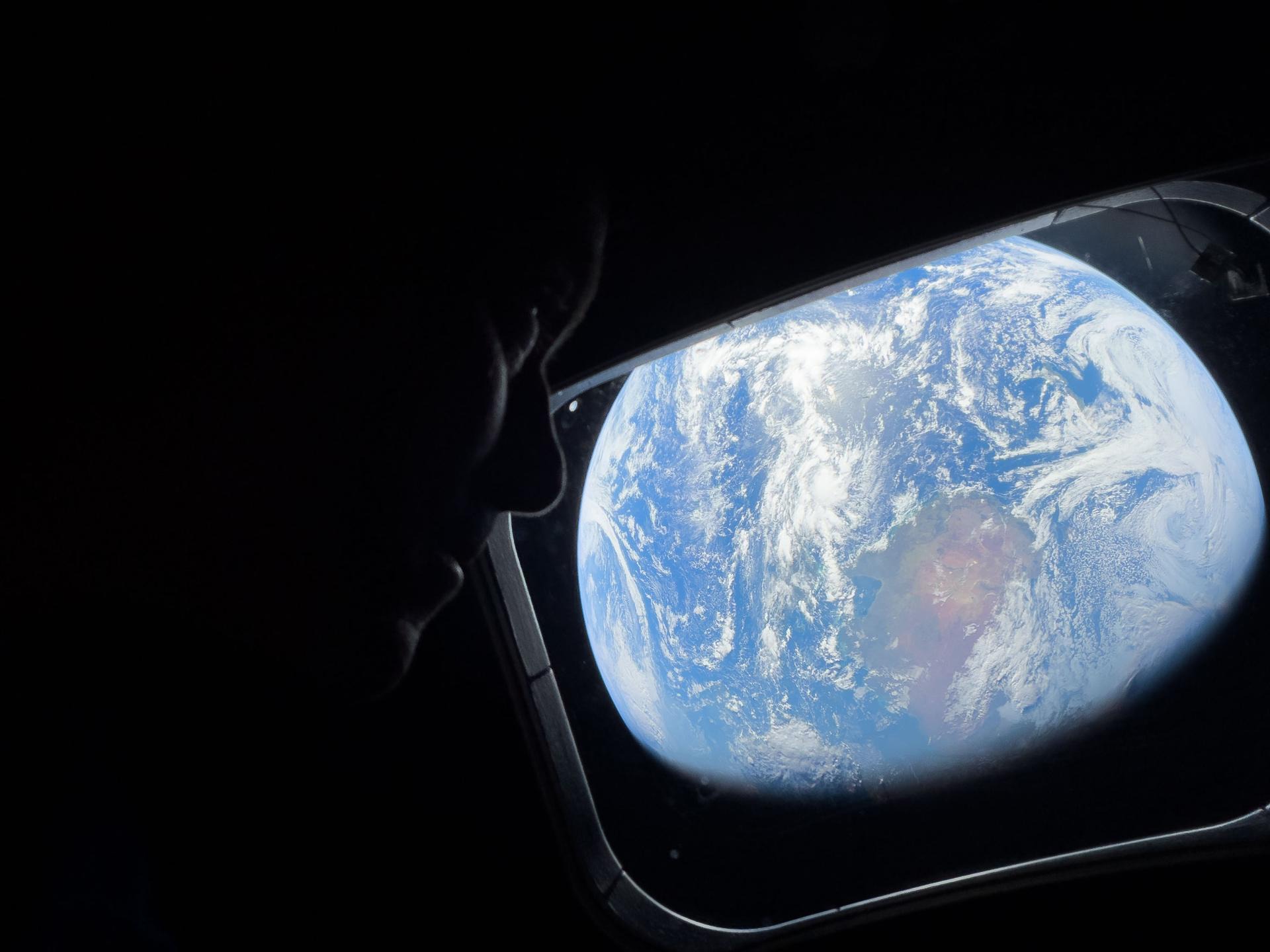
 Nasa astronaut and Artemis II Commander Reid Wiseman peers out of one of the Orion spacecraft's main cabin windows, looking back at Earth, as the crew travels towards the Moon. (Photo: Nasa)
 When the Artemis II mission wrapped up a historic seven-hour lunar flyby, marking humanity’s first return to the Moon since Apollo 17 in 1972, South African space experts were waiting to pick up its signal.
During a planned 40-minute loss of signal, as Orion passed behind the moon, the spacecraft and its crew marked their closest flying at about 6,545km above the surface.
Two minutes later, the crew reached the mission’s maximum distance from Earth, 406,771km, setting a new record for human spaceflight. The crew had already broken the previous record for the furthest distance humans have travelled into space.
Here in SA, at the South African National Space Agency’s (Sansa’s) Hartebeesthoek Ground Station, a team of experts has been tracking the Orion capsule since its launch last week.
Raoul Hodges, Executive Director: Sansa Space Science, told Daily Maverick that they had been contracted, along with other ground stations on Earth, to track the mission “when it is visible to us, because the Earth rotates”.
At Hartebeesthoek, Sansa, which is part of the Department of Science and Technology, has about 100 antennas. But for this mission, they used two antennas, one dating from 1963 and one from 1988. Over the years, the technology has been updated and maintained. One serves as a backup for this mission.
/file/attachments/orphans/View3_772578.jpg "Before going to sleep on flight Day 5, the Artemis II crew snapped one more photo of the Moon as it drew close in the window of the Orion spacecraft. Orion and the four humans aboard entered the lunar sphere of influence at 12.37am EDT on 6 April. That marked the point at which the Moon's gravity had a stronger pull on the spacecraft than the Earth's. Artemis II's closet approach to the Moon will come on flight Day 6 as they swing around the far side before beginning their journey back to Earth. (Photo: Nasa)")
Monitored constantly
“The module with the four astronauts needs its health to be monitored constantly. We bring that information down. Lots of information – telemetric data. When we can see the capsule, we lock onto it. We also do the ranging data – how far it is, the angles, position and so on.
“We have the largest ground station in the southern hemisphere and in Africa. But we are not the only ones doing this. And when they return in a few days, they are coming in a straight line from the moon.”
When there were humans on board there were many backups, he said.
Sansa did not communicate directly with Nasa, but the data was sent to a third party. They were contracted to do the work and received payment.
“We are a small fish in this pond. But it is wonderful to be part of a historic event. It is a huge team effort to get the spacecraft into space and to get the astronauts back safely,” said Hodges.
He explained that all the technical aspects were carefully planned very long in advance.
“Lift-off is key, because you sit on a bomb and you move at 25,000km/h. But to make sure everything works, each accomplishment is an accomplishment in its own right.”
As the crew flew over the moon’s far side, they photographed and described terrain features, including impact craters, ancient lava flows, and surface cracks and ridges formed as the Moon slowly evolved over time.
They also noted differences in colour, brightness and texture, which provide clues that help scientists understand the composition and history of the lunar surface.
The crew witnessed an “Earthset” – the moment Earth dropped below the lunar horizon – as Orion travelled behind the moon and an “Earthrise” as the spacecraft emerged from the opposite edge of the moon.
As the lunar observation period ended, the crew witnessed a nearly hour-long solar eclipse as the spacecraft, the moon and the sun aligned. With a view of a mostly darkened moon, the crew analysed the solar corona — the sun’s outermost atmosphere — as it appeared around the moon’s edge.
/file/attachments/orphans/View2_440216.jpg "Nasa astronaut and Artemis II mission specialist Christina Koch, seen here on Day 4 of the mission, prepping for lunar flyby activities after completing aerobic exercise on the flywheel device. (Photo: Nasa)")
Rare phenomena
During the eclipse, the crew had an opportunity to look for rare phenomena visible only on an unlit portion of the moon. They reported six light flashes created by meteoroids impacting the lunar surface while travelling many thousands of kilometres per hour.
Commander Reid Wiseman said the Orion spacecraft crew “saw sights that no human has ever seen”, while pilot Victor Glover said there were “no adjectives” to describe what they observed.
They are now heading home. “It is so great to hear from Earth again,” said mission specialist Christina Koch as she broke the silence from the spacecraft.
Mission control told the astronauts: “We got a sneak peek at your imagery. It is absolutely stunning, we are all completely in awe of the work you did today.
“Thank you so much for bringing us on this journey with you. We hope you have sweet dreams of moon joy.”
The crew replies: “We’re glad they’re appreciated. We certainly appreciate it up here.”
The Artemis II mission is scheduled to splash down off the coast of San Diego on Friday, 10 April at 2.07am South African time.
Nasa gave an answer for why we need human eyes to observe the moon when we have robots: Human eyes and brains are highly sensitive to subtle changes in colour, texture and other surface characteristics. Having astronaut eyes observe the lunar surface directly, in combination with the advances scientists have made about the moon over the last several decades, may uncover new discoveries and a more nuanced appreciation of its surface features.
Orion carries 32 cameras and devices, including any instrument with a lens capable of capturing photos or video, inside or on the exterior of the vehicle. The systems support engineering, navigation, crew monitoring and a range of lunar science and outreach activities. Fifteen cameras are mounted directly to the spacecraft, and 17 are handheld cameras operated by the crew.
When will humans land on the moon again? Nasa announced this year that Artemis III will no longer attempt a lunar landing. Instead, it will be a crewed mission to low Earth orbit to test rendezvous and docking capabilities with a commercial lunar lander.
It seems that Artemis IV will land on the moon, hopefully in 2028. DM