




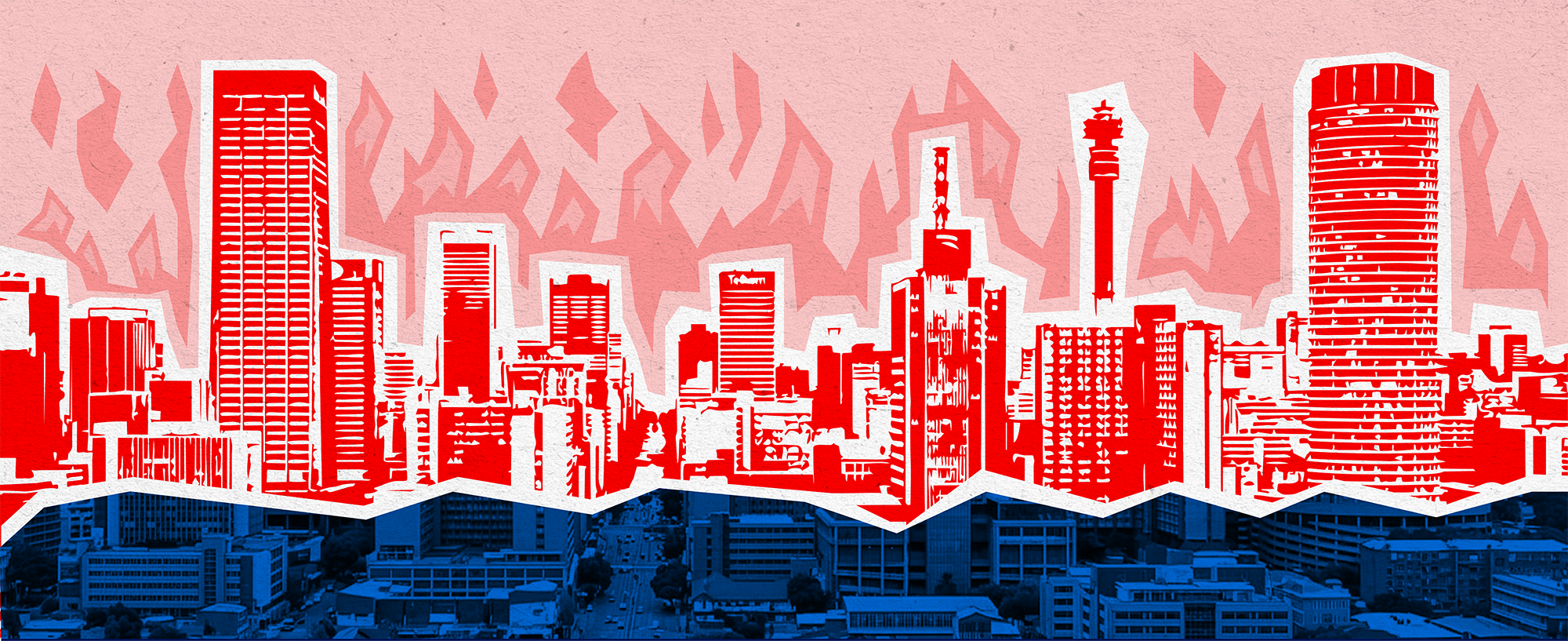
 Joburg’s water crisis is costing its inner-city buildings their insurance cover. (Illustration: Kevin Momberg)
 Johannesburg’s inner city and surrounding business, retail and industrial districts are confronting an escalating crisis: buildings are falling out of the insurance market because of very low water pressure, caused by constant bursts and blockages, while up to 10 fires a day break out across Joburg.
Across the city, failing municipal water pressure is forcing insurers to exclude fire and explosion cover — the very risks most likely to destroy a building. Without a reliable water supply to support fire protection systems, many properties can no longer meet minimum underwriting requirements.
Although water pressure is one of the biggest concerns, property owners say it is only part of the problem. Insurers are increasingly factoring in environmental risks — from neighbouring hijacked buildings to rising crime and urban decay — pushing more properties beyond the threshold of cover.
Business groups say the impact is already visible, with property values in some areas declining by as much as 20% to 25% as investors begin to pull back.
The City of Johannesburg did not respond to requests for comment.
/file/attachments/2990/UninsureableBuildings_infeed1_112732.png)
Antonio Iozzo, CEO of Alpha Insurance, says what is unfolding is not a property-level issue, but a systemic shift in insurability across the city.
“This is not a technical underwriting issue; it is a structural one. When water pressure becomes unreliable, you are removing the primary mechanism that prevents a fire from becoming a total loss. From an insurance perspective, that fundamentally changes the risk.”
Iozzo says this shift is already forcing insurers to change how they deploy capacity.
“Insurers cannot price for a risk they cannot control. When the underlying systems break down, capacity is restricted or removed. That is when buildings fall out of the insurance market.”
He says many property owners discover the implications too late.
“Buildings are insured on the assumption that fire protection systems will function as designed. If that assumption is wrong, the cover does not respond in the way it is expected to.”
Iozzo says insurers are increasingly forced to either exclude fire and explosion cover or withdraw entirely from certain risks.
“You are starting to see parts of Johannesburg where the risk is no longer just high, it is uninsurable under any conventional model.”
He says the issue extends beyond water pressure alone, with multiple risk factors compounding the problem.
“When you combine failing infrastructure with environmental factors like surrounding derelict buildings, crime, and delayed emergency response, the risk escalates rapidly. It is not one issue; it is the accumulation of multiple failures.”
Iozzo says property owners need to take a far more proactive approach to validating their coverage.
“Property owners should insist that their insurer conducts a formal survey of the premises at inception. Without that verification, insurance is often based on assumptions rather than the actual condition of the building.
“The consequence is that premiums can be paid for years under the belief that cover is in place, only for a claim to reveal that the property does not meet the required standards.”
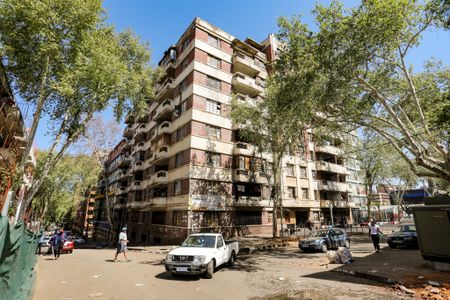
Iozzo says the risk is not theoretical: it directly affects people living and working in parts of the inner city, and it should be taken seriously.
“In large areas of the Johannesburg CBD, buildings have not been properly maintained for years, and there are also hundreds of hijacked or illegally occupied buildings, many of which lack functioning fire protection systems.
“The concern is that occupants assume a building is safe because it is occupied. That is not necessarily the case. If fire systems are not maintained, tested and supported by adequate water supply, they may not function when needed, and that puts people at real risk in the event of a fire.
“The challenge is that most people have no visibility into whether a building is actually compliant. You cannot see whether a sprinkler system will work in an emergency.
“The only way to manage that risk is to ask direct questions: when were systems last tested, is there sufficient water pressure or backup supply, and has the building been formally assessed? In the current environment, safety is no longer something that can be assumed. It needs to be actively verified.”

Bradley Goose, a senior property surveyor at Alpha, says that while solutions can sometimes be engineered, the underlying constraint remains water.
“A lot depends on the layout of the building and there are solutions that can be designed, but generally speaking, if the water pressure is too low, it will affect the sprinklers and the fire hydrants, resulting in fire being excluded from policies. Water pressure is affected by leaks and blockages which the municipalities don’t attend to in time.”
Ely Aluf, CEO of Prive Financial Services, says failing municipal water pressure has become the single biggest barrier to insuring buildings.
“If there is no pressure, there will be no insurance — it’s as simple as that,” he says. “Insurance companies cannot take that risk. The biggest issue our clients are facing right now is water.”
To remain insurable, property owners are increasingly forced to install their own fire-protection infrastructure.
Aluf cites one client who owns a factory in Ekurhuleni, who spent R5.5-million installing a 100,000-litre water storage system, including booster pumps and backup power, simply to meet minimum fire compliance requirements.
“Otherwise their factory cannot be insured,” he says.
In some cases, he says, property owners are also turning to boreholes as a supplementary solution where possible, adding further cost in an already constrained environment.
Saul Mayers, Group Legal and Director at Quorum Holdings, says insurers are increasingly withdrawing cover from inner-city properties, citing fire risk linked to unreliable water supply.
A building in his portfolio lost insurance cover entirely, and no insurer was willing to take on the risk.
“We were accordingly required to sell that building at roughly 25% of its 2016 purchase price,” he said, adding that compliance costs were becoming prohibitive.
“To secure insurance, buildings are expected to comply with current ASIB (Automatic Sprinkler Inspection Bureau) sprinkler requirements. Although some buildings originally complied with regulations applicable at the time of construction, bringing them in line with current standards would cost millions of rands.”
Compounding the problem is administrative collapse.
“Original plans cannot be traced due to loss or damage. Without these plans, additions or alterations cannot be approved.”
Property owners, he says, are effectively trapped.
“Shutting down a building risks hijacking with limited support from JMPD or SAPS. Complying with insurer requirements is financially crippling. Remaining uninsured risks breaching loan covenants.”
/file/attachments/2990/UninsureableBuildings_infeed2_491040.png)
On the ground, the consequences are already visible.
Wynand Engelbrecht of Fire Ops, a private fire response company, says the frequency of incidents is high.
“We are seeing around 10 fires a day in Joburg. Some are small, some are major — but there is often not enough water. People can’t put tanks up in many CBD buildings. There isn’t enough space and the tanks are too heavy to put on roofs, depending on the height of the building. Insurance companies get nervous because there is never enough water — even private fire brigades are limited.”
/file/attachments/2990/UninsureableBuildings_infeed3_856792.png)
For businesses, the consequences are already material — and worsening.
Kulekani Mathe, CEO of Business Unity South Africa, says failing municipal services — particularly water pressure — are directly eroding asset value and investor confidence.
“This is a real problem for businesses across municipalities,” he says.
“Companies are facing significant risk because they cannot insure their buildings. In some cases, assets are effectively exposed — and effectively unfinanceable.”
“We are seeing losses of between 20% and 25% in property values in some areas. Investors are pulling back because the fundamentals no longer make sense.” DM
Sign up to DM’s Joburg newsletter here.