




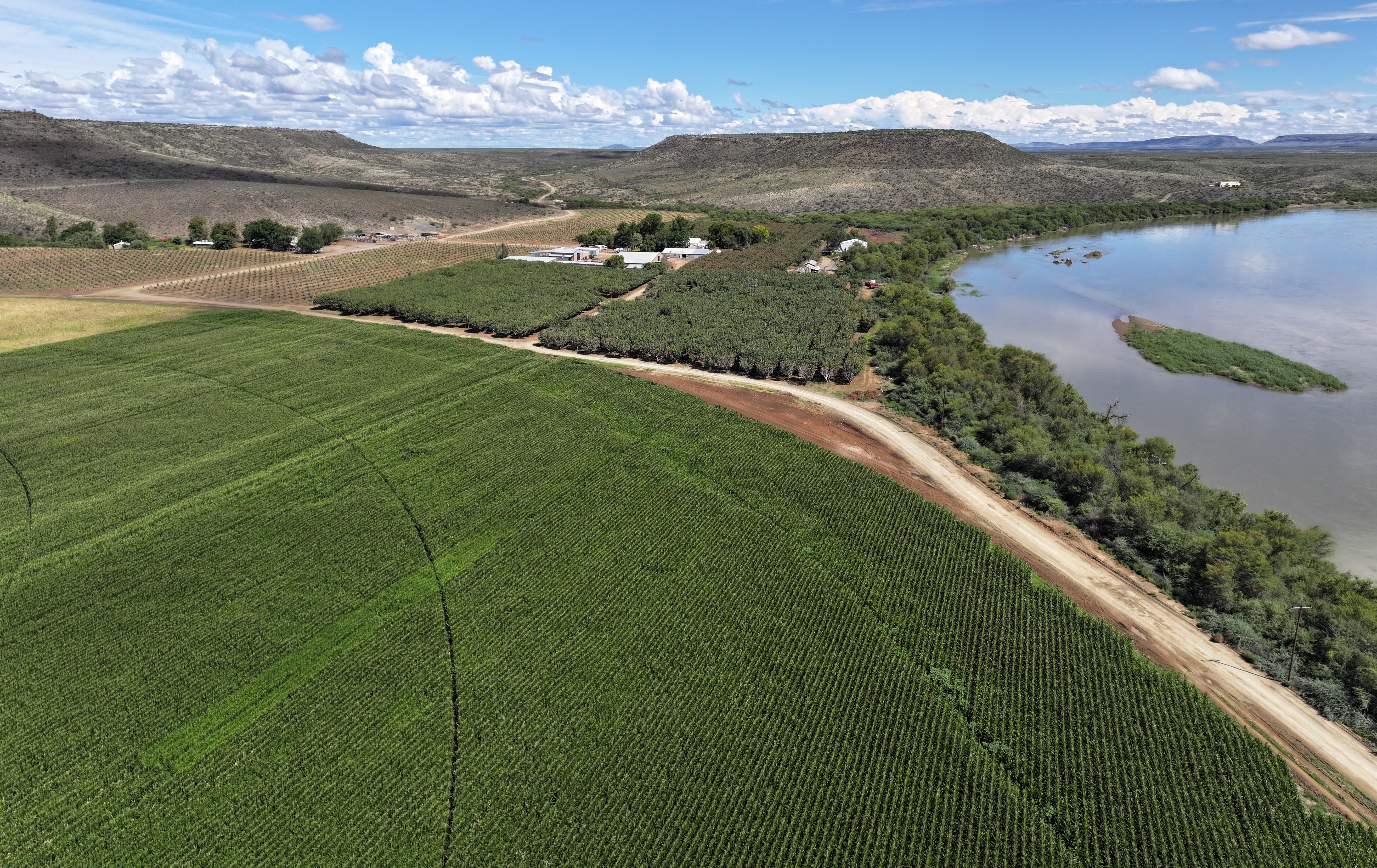
 An aerial view of Karoo Pistachios’ farm. SA’s Northern Cape is poised to become a major player in the global pistachio market, leveraging unique climatic conditions and new agricultural financing models. (Photo: Fedgroup)
 The Karoo landscape is currently bearing witness to the early architecture of an entirely new industry: one backed by patient capital, export ambition and a financing model designed around how trees actually grow, rather than how banks prefer loans to behave.
At a growers’ conference hosted in Prieska by Karoo Pistachios and its primary funding partner, Fedgroup, the vision was laid out in unusually clear terms. Their joint ambition is to build a sector capable of producing up to 60,000 tonnes annually, capture between 5% and 8% of global market share and place SA among the world’s top six or seven pistachio producers within the next decade.
That ambition lands in a global market that is both lucrative and uneven.
Before you dismiss pistachios as “just another nut”, remember that in some parts of the world they carry significant cultural and economic weight. A recent BBC feature on Turkey’s pistachio capital described them as “green gold”, a crop so prized it underpins entire culinary traditions and premium food industries.
Global demand, concentrated production
Yet despite that demand, production is heavily concentrated. The United States, Iran and Turkey control more than 85% of the world’s pistachio production. This means nearly all global output sits north of the equator, in a handful of countries facing mounting pressure from water scarcity, climate volatility and geopolitics. That leaves a gap – and SA is trying to fill it.
A recent report by Mordor Intelligence places the value of the global pistachio market at R92.33-billion ($5.49-billion) this year, with an estimated future value of R118-billion ($7.02-billion) by 2031.
The concentrated production of pistachios in the Northern Hemisphere means there is limited supply and strong demand - this is why you pay a premium at your local store. Import duties are not the main culprit here, as SARS lists in-shell pistachios as duty-free.
Prices in SA also track global benchmarks, with data from Tridge — a company that provides real-time agricultural pricing, market intelligence and connects buyers and exporters — showing high per-kg values for pistachios. Sample South African transaction data also points to high base values, around $36 or R613 per kg in early 2026. Prices also vary depending on whether you buy them with or without shells. For example, at the Empire Shop online, you can buy pistachios at R358 a kg, but if you want to buy the kernels (de-shelled pistachios) the price rockets up to R713 a kg.
/file/attachments/orphans/KarooPistachioCEODavidMuller_756253.jpg "Karoo Pistachios CEO David Muller. (Photo: Fedgroup)")
“We have a counter-seasonal advantage, supply chain diversification, and a premium product,” said Karoo Pistachio CEO David Muller. “We’ve therefore been able to produce premium nuts that rival the best in the world in terms of quality, which makes this such a compelling and lucrative opportunity for the region.”
The Karoo offers a rare combination of conditions: desert heat, winter chill, low rainfall and access to irrigation from the Orange River system. In a country where water is an increasingly scarce resource, that might seem like a vulnerability. Muller argues it is the opposite.
“Water scarcity is a major constraint for all pistachio-producing regions in the world, simply because it’s a desert plant,” he said. “If you switch off the water, it won’t thrive, but it will survive, and when water returns, you just keep going where you left off.”
That resilience is part of the appeal. The urgency is another.
“The current crop selection of farmers are running against the wall,” Muller said. “People need to urgently diversify from corn and wheat, because we’re not competitive on the world market, and climate change is making it more volatile.”
The marriage of slow capital and long-term crops
But the real shift is happening on the balance sheet.
Pistachios are slow money. Trees take years to mature, yields fluctuate and farmers generally only break even around year eight. That timeline has long sat uneasily with traditional financing models that demand predictable, near-term repayments.
/file/attachments/orphans/FedgroupPartnerAlternativeAssetManagementWarrenWinchester_401641.jpg "Fedgroup Partner: Alternative Asset Management, Warren Winchester. (Photo: Fedgroup)")
Fedgroup’s approach is to bend finance to biology. Warren Winchester, Partner: Fedgroup Alternative Asset Management, notes that the company has been on a journey with Karoo Pistachios over six years.
“Our patient capital approach has been structured to align with orchard maturation cycles, seasonal variability and long-term asset value creation,” said Winchester. “There is often a disconnect between traditional funding structures and what perennial crops actually require.”
Instead of fixed repayments, funding is structured around what the trees produce.
“We structure financial instruments that mimic the cash flow cycle and the value creation cycle of the underlying assets,” Winchester explained. “You don’t have to be paying back before the assets are actually producing the income.”
Because pistachios are alternate-bearing – delivering stronger harvests one year and lighter ones the next – the financial model adjusts accordingly. Returns are linked to output, not rigid schedules.
For Muller, that flexibility is not a luxury. It is the difference between building an industry in a decade, or watching it stall for generations.
“If you try to grow within traditional constraints, unlocking an opportunity that should take five to 10 years can end up taking 40 to 50 years, and, quite frankly, many South African farmers simply don’t have that amount of time. They are looking to diversify into high value, alternative crops as a matter of urgency,” he said. “We want to accelerate a process that has traditionally taken 100 years and do it in 20.”
Scale of acceleration
The scale of that acceleration is significant. Getting to 2,000 hectares under cultivation is expected to require close to R1-billion in planting, irrigation and operational capital, before even factoring in land costs. It is, by any measure, a multibillion-rand build.
/file/attachments/orphans/KarooPistachiosGrowersEventAerial_105202.jpg "An aerial view of the Karoo Pistachios growers’ event. (Photo: Fedgroup)")
/file/attachments/orphans/GuestsattheKarooPistachiosGrowersConferenceheldinPrieskaintheNorthernCapeFebruary2026_166496.jpg "Guests at the Karoo Pistachios Growers Conference held in Prieska in the Northern Cape in February 2026. (Photo: Fedgroup)")
/file/attachments/orphans/FedgroupCEOGrantFieldchatstoguestsattheKarooPistachiosGrowersConferenceFebruary2026_559102.jpg "Fedgroup CEO Grant Field chats to guests at the growers conference. (Photo: Fedgroup)")
For Fedgroup, which manages more than R20-billion in assets across investments, lending and alternative assets, pistachios are still a relatively small slice of the overall portfolio. Strategically, however, they sit at the centre of a broader shift towards real, income-generating assets.
/file/attachments/orphans/KarooPistachiosOrangeRiverPumpStation_624402.jpg "Karoo Pistachios’ Orange River pump station. (Photo: Fedgroup)")
“It’s definitely a core strategy,” Winchester said. “We’ve seen this trend globally of increasing demand and dwindling supply, and it has proven massive potential in terms of the financial metrics.”
/file/attachments/orphans/13March2026-WarrenDavid_322050.jpg "Warren Winchester and David Muller in the field. (Photo: Fedgroup)")
There is also a regional development case underpinning the investment. Converting row crops to pistachios dramatically increases labour intensity, while processing and export infrastructure can deepen the value chain further. In a province where economic opportunities are limited, that matters.
Success, however, will not be measured only in hectares planted or export volumes shipped. It will depend on whether SA can position its pistachios as a premium product in a market that already understands value.
In places like Gaziantep, pistachios are more than a commodity. They are identity, tradition and industry rolled into one. SA’s producers are not trying to replicate that history, but they are trying to tap into the same premium narrative.
If they succeed, the Karoo will not just be growing pistachios. It will be offering a glimpse of how agriculture in SA might evolve – funded differently, scaled faster and built with one eye firmly on global markets. DM