




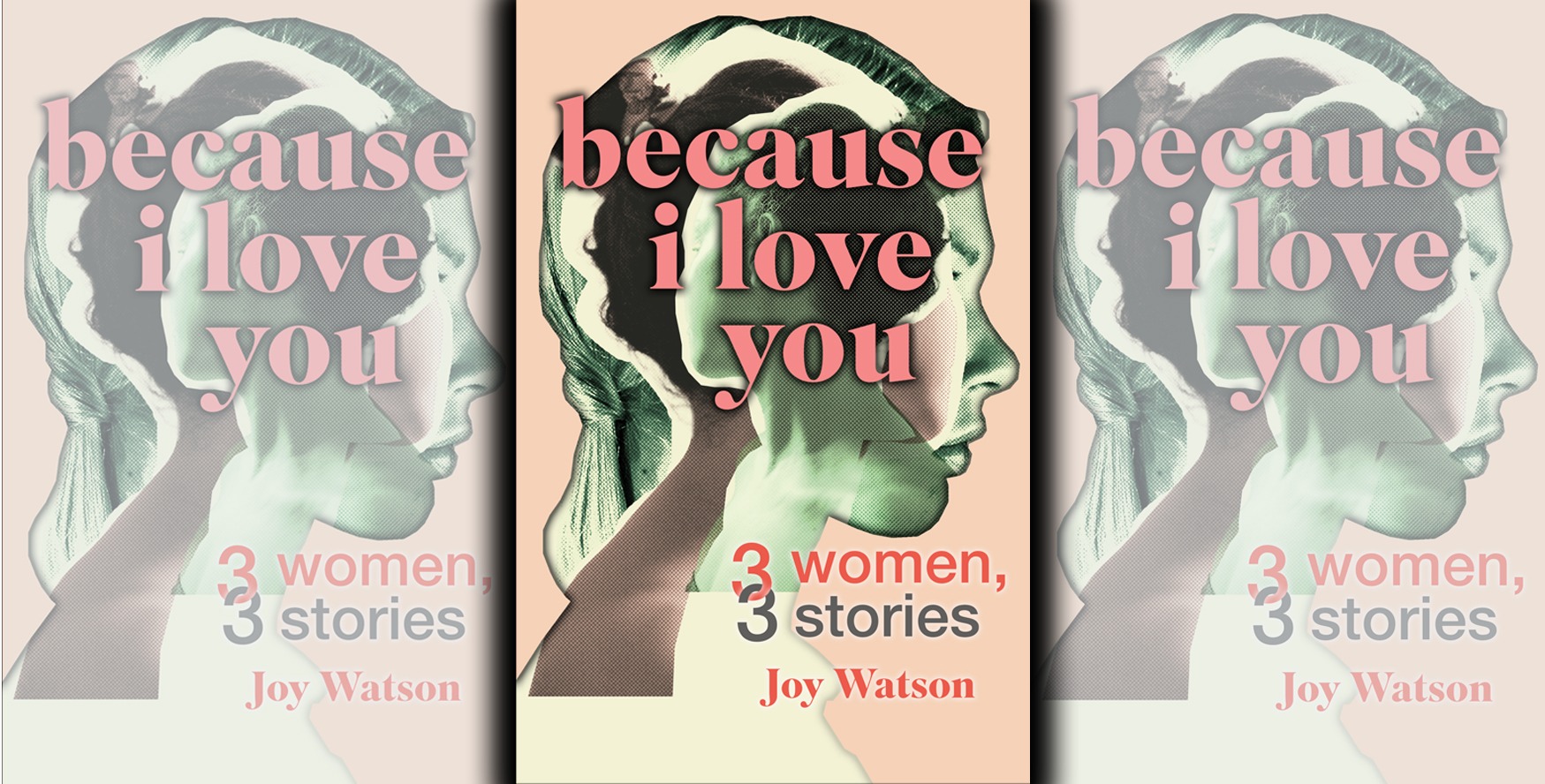
 Because I Love You by Joy Watson. (Image: Jonathan Ball Publishers)
 These are real stories, lightly fictionalised to protect those who lived them. If you have ever felt lonelier in a relationship than you were on your own, this book is for you. And as you begin again, you are not alone. Here is an excerpt.
***
Claiming the night
I was thirteen, wearing a white nightdress that barely brushed my knees, the hem catching moonlight. The house behind me was quiet, sleeping, heavy with the dull ache of my parents’ separation. I wanted motion. I wanted defiance. I wanted to feel the pulse of the world on my skin.
So, I had slipped out of the front door, barefoot and brave, into the balmy hush of the night. The air was soft, the kind that makes you feel like you have done exactly the right thing in stepping out into the night, even though it is taboo.
I walked the long road that curled around our neighbours’ houses and sleeping dogs, my heartbeat syncing with the thrill of stepping into the dark. When I reached the end of the road, I was unsure what to do next, so I sat on the kerb, legs drawn in, chin tilted upward to let the stars look back at me. It felt like the whole sky had waited for me to arrive. I had always imagined doing this – walking the dark, unaccompanied, but I hadn’t known how alive it would make me feel. Like I was becoming someone, even if I didn’t yet know who.
I don’t know what pulled their headlights toward me – fate, bad timing or the sheer audacity of my own little myth in the making. My grandmother and aunt had just left my cousin’s house nearby, when they spotted me at the end of the road. A slip of a girl on a pavement not meant for solitude. They pulled up fast, exasperation sharpening the quiet.
“What on Earth are you doing?” my grandmother asked, though I think she knew. They didn’t yell, but disappointment hung like thick fabric between us. I got into the car. No protest. Just silence.
“We’ll call your mother in the morning,” they said, not cruel, just tired. “Now go to bed.”
I did as I was told. For exactly ten minutes. The house was dark again, sleeping. I slipped through it like a ghost who could not be grounded. Same nightdress, same toes brushing the carpet, front door being quietly opened. I walked the road again, heart racing, not with fear but with fierce joy. I sat on the kerb, reclaiming the stillness like a right. And then – headlights.
They had forgotten something at my cousin’s house, something trivial, I can’t remember what, because that’s not the memory that holds. And there I was. Again. Same kerb. Same nightdress. Same look on their faces, only now edged with disbelief and a bone-deep tiredness.
I’ve always wanted to claim the magic of what the dark can bring. Not just the hush of it, but the invitation. The way night slips into your bones and dares you to imagine yourself differently. As a girl, I thought I could make the dark mine if I met it first – barefoot, wild-hearted, wide-eyed.
As I grew into a woman in a violent country, I learned to cede the night. Not by choice, but by instruction. I learned that to survive meant to stay home, stay small, stay bright enough to be seen but not enough to be wanted. I have always wanted to walk the city with my body, to trace its shapes and shadows as my own. But the city had its own script. It wrote itself onto me – through stares, gropes, street corners that felt like traps. And like ink on skin, I absorbed it. The rules. The glances. The things that keep us safe.
I learned, in time, to hold my body close like a secret. To guard it with keys and codes and good-girl instincts.
What took longer, so much longer, was learning that harm doesn’t always arrive with warning signs. That violence doesn’t always need fists or slurs. It can come quietly, cloaked in words that sound like care, in silences that stretch too long, in small gestures that slowly hollow you out. It took me years to see that words and actions that do not come under the guise of violence can still wound, still shape, still steal. They can still be brutal.
It took me years to see that the heart, the mind and the spirit need fences too; that they too require safekeeping.
***
Our husbands
When we were little, we played an ongoing game, my sister Mary, our cousin Carmen and me. It was shaped by the social messages that fed our subconscious – about romantic love, about men, and our roles within it all.
We played other, more visionary games in which we had superpowers, solved crimes and became wonder women, fuelled, I suppose, by a deeper desire to embody power. But this particular game, let’s call it “Our Husbands”, was one that lingered; a game we’d drop like an old shoe, only to resurrect it days or weeks later, as if it had a life of its own. The Husbands hadn’t always been husbands. In the early days, the game revolved around their courtship, elaborate efforts to win our affection and the inevitable dramas that followed. The Husbands were terribly romantic. Terribly handsome. Terribly tall.
You get the idea.
For reasons I can’t explain, I remember their names with absolute clarity, spared as they are from the battalion of lost childhood memories. Mary’s husband was Brian – a fact I love teasing her about in adulthood. How could a girl so wildly imaginative conjure a lover called Brian? Carmen’s was Michael. Mine, and I say this with some shame, was Charles. I’d like to think I was too young to know of the then Prince of Wales. Given how that story unfolded, it was, in retrospect, not the best choice.
What I remember most is that even though these men loved us and made grand romantic gestures, there were often simmering conflicts with them. There were arguments, resentments, moments of imagined heartbreak. It was never about physical violence. It was something more insidious, the kind of subliminal, slow-burning hurt that comes with relationships. One of us would act out a grievance, and the others would follow, as if our husbands were in sync, always misbehaving at once. Despite this, we decided to marry them anyway. As one does.
Our joint wedding was a major event, played out behind the bed in Aunty Glory’s bedroom. We baked imaginary cakes, set up elaborate floral arrangements. Our dresses were resplendent with studded diamonds, trailing Chantilly lace that shimmered like spun sugar. I walked down the imaginary aisle first, because I was the oldest, and therefore in charge. We stood at the imaginary altar with Brian, Michael, and Charles and exchanged our vows. It was glorious. Too young to know anything about sex, our wedding night ended with an imaginary feast of cake, sweets, and chocolate.
I later wove the story of our marriages’ demise into my debut novel, The Other Me.
Here’s what unfolded: Carmen wasn’t with us the day Mary and I ended our marriages. By then, we had found a kind of peace in the drama, a tolerable level of dysfunction. But then Brian and Charles were called to fight in a war. While they were gone, we discovered we were both pregnant and threw a mud cake party to celebrate. Then came the devastating news: both our husbands had been killed by a bomb. We threw ourselves to the ground, wailing in grief. Their remains were returned to us. Mary received a leg; I was given a head. We held a burial. We cried real tears for the loss of our imaginary husbands, the grief felt visceral.
We stopped playing the game after they died.
Looking back, I wonder if we were rehearsing. All the grand gesturing of love, the dramatic break-ups, the tearful reconciliations. Without realising, were they dress rehearsals for the real thing? I was learning, in play, what it meant to long for someone, to be let down, to feel stitched into a story that could turn on you.
Yet no game prepared me for the first time it wasn’t pretend. When my first heartbreak came for me, it arrived not in imaginary wars or mud cakes, but in the quiet, cruel flicker of being left behind. That’s when I first understood how love could break you open and offer nothing in return. No apology, no neat ending. Just absence, and the unbearable task of carrying on anyway.
I grew up with the notion of romantic love deeply etched into the seams of my heart. The stories I inhaled, the games we played, all pointed to it: love as destiny, as reward, as the thing that would make me whole. I was seventeen when that myth began to splinter. My first boyfriend left me for someone else. Just like that. No warning, no conversation, just a quiet replacement.
I remember the moment with cinematic clarity. The bell had rung, school was over, and I was laughing at something a friend had said as we exited the gates. Then I saw him, casually leaning against a wall on the other side of the road. My heart did that small, familiar skip. I picked up my pace, smiling. But before I could reach him, another girl, one I vaguely knew, walked right up to him and kissed him. I just stood there. My feet rooted in place, but my mind detached, floating upwards, somewhere beyond the trees, watching it all from above. She slung her school bag over her shoulder, leaned into him, and they walked away, just like that, like a mirage that never belonged to me.
In the weeks that followed, I learned the particular cruelty of a broken heart. I couldn’t sleep. I couldn’t eat. The ache was constant, gnawing. I kept asking questions I had no answers for: What had I done wrong? Why wasn’t I enough? What did she have that I didn’t?
No one had ever told me that heartbreak could feel like grief, like the death of possibility. I didn’t know then that this kind of pain wasn’t permanent. That it could live in your chest like a solid form, but that it evaporated eventually. All I knew was the weight of it. How hard it was to pretend I was okay. How much energy it took to keep moving forward when all I wanted was to lie down and dissolve.
But of course, I didn’t. As it is with heartache, eventually the sharp edges dulled. I laughed again. I loved again.
Some losses are beyond our control. The loss of a loved one is not something we get to prepare for, not really. Letting go of someone you love means accepting that no new memories can be made, only old ones revisited. And in time, if we’re lucky, that loss becomes something we carry with more tenderness than resistance.
The stories we shared with them begin to hold us instead of undoing us. DM
Because I Love You, 3 Women, 3 Stories is available for R320. Don’t miss Rebecca Davis in conversation with Joy Watson on Thursday from 12pm to 1pm.