Artemis II: Images from Nasa’s historic crewed journey around the moon
Nasa’s Artemis II marks a major milestone as the first crewed mission in the Artemis programme, sending four astronauts on a 10-day journey around the moon aboard the Orion spacecraft. The mission aims to test critical systems and pave the way for future lunar landings, including the highly anticipated return of humans to the moon.
Nasa astronaut and Artemis II mission specialist Christina Koch peers out of one of the Orion spacecraft’s main cabin windows, looking back at Earth, as the crew travels towards the moon on 4 April 2026. (Photo: Nasa via Getty Images)
From left: Mission specialist Jeremy Hansen of the Canadian Space Agency, mission specialist Christina Koch of Nasa and pilot Victor Glover of Nasa speak to family members during the walkout from the Neil A Armstrong Operations and Checkout Building towards Launch Pad 39B as part of Artemis II’s launch preparations in Titusville, Florida, on 1 April 2026. Artemis II is the first human mission beyond low Earth orbit since 1972. (Photo: EPA / Cristobal Herrera-Ulashkevich) From left: Mission specialist Jeremy Hansen, Victor Glover, commander Reid Wiseman and Christina Koch leave the Neil A Armstrong Operations and Checkout Building before the launch of the Artemis II mission at Nasa’s Kennedy Space Center in Cape Canaveral, Florida, on 1 April 2026. The 98m Space Launch System rocket and Orion spacecraft will take the astronauts around the moon and back, about 370,149km out into space and the farthest any human has yet travelled from Earth. (Photo: Joe Raedle / Getty Images) The Space Launch System rocket carrying the Orion capsule for the Artemis II mission lifts off at the Kennedy Space Center on 1 April 2026. (Photo: EPA / Cristobal Herrera-Ulashkevich) The Space Launch System is a super heavy-lift expendable rocket designed for deep space exploration. (EPA / Cristobal Herrera-Ulashkevich) Guests at the Kennedy Space Center watch the launch of the Space Launch System rocket on 1 April 2026. (Photo: Bill Ingalls / Nasa / Getty Images) The 10-day Artemis II mission with four Nasa astronauts has completed its moon flyby, travelling further any human has from Earth. (Photo: Joe Raedle / Getty Images) People watch the launch of Artemis II from the A Max Brewer Bridge in Titusville, Florida, on 1 April 2026. (Photo: Gerardo Mora / Getty Images) People gather on the day of the launch of the next-generation moon rocket and the Orion crew capsule from the Kennedy Space Center in Florida on 1 April 2026. (Photo: Reuters / Marco Bello) Orion snapped this high-resolution selfie in space with a camera mounted on one of its solar array wings during a routine external inspection of the spacecraft on the second day into the Artemis II mission on April 3, 2026. NASA's Artemis II mission will take Wiseman, Glover, Koch, and Hansen on a 10-day journey around the Moon and back aboard their Orion spacecraft. (Photo: NASA via Getty Images) Artemis II mission specialist and CSA (Canadian Space Agency) astronaut Jeremy Hansen enjoys a shave inside the Orion spacecraft during Flight Day 5, April 5, 2026, and ahead of the crew's lunar flyby on April 6. (Photo: NASA via Getty Images) Artemis II crewmember sleeping bags are illuminated inside the Orion spacecraft ahead of the crew's lunar flyby on April 6, 2026. (Photo: NASA via Getty Images) Artemis II pilot and NASA astronaut Victor Glover peers out one of the Orion spacecraft's windows looking back at Earth ahead of the crew's lunar flyby on April 6, 2026. (Photo: NASA via Getty Images) The Moon as it drew close to the window of the Orion spacecraft on 06 April 2026, which marked the point at which the Moon's gravity had a stronger pull on the spacecraft than the Earth's. (Photo: EPA/NASA) Artemis II commander and NASA astronaut Reid Wiseman looks out one of the Orion spacecraft's main cabin windows at the Moon ahead of the crew's lunar flyby on April 6, 2026. (Photo: NASA via Getty Images) NASA astronaut Christina Koch is illuminated by a screen inside the darkened Orion spacecraft on the third day of the agency's Artemis II mission on April 3, 2026. To the right of the image's center, CSA (Canadian Space Agency) astronaut Jeremy Hansen is seen in profile peering out of one of Orion's windows. Lights are turned off to avoid glare on the windows. NASA's Artemis II mission will take Wiseman, Glover, Koch, and Hansen on a 10-day journey around the Moon and back aboard their Orion spacecraft. (Photo: NASA via Getty Images) Earthset captured through the Orion spacecraft window at 6:41 p.m. EDT, 06 April 2026, during the Artemis II crew's flyby of the Moon. In the foreground, Ohm crater has terraced edges and a flat floor interrupted by central peaks. (Photo: EPA/NASA) Earth sets at 6:41 p.m. EDT, April 6, 2026, over the Moon’s curved limb in this photo captured by the Artemis II crew during their journey around the far side of the Moon. Orientale basin is perched on the edge of the visible lunar surface. Hertzsprung Basin appears as two subtle concentric rings, which are interrupted by Vavilov, a younger crater superimposed over the older structure. The lines of indentations are secondary crater chains formed by ejecta from the massive impact that created Orientale. The dark portion of Earth is experiencing nighttime. On Earth’s day side, swirling clouds are visible over the Australia and Oceania region. (Photo: NASA via Getty Images) Captured by the Artemis II crew during their lunar flyby on April 6, 2026, this image shows the Moon fully eclipsing the Sun. From the crew’s perspective, the Moon appears large enough to completely block the Sun, creating nearly 54 minutes of totality and extending the view far beyond what is possible from Earth. The corona forms a glowing halo around the dark lunar disk, revealing details of the Sun’s outer atmosphere typically hidden by its brightness. Also visible are stars, typically too faint to see when imaging the Moon, but with the Moon in darkness stars are readily imaged. This unique vantage point provides both a striking visual and a valuable opportunity for astronauts to document and describe the corona during humanity’s return to deep space. The faint glow of the nearside of the Moon is visible in this image, having been illuminated by light reflected off the Earth. (Photo: NASA via Getty Images) Peering out one of the four windows near the display console on the Orion spacecraft, the Earth is illuminated by the blackness of space and grows smaller as the crew journeys closer to the Moon. This image was taken by an Artemis II crew member on the fifth day of the mission. (Photo: NASA via Getty Images) Captured from the Orion spacecraft near the end of the Artemis II lunar flyby on April 6, this image shows the Sun beginning to peek out from behind the Moon as the eclipse transitions out of totality. Only a portion of the Moon is visible in frame, its curved edge revealing a bright sliver of sunlight returning after nearly an hour of darkness. In final moments of the eclipse observed by the crew, the reemerging light creates a sharp contrast against the Moon’s silhouette and reveals lunar topography not usually visible along the lunar limb. This fleeting phase captures the dynamic alignment of the Sun, Moon, and spacecraft as Orion continues its journey back from the far side of the Moon. (Photo: NASA via Getty Images)





/file/attachments/orphans/13878477_568278.jpg "From left: Mission specialist Jeremy Hansen of the Canadian Space Agency, mission specialist Christina Koch of Nasa and pilot Victor Glover of Nasa speak to family members during the walkout from the Neil A Armstrong Operations and Checkout Building towards Launch Pad 39B as part of Artemis II’s launch preparations in Titusville, Florida, on 1 April 2026. Artemis II is the first human mission beyond low Earth orbit since 1972. (Photo: EPA / Cristobal Herrera-Ulashkevich)")
/file/attachments/orphans/GettyImages-2269417686_915189.jpg "From left: Mission specialist Jeremy Hansen, Victor Glover, commander Reid Wiseman and Christina Koch leave the Neil A Armstrong Operations and Checkout Building before the launch of the Artemis II mission at Nasa’s Kennedy Space Center in Cape Canaveral, Florida, on 1 April 2026. The 98m Space Launch System rocket and Orion spacecraft will take the astronauts around the moon and back, about 370,149km out into space and the farthest any human has yet travelled from Earth. (Photo: Joe Raedle / Getty Images)")
/file/attachments/2990/13878704_606117.jpg "The Space Launch System rocket carrying the Orion capsule for the Artemis II mission lifts off at the Kennedy Space Center on 1 April 2026. (Photo: EPA / Cristobal Herrera-Ulashkevich)")
/file/attachments/orphans/13878705_571546.jpg "The Space Launch System is a super heavy-lift expendable rocket designed for deep space exploration. (EPA / Cristobal Herrera-Ulashkevich)")
/file/attachments/orphans/GettyImages-2268825411_580668.jpg "Guests at the Kennedy Space Center watch the launch of the Space Launch System rocket on 1 April 2026. (Photo: Bill Ingalls / Nasa / Getty Images)")
/file/attachments/orphans/GettyImages-2269443833_161949.jpg "The 10-day Artemis II mission with four Nasa astronauts has completed its moon flyby, travelling further any human has from Earth. (Photo: Joe Raedle / Getty Images)")
/file/attachments/orphans/GettyImages-2269444423_955673.jpg "People watch the launch of Artemis II from the A Max Brewer Bridge in Titusville, Florida, on 1 April 2026. (Photo: Gerardo Mora / Getty Images)")
/file/attachments/orphans/RC2MGKACID6J_246435.jpg "People gather on the day of the launch of the next-generation moon rocket and the Orion crew capsule from the Kennedy Space Center in Florida on 1 April 2026. (Photo: Reuters / Marco Bello)")
/file/attachments/orphans/GettyImages-2269359611_617235.jpg "Orion snapped this high-resolution selfie in space with a camera mounted on one of its solar array wings during a routine external inspection of the spacecraft on the second day into the Artemis II mission on April 3, 2026. NASA's Artemis II mission will take Wiseman, Glover, Koch, and Hansen on a 10-day journey around the Moon and back aboard their Orion spacecraft. (Photo: NASA via Getty Images)")
/file/attachments/orphans/GettyImages-2269645532_320747.jpg "Artemis II mission specialist and CSA (Canadian Space Agency) astronaut Jeremy Hansen enjoys a shave inside the Orion spacecraft during Flight Day 5, April 5, 2026, and ahead of the crew's lunar flyby on April 6. (Photo: NASA via Getty Images)")
/file/attachments/orphans/GettyImages-2269645449_146761.jpg "Artemis II crewmember sleeping bags are illuminated inside the Orion spacecraft ahead of the crew's lunar flyby on April 6, 2026. (Photo: NASA via Getty Images)")
/file/attachments/orphans/GettyImages-2269645363_621548.jpg "Artemis II pilot and NASA astronaut Victor Glover peers out one of the Orion spacecraft's windows looking back at Earth ahead of the crew's lunar flyby on April 6, 2026. (Photo: NASA via Getty Images)")
/file/attachments/orphans/13885077_668190.jpg "The Moon as it drew close to the window of the Orion spacecraft on 06 April 2026, which marked the point at which the Moon's gravity had a stronger pull on the spacecraft than the Earth's. (Photo: EPA/NASA)")
/file/attachments/orphans/GettyImages-2269645555_274630.jpg "Artemis II commander and NASA astronaut Reid Wiseman looks out one of the Orion spacecraft's main cabin windows at the Moon ahead of the crew's lunar flyby on April 6, 2026. (Photo: NASA via Getty Images)")
/file/attachments/orphans/GettyImages-2269359193_486248.jpg "NASA astronaut Christina Koch is illuminated by a screen inside the darkened Orion spacecraft on the third day of the agency's Artemis II mission on April 3, 2026. To the right of the image's center, CSA (Canadian Space Agency) astronaut Jeremy Hansen is seen in profile peering out of one of Orion's windows. Lights are turned off to avoid glare on the windows. NASA's Artemis II mission will take Wiseman, Glover, Koch, and Hansen on a 10-day journey around the Moon and back aboard their Orion spacecraft. (Photo: NASA via Getty Images)")
/file/attachments/orphans/13887320_462776.jpg "Earthset captured through the Orion spacecraft window at 6:41 p.m. EDT, 06 April 2026, during the Artemis II crew's flyby of the Moon. In the foreground, Ohm crater has terraced edges and a flat floor interrupted by central peaks. (Photo: EPA/NASA)")
/file/attachments/orphans/GettyImages-2269650026_816885.jpg "Earth sets at 6:41 p.m. EDT, April 6, 2026, over the Moon’s curved limb in this photo captured by the Artemis II crew during their journey around the far side of the Moon. Orientale basin is perched on the edge of the visible lunar surface. Hertzsprung Basin appears as two subtle concentric rings, which are interrupted by Vavilov, a younger crater superimposed over the older structure. The lines of indentations are secondary crater chains formed by ejecta from the massive impact that created Orientale. The dark portion of Earth is experiencing nighttime. On Earth’s day side, swirling clouds are visible over the Australia and Oceania region. (Photo: NASA via Getty Images)")
/file/attachments/orphans/GettyImages-2269645695_204396.jpg "Captured by the Artemis II crew during their lunar flyby on April 6, 2026, this image shows the Moon fully eclipsing the Sun. From the crew’s perspective, the Moon appears large enough to completely block the Sun, creating nearly 54 minutes of totality and extending the view far beyond what is possible from Earth. The corona forms a glowing halo around the dark lunar disk, revealing details of the Sun’s outer atmosphere typically hidden by its brightness. Also visible are stars, typically too faint to see when imaging the Moon, but with the Moon in darkness stars are readily imaged. This unique vantage point provides both a striking visual and a valuable opportunity for astronauts to document and describe the corona during humanity’s return to deep space. The faint glow of the nearside of the Moon is visible in this image, having been illuminated by light reflected off the Earth. (Photo: NASA via Getty Images)")
/file/attachments/orphans/GettyImages-2269645612_949691.jpg "Peering out one of the four windows near the display console on the Orion spacecraft, the Earth is illuminated by the blackness of space and grows smaller as the crew journeys closer to the Moon. This image was taken by an Artemis II crew member on the fifth day of the mission. (Photo: NASA via Getty Images)")
/file/attachments/orphans/GettyImages-2269645512_784732.jpg "Captured from the Orion spacecraft near the end of the Artemis II lunar flyby on April 6, this image shows the Sun beginning to peek out from behind the Moon as the eclipse transitions out of totality. Only a portion of the Moon is visible in frame, its curved edge revealing a bright sliver of sunlight returning after nearly an hour of darkness. In final moments of the eclipse observed by the crew, the reemerging light creates a sharp contrast against the Moon’s silhouette and reveals lunar topography not usually visible along the lunar limb. This fleeting phase captures the dynamic alignment of the Sun, Moon, and spacecraft as Orion continues its journey back from the far side of the Moon. (Photo: NASA via Getty Images)")
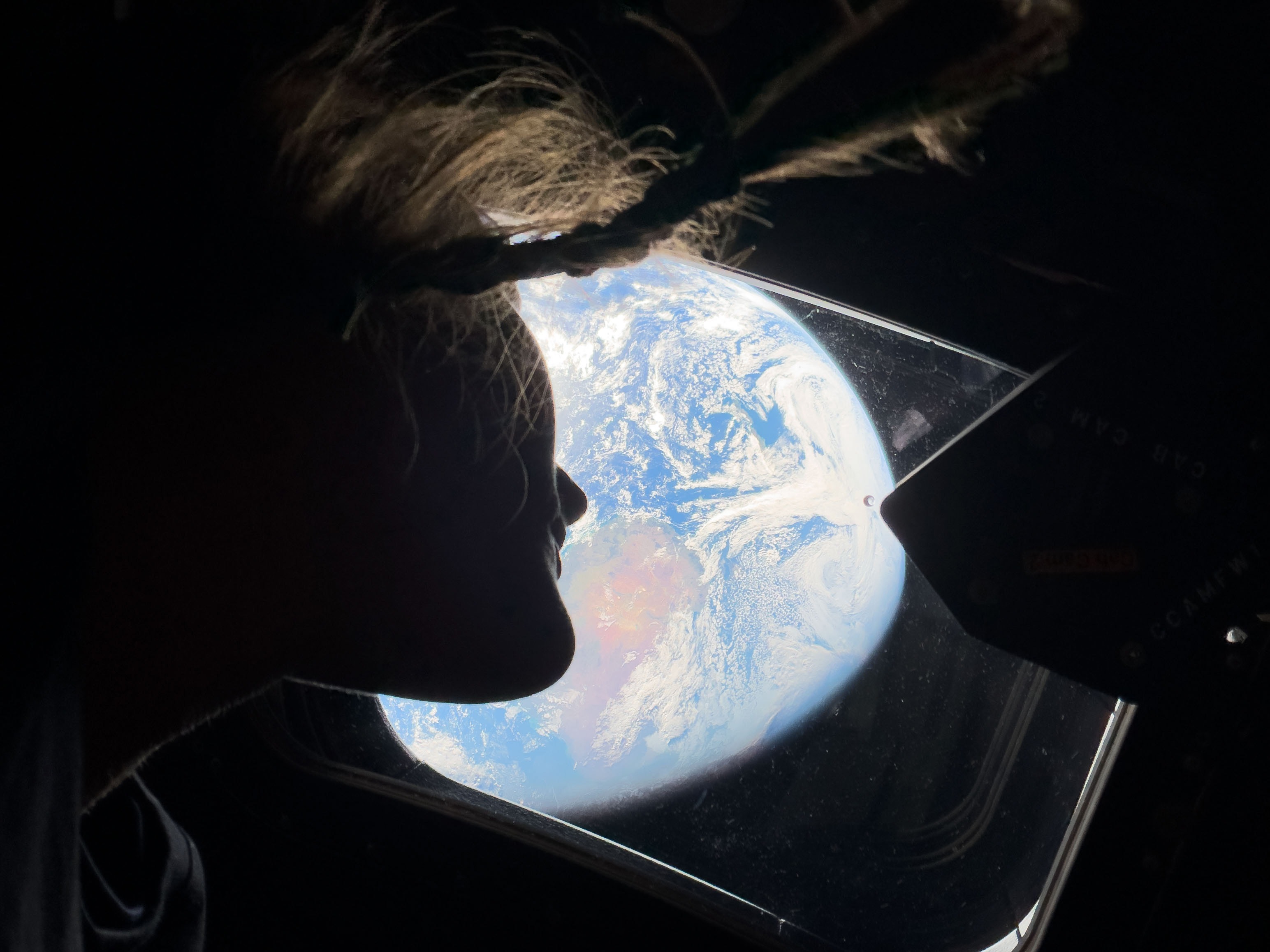 Nasa astronaut and Artemis II mission specialist Christina Koch peers out of one of the Orion spacecraft’s main cabin windows, looking back at Earth, as the crew travels towards the moon on 4 April 2026. (Photo: Nasa via Getty Images)