



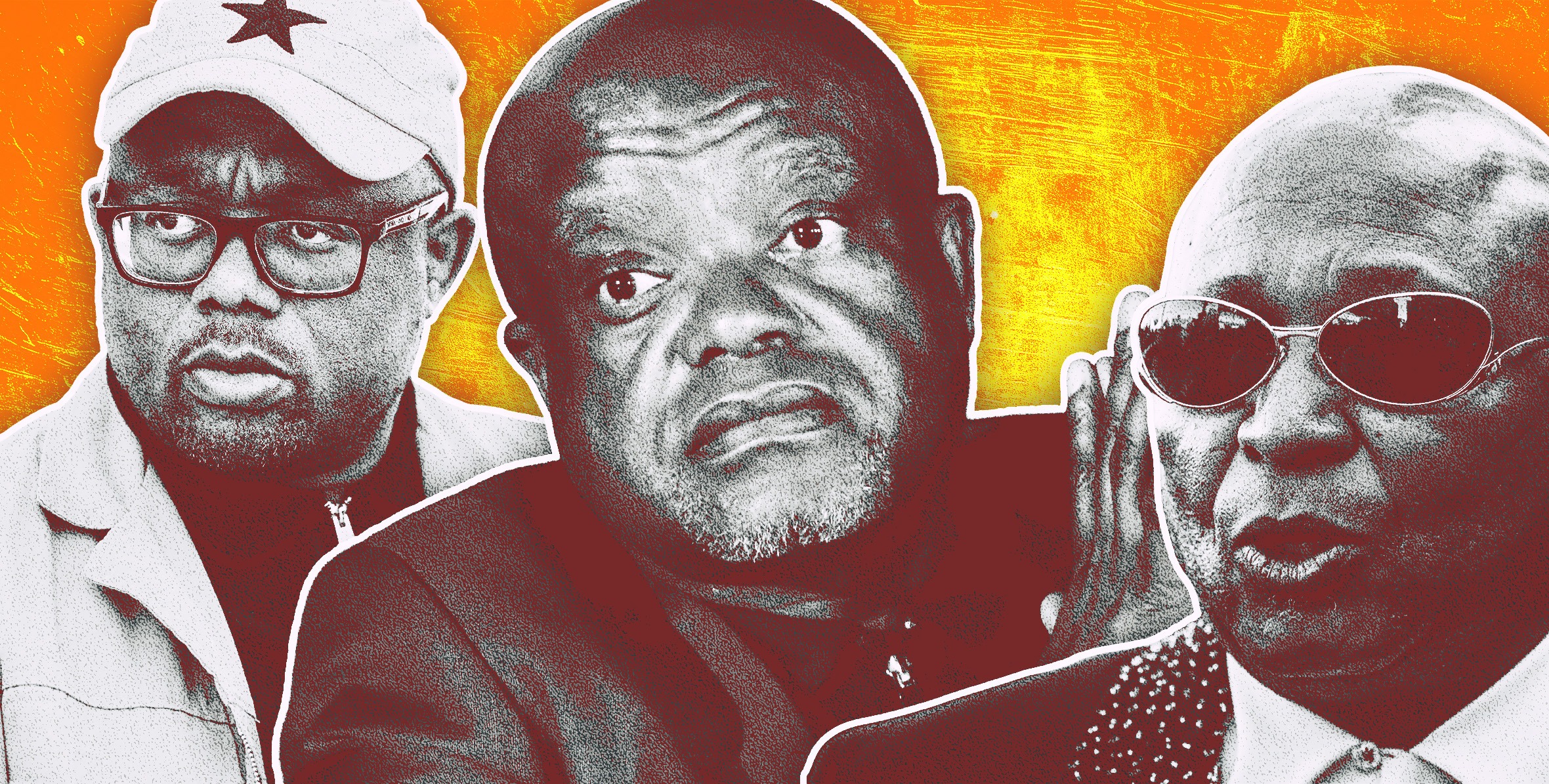
 Illustrative image: Dr Mgcini Tshwaku(Photo: Gallo Images/Luba Lesolle) | Dada Morero (Photo: Gallo Images/Sharon Seretlo) | Kenny Kunene (Photo: Per-Anders Pettersson/Getty Images)
 How would a populist national coalition govern the country? We have the answer.
In 2016, the ANC’s share of the vote in Johannesburg dropped to 44.5%, and then fell further to 33.6% in 2021. This made it the first major city where many supporters of the traditional liberation movement chose not to vote.
The DA ran Johannesburg when Mayor Herman Mashaba briefly partnered with the EFF. After that, the ANC came back into power as the party with the most Council seats, but it still did not have a full majority.
Since then, it has “governed” Johannesburg with the EFF and PA, along with a number of other micro-populist and personality-driven parties.
Johannesburg will be at the epicentre of the upcoming local government election and will probably be the most fiercely contested metro, as its infrastructure and governance have collapsed. With more than six million residents, many of whom are outspoken, the city’s decline has led to strong resistance from citizens. This has put a national and even global spotlight on whether a populist coalition can govern effectively.
The networks that drive a city – electricity, water and transport – are all in crisis, and the ANC has had to intervene both as national party and state. As the party, the head of its Veterans League, Snuki Zikalala, heads a so-called “bomb squad” to improve services. At the state level, a Presidential Working Group under Operation Vulindlela (President Cyril Ramaphosa’s own governance team) has been appointed to the city.
Three major crises
Neither effort has managed to solve these three major crises.
This shows what a populist government at the provincial and national levels might look like. Poor appointments and inconsistent policies could lead to the collapse of basic infrastructure. Almost no professional engineers remain on the boards that oversee water, electricity and roads. Instead, party members are put on these boards, and while many mean well, they are often not qualified for the job.
The latest City Power quarterly report shows that high-voltage outages have gone up by 15%, with 26,184 reported power cuts in the same period. In two quarters in 2025, the Daily Maverick reported 100,000 power cuts.
The utility has a R19.6-billion overdraft and survives only because of an internal loan from the City. Its liabilities of R30.099-billion are much higher than its assets of R8.98-billion. This is a downward spiral for the utility. Electricity has become so expensive that people are going back to using wood and paraffin. Paraffin prices have now nearly doubled, as Sunday Times editor Makhudu Sefara wrote.
Water is still in crisis, nearly two months after Ramaphosa promised urgent action in his State of the Nation address in February. What stands out is that the electricity and water problems are even worse in areas where poor black people live.
The executive mayor, Dada Morero, promised to ameliorate the impact of a prepaid electricity charge of R230 (with VAT) per purchase of R1,000 (or proportionately applied) on poor people almost three years ago, but he hasn’t delivered.
Water is throttled nightly, mostly in the poor parts of the city – it is reduced to a trickle or no supply at all, meaning that many communities are back to a bucket system. These are the Deep South (Orange Farm, Ennerdale and Lenasia), Midrand, Commando (Hurstville, Brixton and Crosby), and Soweto (Meadowlands, Zondi and Chiawelo) systems – most of which are where black, mostly working-class people live.

With the Patriotic Alliance in charge of transport, affordable and reliable transport for workers is still out of reach. The Metro Bus system is in crisis, and the Rea Vaya bus rapid system is also struggling. A link from the south to the north of the city is nine years overdue and has been caught up in corruption, with the Auditor-General reporting at least a billion rand involved.
Taxi ranks are created willy-nilly and without planning, as an expensive transport interchange lies dormant.
There are more examples, but these are enough to draw some conclusions about this populist government. It is not ideological or radical. Instead, it is inexperienced and does a poor job serving the people it claims to represent: poor and working-class black people.
City pays twice for the same service
At the same time, there is a lot of patronage, with each municipal service also being outsourced to companies connected to the coalition parties. This means the City pays twice for the same service, leaving it deeply in debt and dependent on loans.
The coalition government does not have a clear or consistent strategy. Instead, it often starts and then abandons populist campaigns against migrants, zama-zamas (informal or illegal miners), crime and by-law violations. None of the at least 10 campaigns launched have made a real difference.
What is most surprising is that the Council has not even tried to create policies or provide services for the city’s most marginalised communities. These include informal waste traders, people addicted to nyaope, and homeless people who live on pavements and in bus shelters across Johannesburg.
Will SA collapse? It will struggle but not collapse, as the city shows. In the city, social capital has been leveraged into WhatsApp democracy where persistent citizens badger politicians and officials all the time. And civil society has organised itself into the Johannesburg Crisis Alliance, which acts as a bulwark against the worst excesses of poor government. There would be similar resistance at a national government level. DM