




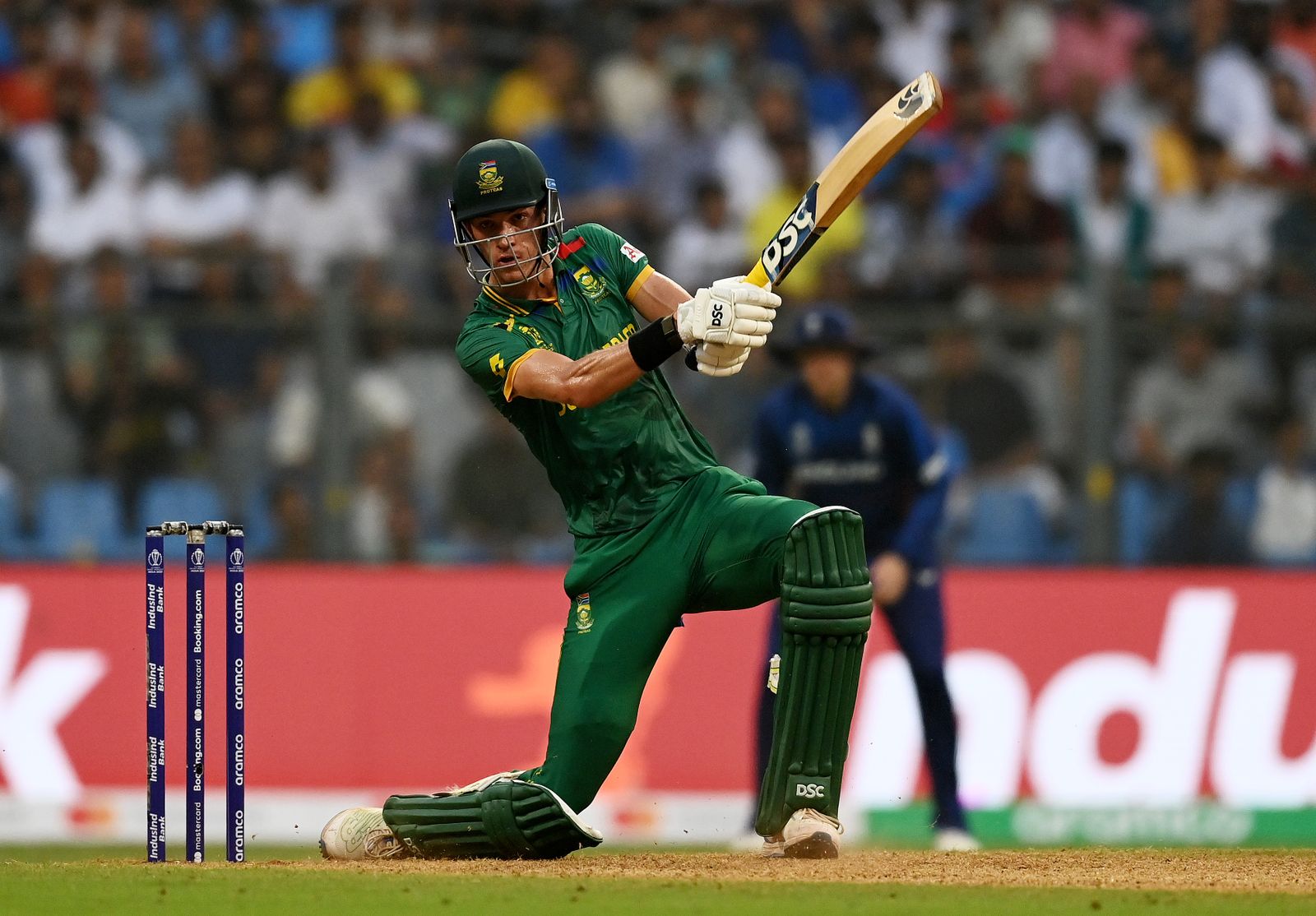
 Marco Jansen hits a six during South Africa’s World Cup match against England at Wankhede Stadium in Mumbai, India, on 21 October 2023. (Photo: Gareth Copley / Getty Images)
 About two decades ago, a cricketer’s main focus in their career was representing their country in Tests and one-day internationals (ODIs). There would be a bit of domestic cricket, and a sprinkle of county cricket for some. T20 cricket was not the behemoth it is now, especially at franchise level.
Now the landscape has shifted and most elite cricketers find themselves having to juggle the pride of representing their countries with the pursuit of the life-changing pay days that come with playing in lucrative T20 leagues around the world, whether it’s the Indian Premier League (IPL), The Hundred in England, Australia’s Big Bash League or South Africa’s own SA20 league.
Cricket has evolved into a high-octane, year-round industry because of the globalisation of the game, particularly at franchise level in the T20 format. This leaves the best cricketers with demanding schedules that can drain them physically and mentally. The amount of travelling and exposure to different time zones adds to the strain, on top of the physical demands of the sport.
Cricket SA’s approach
In the case of South African cricket, take someone such as all-rounder Marco Jansen. The 25-year-old (who turns 26 at the beginning of May) has struggled with injury niggles over the past couple of years.
Granted, sport and injuries can never be separated. They are like trees and leaves, although they affect individuals differently throughout their careers. However, in Jansen’s case, Cricket South Africa (CSA) has acknowledged that his workload plays a part in his injury issues.
In 2024, the Proteas’ limited-overs coach at the time, Rob Walter, said Jansen was “presenting with chronic physiological and physical things that are predisposed to fast bowling”. CSA stepped in and put Jansen in a programme that they hoped would help him shake off his recurrent fitness problems.
“Obviously the workload on young cricketers has gone through the roof, especially guys who bowl fast. In order to ensure that their injuries didn’t put up the stop sign [on their careers], we wanted to put them on a conditioning block,” Walter said.
In addition to being a world-class fast bowler, Jansen contributes with the bat for his respective teams, whether it’s in the middle order or lower down the batting line-up. For his country he is also a vital cog in all three international formats: Tests, ODIs and T20s.
All-rounders of yesteryear, such as Jacques Kallis and Shaun Pollock, were vital for their country in Tests and ODIs, and dabbled in T20 later in their careers.
The modern cricket condition
For today’s all-round stars such as Jansen, there are greater demands in playing three primary formats.
T20 cricket is about the spectacle, as opposed to the strategic and calculated nature of the longer formats. This means that just as batters are aiming for the boundary with almost every ball bowled to them, bowlers too are overexerting themselves by bowling as fast and aggressively as possible in their four overs.
/file/attachments/2990/TL_0995562-scaled_616974.jpeg)
According to Andrew Breetzke, chief executive at the South African Cricketers’ Association, modern-day cricket is a juggling act. It’s about preserving the interests of national teams, along with the mental and physical wellbeing of the players. Of course, the T20 leagues around the world also ensure that cricketers walk away from the sport having financially earned back the physical effort they invest in their short careers.
“Player workload is a significant issue and concern for all professional cricketers. And if you start playing across different leagues, it’s even more challenging. One has to remember that when a player is contracted in South Africa, for him or her to play overseas, the player must secure a no objection certificate from Cricket South Africa,” Breetzke told Daily Maverick.
“Part of that no objection certificate is the right of Cricket South Africa to review the player’s physical wellbeing, relative to the workload. So, it’s part of a discussion that happens with a player when they get released to play overseas, wherever that may be.
“Cricket South Africa also has a right to call a player back if there is an injury or they believe that the player is taking strain – whatever the case might be. So, it’s a constant discussion with a player, his management team and the national federation about workload,” said Breetzke.
Personalised player approach
Breetzke explained that when a player is contracted to CSA, they sit down with the federation to draft a player development plan, which is essentially their personal career plan, charting what the next year or two in their career might look like.
This is where discussions around participation in T20 global leagues and representing South Africa are held. The aim is to strike a balance between the player’s interests and the CSA’s.
/file/dailymaverick/wp-content/uploads/2025/04/Corbin-Bosch-and-Ryan-Rickelton-have-starred-for-Mumbai-Indians.jpg "Corbin Bosch and Ryan Rickelton have starred for the Mumbai Indians. (Photo: Indian Premier League)")
“This is an upfront discussion where a particular player’s schedule is agreed upon. Part of that agreement is around a player’s physical wellbeing, looking at what they believe they can or can’t do,” Breetzke said.
“So, it’s not just a case of a player going away and saying, ‘I want to play here and there’, and CSA saying the player can’t do that. It’s a discussion. To prolong your career, you need to manage your workload. That is the absolute gospel.”
Benefits for female cricketers
Breetzke pointed out that whereas the increasing playing schedule for men’s cricketers is concerning and is a constantly shifting landscape, the situation is different for women cricketers.
Globally, many female sports stars are still playing catch-up to their male counterparts, whether it’s in terms of equal opportunities or remuneration. According to Breetzke, Proteas Women stars taking on more cricket can only benefit the sport in the country.
“If you have your players playing at the highest level of franchise cricket, such as in the IPL and the SA20, it improves the country’s cricket,” he said. “That’s even more relevant for the women. We have a small domestic competition in the women’s game. But we have women playing in the franchise leagues around the world, such as the Big Bash in Australia, as well as the leagues in India and England. That can only improve our game.
“Also, given that the women hardly play Test cricket, their schedule and its demands are different. But that does not mean there’s no management of the workload for some of our top women. It’s a little easier with them because they don’t play as much cricket.”
Proteas Men coach Shukri Conrad has said that he expects his star players to prioritise the national team over playing in the ever-expanding T20 franchises. However, the financial gain of playing in those leagues sometimes outweighs representing one’s country. Some players are therefore increasingly choosing to walk away from some international cricket formats, or retiring from international cricket altogether. DM
This story first appeared in our weekly DM168 newspaper, available countrywide for R35.
/file/attachments/2990/DM-02042026_907319.jpg)