
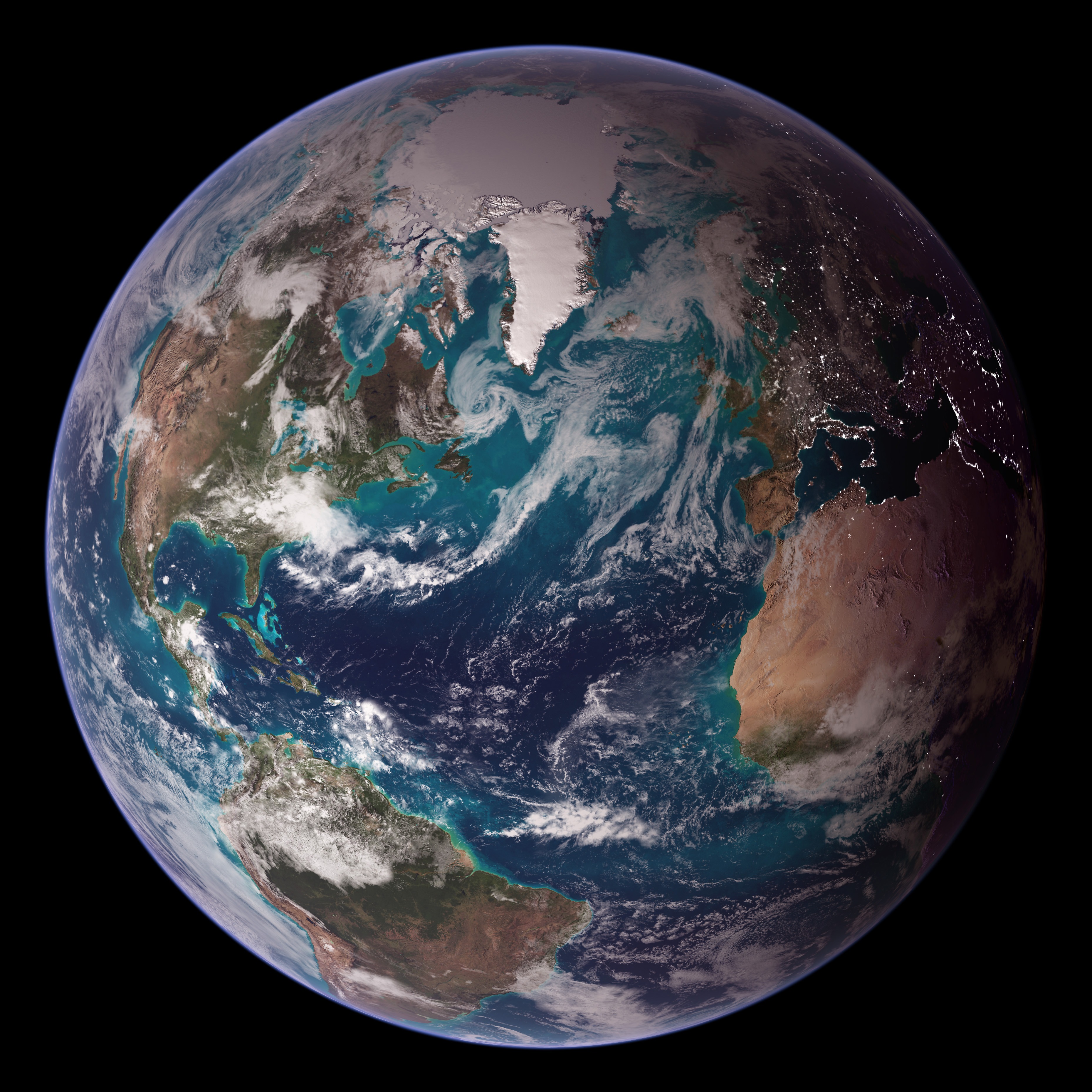
 The oceans pictured from space. (Photo: Nasa)
 If an alien civilisation arrived on Earth and dipped a probe into the ocean, what would it find?
“They would 100% detect that something unnatural is going on,” says Dr Jarmo-Charles Kalinski, a biochemist at Rhodes University. “These are chemicals where the origin isn’t in the natural environment.”
That simple thought experiment captures the unsettling thrust of a new global analysis of ocean chemistry: the seas now carry a clear chemical signature of human industry.
In a study drawing on more than 2,300 seawater samples from across the Atlantic, Pacific and Indian oceans, researchers found that human-made compounds – once thought of as trace pollutants – are now widespread and embedded within the ocean’s dissolved organic matter.
Put differently, these substances are no longer just contaminants drifting through the water. They are part of the water’s chemistry.
New way of seeing pollution
Kalinski is quick to temper the idea that this is entirely new. “Pollutants have been part of the ocean chemistry for a while,” he says. “But what’s changed is how we detect them – and the scale at which we can see them.”
Traditionally, scientists searched for a limited list of known chemicals – perhaps a dozen or two – using targeted methods. This study took a different approach. Instead of looking for specific compounds, researchers scanned for chemical “fingerprints” across entire datasets.

“That approach just hasn’t been applied at this scale before,” Kalinski explains. “So what we’re seeing now is a much broader picture.”
That picture is striking. Across ecosystems – from estuaries to coral reefs to the open ocean – industrial chemicals, pharmaceuticals and pesticides were consistently detected. Industrial compounds, in particular, proved the most pervasive, appearing far from shore and across multiple ocean basins.
/file/attachments/orphans/imagecopy_955456.jpg "Types of pollution found (Photo: Jarmo-Charles Kalinski)")
From rivers to open ocean
The study also sheds light on how these chemicals move.
“What we could see,” says Kalinski, “is that pollution decreases with distance from the coast.” Near river mouths and estuaries, concentrations are highest. Further offshore, levels drop – but do not disappear.
This pattern suggests a clear pathway: land to river to sea.
In estuarine zones, the study found particularly strong chemical signatures, reflecting inputs from urban wastewater, agriculture and industry. In contrast, the open ocean showed lower concentrations – but still detectable levels of industrial compounds.
Even remote regions were not untouched.
“What surprised me,” Kalinski says, “was the widespreadness – that we were able to find some in all datasets”.
Plastic’s invisible side
Much of the chemistry points back to plastics – but not in the way most people imagine.
Rather than floating bottles or visible debris, the study highlights what might be called the invisible phase of plastic pollution: the breakdown of materials into molecular fragments that dissolve into seawater.
/file/attachments/orphans/SpinnerdolphinsontheopenoceansGilesLaurentWikimediaCommons_800519.jpg "Spinner dolphins on the open oceans. (Photo: Giles Laurent, Wikimedia Commons)")
“If you take a piece of plastic,” Kalinski explains, “it breaks down into microplastics, then nanoplastics… and eventually into very small parts that are fully in solution.”
At that point, plastic is no longer a particle. It is chemistry.
Additives used in plastics – such as phthalates, glycols and flame retardants – were among the most widely detected compounds. These chemicals leach out over time, especially under sunlight and heat, and become part of the ocean’s dissolved organic matter.
“I mean, everything is chemicals, right?” Kalinski says. “Plastic will break down… and those components leach into the water over time.”
No pristine ocean?
Does this mean the idea of a “clean” ocean is obsolete?
“That’s what it seems like,” Kalinski says.
But he is careful not to overstate the case. The study does not measure absolute concentrations directly; instead, it detects signals – relative indicators of presence.
“All we know from this paper,” he says, “is there’s a substantial amount. It’s not negligible. But the exact percentage – we don’t know yet.”
Still, the scale is notable. In some coastal samples, anthropogenic compounds accounted for a significant portion of the detectable chemical signal, with the highest contributions observed near estuaries and shorelines.
/file/attachments/orphans/Don-AntarcticOcean-7_574572.jpg "The Antarctic Ocean – could it be far enough to avoid our pollutants? (Photo: Don Pinnock)")
Unknown long-term impact
One of the most striking aspects of the research is how much remains uncertain.
“How long do these molecules last?” Kalinski repeats. “That’s largely unknown.”
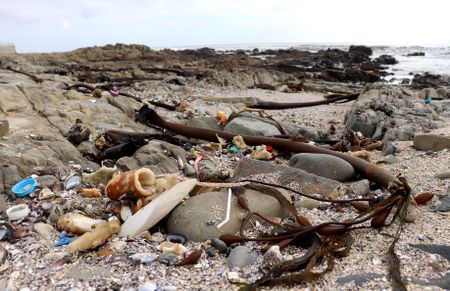
Some chemicals may break down within days or weeks. Others – like PFAS, often called “forever chemicals” – can persist for decades. Many fall somewhere in between, interacting with sunlight, microbes and ocean currents in ways scientists do not yet fully understand.
The ecological consequences are equally unclear.
“A lot of these compounds have biological activity,” he says. “They might interfere with microbes in the ocean… and that directly affects things like the carbon cycle.”
The ocean plays a central role in regulating Earth’s climate, absorbing carbon dioxide and supporting microscopic life such as phytoplankton. If that system is disrupted, the effects could ripple globally.
“But what the actual impact is,” Kalinski says, “that’s by and large unknown.”
/file/attachments/orphans/Don-AntarcticOcean-3_357103.jpg "Wandering albatross in the South Atlantic but<br>not out of harm’s way. (Photo: Don Pinnock)")
not out of harm’s way. (Photo: Don Pinnock)
What wasn’t seen
Perhaps as telling as what the study found is what it did not.
Certain classes of chemicals – especially PFAS – were not detected, not because they are absent, but because the analytical method used was not sensitive to them.
“I suspect they’re there,” Kalinski says. “We just weren’t able to see them.”
This points to a broader issue: the study is a snapshot, not a full accounting.
“We are definitely seeing just the tip of the iceberg,” he says.
Call for deeper monitoring
The researchers describe their work as a first step – a global scan that identifies what might need closer monitoring.
“What we’ve established now is essentially a suspect list,” Kalinski says. “Stuff that should be monitored properly.”
Future studies will aim to measure actual concentrations, expand geographic coverage and track how these chemicals behave over time.
For Kalinski, the urgency lies not in alarmism, but in understanding.
“When I started this project,” he says, “I was surprised at how little we actually know about the effect of pollution in the ocean.”
That, more than anything, is the story emerging from the data: not just that human chemistry has reached the deep ocean – but that science is only beginning to grasp what that means. DM