




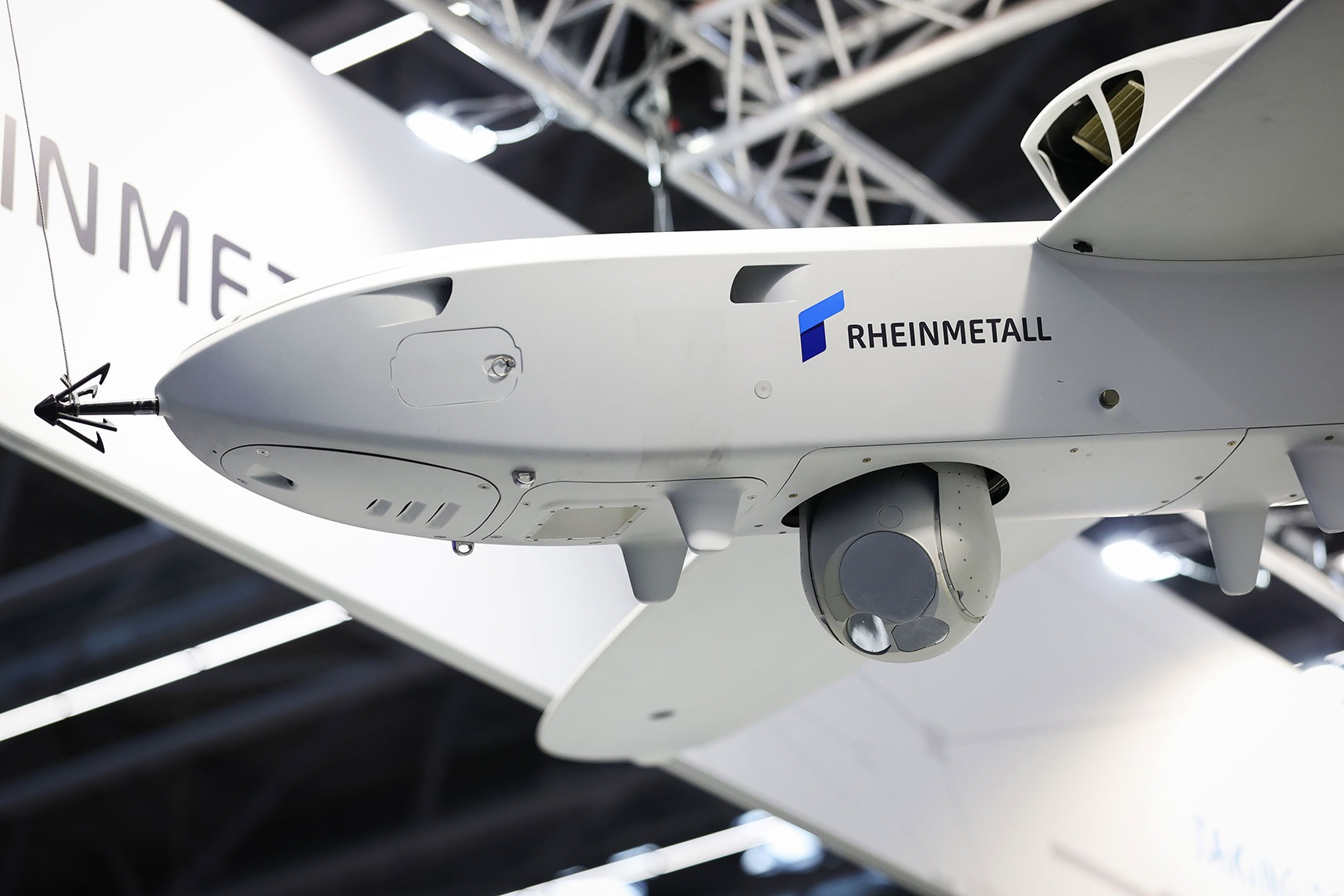
 The Luna NG, an unmanned surveillance and reconnaissance aerial vehicle and an uncrewed aircraft system drone hangs on display at the Rheinmetall stand at the XPONENTIAL Europe autonomous systems and robotics trade fair on 26 March 2026 in Dusseldorf, Germany. (Photo: Andreas Rentz / Getty Images)
 The eyes of the world may be on oil markets now, but corporate executives are still working hard to deliver their strategies in an environment of uncertainty and volatility. This is the benefit of having a strong balance sheet and a clearly articulated strategy – even when things get a little insane out there, the show can (and must) go on.
This week, we look at two JSE-listed companies that have announced acquisitions that make a lot of strategic sense.
RCL Foods throws shareholders a bone
RCL Foods announced the acquisition of Martin & Martin, the company that produces brands such as Husky, Pamper, Beeno and Bob Martin. With people spending an increasing amount on their pets, this is a strong growth area at your local grocery store.
RCL Foods specifically references the “humanisation of pets” – a clever way of describing how consumer spending has shifted favourably in this category. Although there are plenty of good reasons to be concerned about what this means for population demographics, there’s a clearly observable change in spending in the baby aisle versus the pet aisle.
Human birth rates are plummeting, while Fluffy is being given better-quality food and toys. In the FMCG (fast-moving consumer goods) space right now, you’re far better off investing in dog biscuits than in baby bottles.
The enterprise value for this deal is R695-million. We don’t have a fantastic level of detail on the underlying financials, with RCL only providing numbers for the year ended December 2024. This very outdated view is one of R75.2-million in Ebitda and R90.2-million in adjusted Ebitda. It’s difficult to judge without the 2025 numbers, but it seems they’ve paid a multiple that reflects the underlying growth potential.
Or, put simply, they’ve paid full price for this deal. To generate really good returns from it, they will need to maximise the opportunity in this space. Thankfully, they’ve bought some really strong underlying brands here, so they have every chance of doing so.
It’s a category two transaction, so shareholders won’t be asked to vote on it. I can’t see that they will be upset though, since this transaction feels like a sensible bolt-on acquisition for RCL Foods. It’s in a category that is clearly generating a lot of growth, with the added benefit of being in RCL Foods’ home market.
The share price is down 17% year-to-date, but this is primarily because of pressure in the sugar industry. Diversification away from the sugar industry – like through this transaction – will be welcomed by investors.
Sirius Real Estate: defence properties in Europe
What on earth is a “defence property”?
We aren’t talking about an army barracks here. In this context, these are private properties with commercial tenants who operate in the defence space. This also doesn’t mean that tanks are rolling off the lines. In the modern world, these companies are often in hi-tech industries with products that have application in the defence market.
So, what makes the properties so specialised then?
Interestingly, it’s as much about the location as anything else. For various strategic regions, there are particular areas in countries such as Germany that have a strong industrial base in the defence industry. For example, the latest deal by Sirius Real Estate is for a property in the city of Kiel, a maritime industrial defence and transport hub with easy access to the Baltic Sea.
And yes, in case you’re wondering, both Russia and Germany are on the Baltic Sea. It’s not hard to see why it matters to Germany to have a strong industrial base in Kiel.
This is part of the broader strategy at Sirius Real Estate: investing in the theme of Europe’s increased defence spending. Germany is just one of the European governments throwing an absolute fortune at the country’s defence capabilities in the wake of Donald Trump’s isolationist policies in the US.
This creates plenty of demand for properties in areas that are important to the defence industry. Aside from the benefits of hard currency earnings and high-quality tenants, focusing on this sector gives Sirius Real Estate exposure to a genuine growth area in Europe. And if you know anything about Europe, you’ll know that growth is hard to come by in the region.
The deal in Kiel is for a business park for about R1.82-billion (€93.4-million). The primary tenant is Rheinmetall, easily the most famous name in the German defence industry. Rheinmetall’s share price is up 2.5x since the start of 2025, with the market latching on to the story around Europe’s increased defence spending. Although it doesn’t affect Sirius at all, it’s perhaps worth mentioning that Rheinmetall is only up 16% in the past year in a very choppy market. To make the big money in that stock, you needed to get in early.
As for Sirius, they are quite happy to collect rent from Rheinmetall. Sitting further up in the value chain like this creates a far smoother return profile over time for investors.
The net initial yield on the transaction is 8.2%. Sirius will be collecting rent from Rheinmetall for at least the next four years. There’s some space to add more tenants, since the property is 98.5% occupied at present. With a small development on-site that is due to be completed in 2027, and a tenant already locked in with a 10-year lease, there’s further upside in this deal for Sirius.
This deal doesn’t have as many active management elements as some of the other transactions we’ve seen at Sirius. For example, the vacancy rate is often lower, or the development potential is higher. But it does make a world of sense in the context of their defence strategy, with some upside in the yield over time. DM