




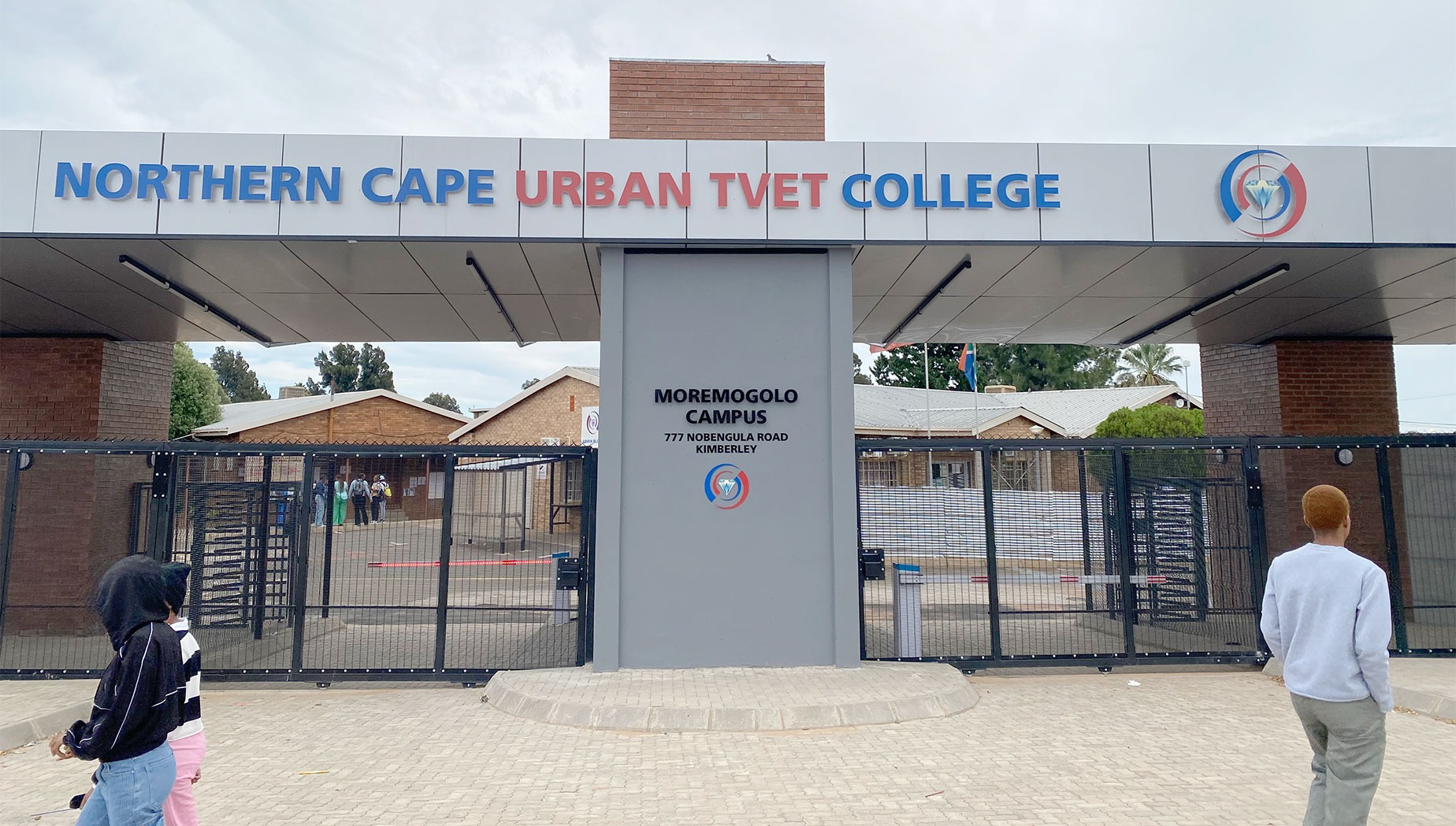
 Costly gates at the Northern Cape TVET Urban College, which have yet to be opened. (Photo: Siyabonga Goni)
 An investigation by the Platform to Protect Whistleblowers in Africa and Daily Maverick has revealed how students at the Northern Cape Urban TVET College have been forced to live in unsafe conditions because of alleged governance failures, systemic corruption and financial mismanagement.
The public education institution which is based in Kimberley comprises the City, Moremogolo, and Phatsimang campuses. It is mandated to provide vital accredited skills training, apprenticeships and learnership programmes.
But as far back as May 2022 the National Assembly’s Portfolio Committee on Higher Education, Science and Innovation, submitted a dossier detailing allegations of fraud and maladministration to Dr Juanita Beukes, chairperson of the Northern Cape Urban TVET College Council.
The dossier revealed a collapse in basic financial oversight at the college. Finance officials admitted to lacking the expertise to determine fair pricing, leaving the college vulnerable to inflated costs. Record-keeping was described as “severely compromised”, and a dangerous centralisation of power was identified as an inhibitor to accountability.
The committee noted a “visible lack of consistency” in applying policies, urging the college council to engage management on these discrepancies immediately.
On-site investigation
Recently over two days on 18 and 19 March Daily Maverick made a site visit to the three campuses. What it revealed was dilapidated housing conditions that posed significant risks to students’ health and safety. When questioned about these findings, Elgin Mokokong, the deputy principal for innovations, who is currently acting as principal despite a permanent principal being in place, said repairs were being carried out at the facilities.
Principal Brian Thamsanqa Madalane remains the substantive Principal of Northern Cape Urban TVET College and is currently serving in an acting capacity as Regional Manager (Northern and Western Cape).
Deputy director-general responsible for TVET colleges, Sam Zungu, told Daily Maverick that these arrangements were consistent with departmental deployment practices and do not constitute a vacancy in the principalship.
/file/attachments/orphans/photo1-1_872314.jpg "Northern Cape Urban TVET principal Brian Thamsanqa Madalane. (Photo: Northern Cape Urban TVET college website)")
The R11m entrances
The site visit also revealed disparities in infrastructure spending.
At the Moremogolo Campus, the college had spent R11,786,736 on two new entrances to be used by students and vehicles. Both were still under construction.
/file/attachments/orphans/Moremogolo-Campus-building-a-second-gate-for-delivery-vehiclescosting-taxpayers-money-while-main-gate-remains-closed-18-March-2026_288005.jpg "A second gate for delivery vehicles is under construction at the Moremogolo Campus, while the main gate remains closed. (Photo: Siyabonga Goni)")
Defending the expenditure, Mokokong said, “The college implemented its procurement processes ... and the Auditor-General did not raise findings on the procurement processes. The entrances are not yet in use due to the project not yet being completed, and the official handover has to be done.”
The deputy director-general responsible for TVET colleges, Sam Zungu, said: “The project was executed through council-approved procurement processes at a confirmed cost of R11,786,736. Importantly, no findings of irregularity or non-compliance were raised by the Auditor-General.”
In sharp contrast, at the Phatsimang Campus, one of the entrance gates is a rusted relic that remains open 24/7, presenting a significant security risk. Mokokong justified this by saying the gate was intended for “emergencies”.
/file/attachments/orphans/While-City-and-Moremogolo-Campus-have-expensive-gates-students-from-Phetsimang-are-forced-to-use-a-rsuted-gate-to-enter-and-exit-the-campus-19-March-2026-Credit-Mpilo-Mkhontshe_411925.jpg "The rusted entrance gate at the Phatsimang Campus. (Photo: Mpilo Mkhonza)")
At the City Campus, management spent R8-million on renovations, but despite this, buildings on the campus have cracks across walls, leaking ceilings and poor drainage.
/file/attachments/orphans/While-the-Acting-Principal-claims-that-R8-million-was-spent-on-renovations-cracks-are-visible-inside-the-City-Campus-College-18-March-2026_544397.jpg "Mildew on a leaking ceiling at the City Campus. (Photo: Siyabonga Goni)")
/file/attachments/orphans/Water-pipes-remain-covered-with-black-plastics-while-the-College-said-R8-million-was-spent-on-renovations-18-March-2026_220612.jpg "Makeshift repairs to infrastructure at the City Campus. (Photo: Siyabonga Goni)")
In response Mokokong said, “The college had procured the services for repairs and renovations to existing buildings at City Campus. This did not only include painting, but repairs of ablution facilities, including those for persons with special needs.
“Classrooms were painted, floors repaired, windows repaired, tiling installed, etc. It must be noted that all works were specified, quantified and approved by a professional quantity surveyor, who was the project manager on the project.”
Students left in the cold
While millions were used to build gates, the Daily Maverick site visit showed how students on campus are facing a severe housing crisis.
Nowhere is this neglect more visible than at the Phatsimang Campus, where a hostel remains a derelict “ghost town” despite a R5-million renovation contract awarded back in 2019. Inside the abandoned blocks, the scene is grim: dust blankets broken stoves, mattresses rot against water-damaged walls, and toilets are clogged with filth and cobwebs.
/file/attachments/orphans/Inside-the-Phetsimang-Hostel-Campus-where-units-remain-closed-due-to-poor-infrustracture-and-are-dirty-18-March-2026_574074.jpg "The interior of the derelict hostel on the Phatsimang Campus. (Photo: Siyabonga Goni)")
Mokokong admitted that the hostel was “uninhabitable” and “a threat to human life”. Consequently, students are forced to live at the nearby Phomolong informal settlement, where they pay exorbitant rents for shacks.
Mpilo Mkhonza, a Business Management student from KwaZulu-Natal, described his struggle: “I am renting [a shack] here, paying R1,600. Where I live, if it is hot, it is hot inside; if it’s cold, it’s also cold [inside]. Since I arrived, the hostel has never been used. If I were staying on campus, things would have been better and safer.”
/file/attachments/orphans/Mpilo-Mkhonste-a-Business-Management-student-from-NC-urban-Tvet-college-is-renting-a-R1600-shack-saying-it-is-difficult-to-live-in-a-shack-18-March-2026_726883.jpg "Mpilo Mkhonza inside the shack that he rents for R1,600 a month. (Photo: Siyabonga Goni)")
/file/attachments/orphans/Student-from-Phetsimang-College-Mpilo-Mkhontse-uses-an-unsafe-toilet-despite-paying-R1600-while-campus-housing-remains-closed-18-March-2026_719432.jpg "The toilet at Mpilo Mkhonza’s shack. (Photo: Siyabonga Goni)")
The state of the derelict hostel even made it to Parliament where Higher Education and Training Portfolio Committee member, Delmaine Christians asked the former higher education minister, Nobuhle Nkabane, why the building remained closed for five years despite a R5-million renovation tender.
“The college undertook renovations of several hostel blocks,” replied Nkabane. “Upon inspection, management and the college council determined that these facilities were not fit for habitation and that accommodating students in these hostels would pose a significant safety risk.
“Consequently, it was agreed that student occupation would not commence until all units were rendered habitable. Certain units could not be renovated immediately due to limited financial resources.”
Whistleblowers alleged that a cafeteria at the Phatsimang Campus was turned into a classroom, which Mokokong denied. “Phatsimang does not have a cafeteria as yet,” she said. During Daily Maverick’s site visit, it was apparent that the classroom in question was a different size to others on campus.
/file/attachments/orphans/Phetsimang-Campus-has-turned-what-was-alleged-to-be-a-cafeteria-into-a-classroom-due-to-limited-classrooms-18-March-2026_128727.jpg "The classroom was a different size from the others on the campus. (Photo: Siyabonga Goni)")
Empty tanks and generators
The mismanagement appears to extend to basic utilities. While the college installed large pressed-steel sectional water tanks for industrial-scale storage, they have reportedly been empty for months. Students at Phatsimang must rely on three small JoJo tanks for their water supply.
/file/attachments/orphans/IMG_0008_687077.jpg "Metal water tanks at the three campuses remain empty. (Photo: Siyabonga Goni)<br>")
Mokokong attributed the failure to commission the steel tanks to the unexpected discovery of asbestos piping. “This work is ongoing as it demands more financial resources and expertise,” she said.
Energy security at the college is equally precarious. Documents show the college spent nearly R500,000 on generators and solar panels. Yet, whistleblowers report that when the grid goes down, the campus remains in darkness.
/file/attachments/orphans/Expensive-generator-installed-at-City-Campus-protected-by-sheds-and-fence-Whistleblowers-say-the-generators-has-never-been-used-18-March-2026_237406.jpg "Steel bars protect a generator at City Campus, which whistleblowers say has never been used. (Photo: Siyabonga Goni)")
While Mokokong maintains the solar panels are “functional and assisting the college in reducing the electricity bill”, the Phatsimang Campus manager, Lynette Pietersen, confirmed a recent total blackout, stating, “They did inform me that there was no electricity on campus.”
Future in the balance
As the college pushes back the renovation of student residences to 2026/2027, the future of its students hangs in balance. With millions sunk into incomplete infrastructure while students live in shacks, whistleblowers are calling for urgent national intervention to rescue the institution from a total collapse of governance. DM