
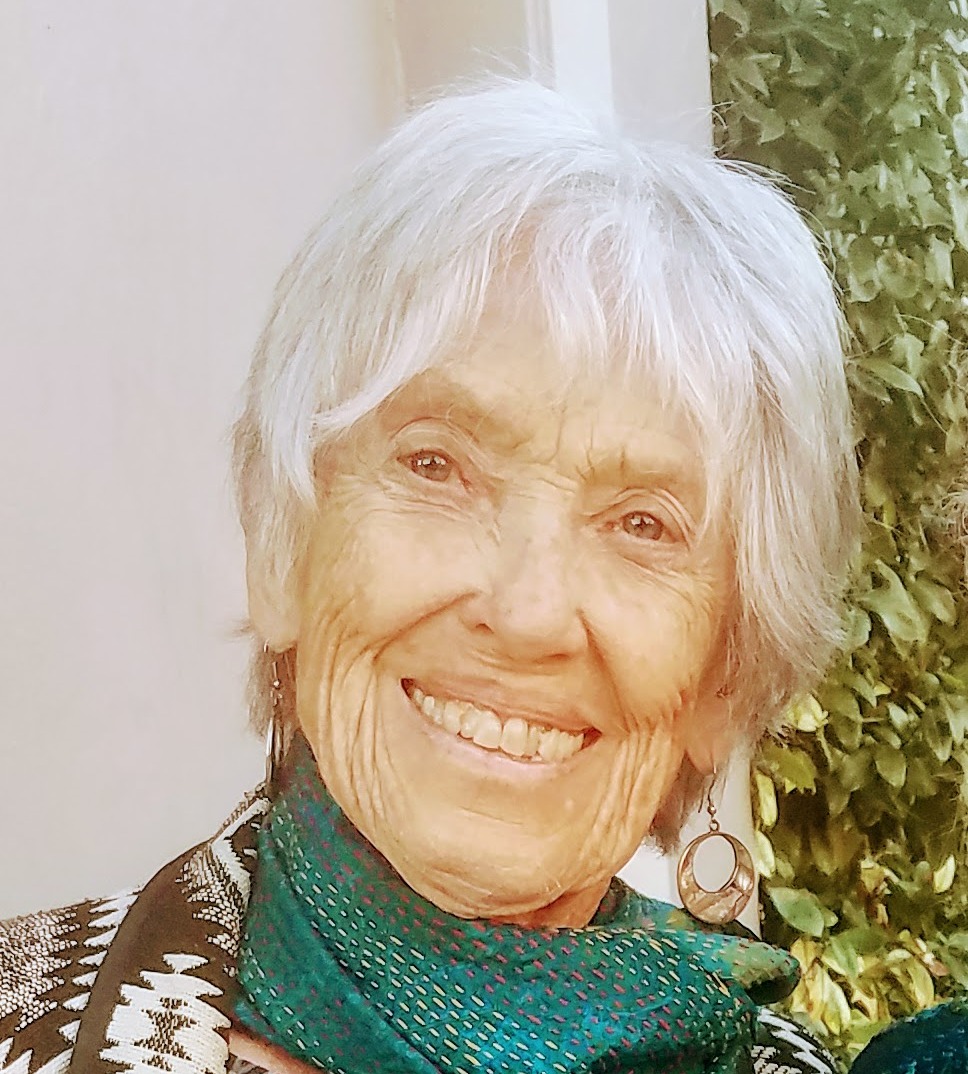
 The late eco-philosopher Joanna Macy. (Photo: Work That Connects website)
 These days, climate graphs look like fever charts, extinction rates read like obituaries and the daily news has the emotional texture of a storm that never clears. Across the world, people working closest to the fractures – scientists, conservationists, journalists, activists – are discovering a shared, disorienting truth: it’s not just ecosystems that are unravelling. Our emotional worlds are too.
Long before climate grief became a recognised phrase, Joanna Macy was already sitting with people inside that pain. She didn’t rush to fix it. She didn’t offer distraction or denial. Instead, she did something both radical and oddly practical: she treated grief for the Earth as evidence of love, and love as a renewable energy source.
To hear two of her closest collaborators, Constance Washburn and Molly Brown, describe it, Macy’s life work was less about solving the climate crisis and more about cultivating the emotional resilience required to face it without going numb. Her work was an invitation into what she called “the work that reconnects”, a way of seeing ourselves as stitched into the fabric of a living, breathing Earth.
“People come in already carrying grief,” Washburn says. “What they don’t have is permission to feel it. Once they realise their grief isn’t pathological, that it’s relational, it changes everything.”
This realisation is revolutionary. In a world that prefers productivity to vulnerability, grief can feel like a malfunction. You’re supposed to “stay positive”, keep going, keep posting solutions, keep raising funds. But in the conservation community especially, burnout has become almost endemic. People who care deeply are discovering that caring hurts.
Restoration of agency
Brown, an eco-psychologist based in northern California who began working with Macy in 1990, says the turning point for many participants in this work comes when they discover they are not alone in their despair.
“There’s this enormous relief,” she explains. “You sit in a circle and realise the anger, the sorrow, the fear – they are shared. That shared recognition restores agency. You’re no longer isolated with your feelings. You’re part of a community that can hold them.”
This restoration of agency may be one of the most urgently needed medicines of our time. Climate change, biodiversity collapse and social fragmentation all carry a particular emotional weight: they’re global problems with no single hero. The scale alone can induce paralysis.
/file/attachments/2990/gpbl-G3pRyhFX2DY-unsplash-1024x768_504759.jpg)
“Western culture has trained us to think we, as individuals, have to save the world,” Brown says. “That’s impossible. And when people realise they can’t, they shut down.
“Joanna helped people see themselves as participants in a much larger web of life. You do your part. Trees do theirs. Microbes do theirs. That’s how resilience works.”
Washburn lives in California’s Bay Area and came to Macy through a background in environmental activism, Buddhism and theatre. Through Macy, she realised that grief need not be avoided, but could be expressed creatively and communally.
“I’d always been asking how to change hearts, not just policies,” she recalls. “Science alone wasn’t stopping destruction. We needed to reach people at the level of emotion.”
This emotional honesty lies at the heart of what Macy called “sustaining the gaze” – the willingness to look directly at ecological collapse without turning away. It sounds simple. In practice, it is one of the hardest disciplines imaginable.
“We’re conditioned to look away,” says Washburn. “But when we do, the fear doesn’t disappear. It just goes underground. Sustaining the gaze means facing what’s happening while staying connected to others. That’s what keeps despair from becoming incapacitating.”
There’s a paradox here: by making space for grief, people often discover renewed vitality. Brown has seen it happen repeatedly. Participants arrive weighed down by dread, but when given structured ways to express their feelings – through open-ended reflections, ritualised practices, shared storytelling – they leave energised.
“It’s because grief is a reflection of love,” Washburn explains. “When you allow it, you reconnect with what matters most. And from there comes the question: what is mine to do?”
This question has no universal answer. For some, it leads to activism. For others, it means tending local ecosystems, supporting community resilience, teaching children or caring for family members. Macy never prescribed specific actions. She trusted that when people reconnected with their sense of belonging to the Earth, their next steps would emerge naturally.
Hope, in this framework, is not optimism. Macy made a clear distinction between passive hope – the wish that things will turn out well – and what she called active hope: the decision to participate in creating the future you desire, even without guarantees.
“She would say uncertainty isn’t an excuse for inaction,” Brown recalls. “It’s where courage lives. We don’t know what our actions will lead to, but that doesn’t mean they don’t matter.”
This perspective feels particularly relevant in today’s environmental discourse, where headlines often swing between catastrophe and false reassurance. Many activists have grown wary of narratives that package hope as a marketing tool. Macy offered something sturdier: the capacity to act without certainty.
Her influence came not only from what she taught, but how she embodied it. Both Washburn and Brown remember her as intensely present. Conversations with her felt like stepping into a field of hyperfocused attention. She was known to stop mid-walk to marvel at a flower or study how a plant reached for sunlight. This sense of wonder wasn’t escapism; it was nourishment.
“She lived in curiosity,” Washburn says. “She could hold awareness of global crises while still being amazed by small details of life. That balance kept her grounded.”
Humour played a crucial role too. Environmental work can easily become heavy, but Macy had a theatrical flair that brought levity into serious spaces. Brown remembers her commanding large audiences with dramatic presence – never ego-driven, always in service of the message. Laughter wasn’t a distraction, it was a reminder of humility.
“She understood we’re part of something much larger than ourselves,” Brown says. “That perspective allows for humour. It keeps despair from becoming self-absorbed.”
In the context of biodiversity loss, this humility carries special weight. Species extinction is often framed statistically, but Macy encouraged people to experience it relationally. The disappearance of a species is not just data – it’s the loss of a unique expression of life. Feeling that loss is part of honouring interconnection.
Washburn situated this awareness within deep time. Humanity is one chapter in a much longer evolutionary story. Life on Earth has endured mass extinctions before. Although this knowledge does not diminish responsibility, it does place human action within a broader context.
“We’re participants, not controllers,” she says. “Our role is to nurture the life around us and trust that larger processes are unfolding beyond our understanding.”
A rational response to relational loss
For people concerned about our unravelling environment, Macy’s legacy offers a powerful reframing. Climate grief is not a weakness to overcome; it is evidence of belonging. Biodiversity sorrow is not sentimental; it is a rational response to relational loss.
When people are given tools to process these emotions collectively, they often discover renewed capacity for engagement. The shift from isolation to solidarity changes everything. Brown sees this repeatedly in group settings. Practices as simple as completing an open sentence – “When I look at the world, I feel…” – can unlock insights people didn’t know they were carrying. The process is experiential, not intellectual. It brings emotion and action back into alignment.
Suppressing grief doesn’t make it disappear. It resurfaces as burnout, cynicism or apathy. Integrating grief transforms it into fuel for compassionate engagement.
Perhaps the question Macy most often posed remains the most relevant now: what brings you alive? In a time when environmental discourse is saturated with urgency, this question can feel almost subversive. Yet aliveness is precisely what sustains long-term commitment. Without it, activism becomes obligation rather than inspiration.
Washburn describes Macy as a cheerleader for human creativity. She delighted in people’s projects – restoration efforts, community gardens, educational programmes – not because they promised immediate solutions, but because they represented life responding to crisis with imagination.
To be alive in this moment, Macy believed, means allowing yourself to feel both the beauty and the pain of the world. Stuffing grief leads to illness – personal and cultural. Feeling it reconnects us with purpose.
Joanna Macy died in July 2025, but her influence continues to ripple through environmental communities worldwide. Her work offers no easy answers to ecological collapse. Instead, it provides a way to remain emotionally present, relationally connected and creatively engaged.
As Brown reflects, life itself has always responded to adversity with adaptation, and humans are part of this continuing process. Our responsibility is not to control outcomes, but to participate with courage.
If climate grief knocks on the door again – and it will – perhaps the most ecological response is not to barricade ourselves against it. Perhaps it is to open the door, welcome it in and ask the question Macy so often posed: what are you here to teach us about how deeply we belong? DM
/file/attachments/2989/NOtesfromasmallfinal_693776.jpg)
This story first appeared in our weekly DM168 newspaper, available countrywide for R35.
/file/attachments/2990/DM-02042026_907319.jpg)