




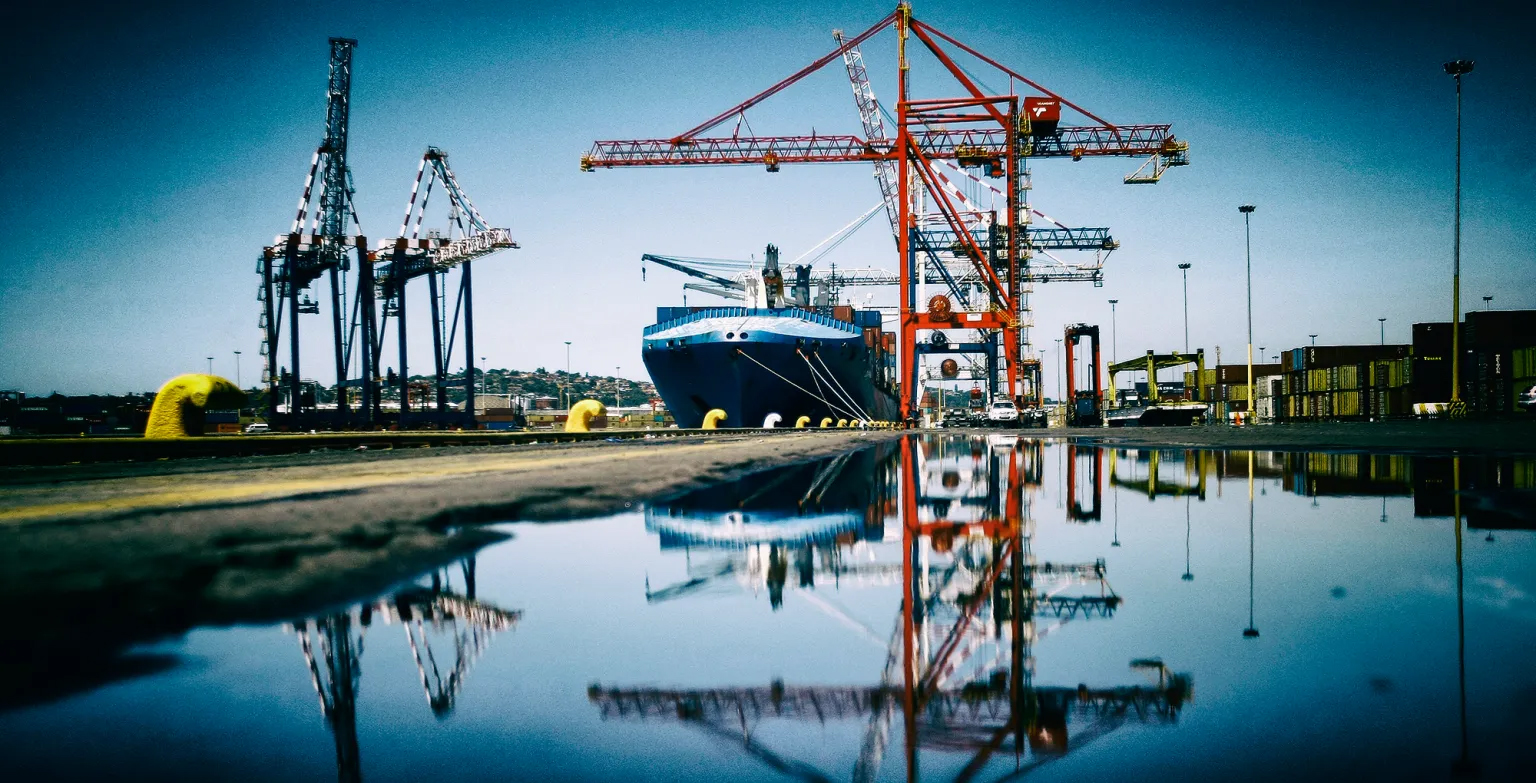
 Gantry cranes above a container ship in the terminal at the Port of Durban. (Photo: Kevin Sutherland / Bloomberg via Getty Images)
 /file/dailymaverick/wp-content/uploads/2025/10/label-Op-Ed.jpg)
Global trade is under assault by populist-inspired protectionism. Tariffs are US President Donald Trump’s weapon of choice in this attack. As a result, the world is seemingly deglobalising. At least this is how the mass media tells it. Intended or not, deglobalisation conjures up the 1930s, which ushered in the Great Depression, and the global conflagration of World War 2. It is a very scary prospect.
The global economy is indeed in a profound transition. But deglobalisation it is not. The unpredictable trade actions of the US have been described by academic MSS Namaki as “reclusive and isolationist”. What is incorrectly labelled “deglobalisation” can be more accurately termed “globalisation minus one”. There is a belief in failed globalism from which the laissez-faire opening of economies to free trade has led to severe economic disruption as well as the resultant social costs.
The rules-based system that governed global trade, which evolved from Bretton Woods, has been steadily weakened over the past few decades. Yes, the World Trade Organization’s (WTO) repeated attempts to advance global free trade have also failed. And yes, a turning point has unmistakably arrived, catalysed by Trump’s “Liberation Day” tariffs. But it is not a turning point to deglobalise. Instead, the global economy is turning toward reglobalisation, but within a far more complex, multipolar system.
In this multipolar world, the US is no longer the unipolar power. New “poles” have emerged, including China, Europe and a few loose groupings in the Global South. Global trade is increasingly organised through regional and bilateral agreements that no longer adhere to rules that were meant to be universal. According to the WTO, the number of regional and bilateral trade agreements increased from 291 in 2017 to 375 in 2025. Simply put, the principle of multilateralism, anchored in more stable shared values, is being replaced by constantly evolving shared interests.
However, there are no signs that global trade is in retreat. Data from the UN show that global trade grew from $24-trillion to $33-trillion between 2014 and 2024. The IMF projects that global trade will continue to grow by 30% to 40%, reaching between $42-trillion and $45-trillion by 2035. However, the pattern and direction of global trade in this new multipolar world will change significantly in the coming decade. As China has fundamentally changed the global economy this century, it will continue to be the key driver of change.
It is easy to see China only as a relentless export machine, which it certainly is. However, its role in the multipolar world is also complex and multifaceted. China is now one of the world’s biggest bankers and investors. According to China’s State Council, the country’s foreign direct investment (FDI) rose from $120-billion in 2015 to $200-billion in 2024, a 64% increase. While China’s Belt and Road Initiative (BRI) has captured the media’s attention, total BRI-related capital flows account for less than 20% of China’s total overseas investment – relatively little to the developing world. About 57% of China’s FDI actually went to middle-income emerging markets (International Development Lab). A large chunk of this investment has gone to Southeast Asia, supported by the Chinese diaspora in the region. For example, according to OCBC Global Market Research, six countries in the Association of Southeast Asian Nations received $266-billion of Chinese FDI in 2024, up from $190-billion in 2022. More significantly, rising Chinese FDI is tightly correlated with its growing trade with the region.
As China began to emerge as an economic competitor (in low-end manufacturing) in the mid-1990s, many countries in the region warned of the economic threat it posed. Singapore’s prime minister at the time, Goh Chok Tong, frequently spoke of both the opportunity as well as the challenge that China posed. He remarked in 2005 that Singapore has to “reposition and reinvent itself to stay competitive in higher-value products and complex manufacturing”. But the region has been adept at increasing its own competitiveness through embracing and embedding Chinese capital into its own economies.
Vietnam and Malaysia are such examples. By 2024, the stock of Chinese FDI in Vietnam reached $31-billion, and more than half of Vietnam’s imports were from China, mostly in electrical components, machinery and auto parts, which simultaneously boosted Vietnam’s export capacity and accelerated its industrialisation, propelling Vietnam to the fastest-growing economy in Asia. At a higher level of income and technological sophistication, Malaysia attracted Chinese investment in hi-tech manufacturing and research and development, which turbo-charged Malaysian exports and helped turn the Malaysian state of Penang into the Silicon Valley of Southeast Asia. Asia has become a major industrial and trading bloc, with China at its centre.
In the new multipolar world, China’s strong exports have also led it to use investment as a pre-emptive strategy. It invests in markets where its exports outcompete local producers, both to build supply chains close to the market and to create jobs locally to placate disgruntled politicians. In Europe, for example, Hungary, Poland and Germany have become major recipients of Chinese investment in the wake of growing Chinese exports to these markets.
While Africa is a minor player in global trade, African economies are at risk of further marginalisation as a result of these macro trends. Small market size, economic fragmentation and lack of connected infrastructure are all challenges that need to be addressed. But the opportunity for Africa to establish its own “pole” in the new multipolar world is also immense.
The Africa Continental Free Trade Area (ACFTA) is perhaps the most ambitious free trade project since the WTO itself. It is envisioned that, by reducing trade barriers, the economic prospects of a continent of more than 1.3 billion people with a combined GDP of $2.5-trillion – almost identical to India’s – will be boosted. It has been calculated that if Africa were to increase its share of global trade from 2% to 3%, the one-percentage-point increase would generate about $70-billion in additional income per annum for the continent.
In the new multipolar world, African countries can do little to counter unilateral trade actions, but they can embrace a self-supportive regionalism through ramping up intra-African trade as intended by ACFTA. Rising intra-regional trade will, in turn, attract more FDI inflows, establishing the region as a major investment destination. There has been significant interest from both emerging and developed markets in Africa in recent years – Brazil, China, India, Indonesia, Korea, Malaysia, Morocco, Singapore and Turkey have all been among the protagonists. These have been driven both geopolitically and commercially. But, for their part, African countries have yet to demonstrate convincingly that they can truly compete for investment in the multipolar world.
China as an investor can potentially move the dial for Africa. While it already is Africa’s largest trading partner, its investment in the continent, relative to other regions, remains low, despite Africa’s strategic potential for Beijing. For instance, China’s FDI stock in South Africa is about $13-billion, a mere 15% of Singapore’s, 42% of Vietnam’s and 62.5% of Malaysia’s. South Africa should be able to attract many multiples of this amount. Thus far, despite China’s expanding presence in Africa, the two countries’ interests have only intersected but have not been fully leveraged. Many projects are politically driven without a solid commercial foundation. More importantly, Chinese FDI in South Africa has yet to fully leverage South Africa’s strategic position on the continent. It is hard to identify a single collaborative project between China and South Africa that operates at a continental level. This is unfortunate. The reality is that most African countries lack the market size, corporate clout and managerial capacity to bring the region together as one of the poles in the new multipolar world. Only South Africa is in a position to strategically craft a new geo-economic paradigm for the region. But, to date, South Africa’s politics and ideology have distracted attention and obscured the opportunity.
Recognising the opportunity is one side of the coin. The other side is to recognise how far South Africa has fallen behind other emerging regions, such as Southeast Asia and the Gulf Cooperation Council, which have been powered by Chinese trade and investment. Bringing these two sides of the coin together is an urgent call to action.
Through pragmatic, results-focused policy reforms, a rejuvenated South Africa could begin to recapture the confidence of global capital. Deep structural reforms, including better public-sector performance, improved logistics infrastructure and a more coherent and pro-active stance on consolidating the regional African markets, are needed. If these are set in motion, South Africa could, in a relatively short period, become an enabling hub for Chinese, emerging and Western companies to establish their regional headquarters and to build supply chains to serve their expansions into a large, expanding and increasingly integrated pan-African economy. In this regard, a partnership between China and South Africa can be built on the basis of strong shared interests: China’s ambition to expand trade and investment in Africa, and South Africa’s ambition to leverage Chinese trade and investment to turbocharge its own economic growth. South Africa today has a rare opportunity to succeed by playing a leading role in enabling Africa, and thereby itself, to succeed in the multipolar world. DM
Dr Martyn Davies is a former head of emerging markets in a Big Four strategy and advisory practice and a member of the World Economic Forum’s Global Agenda Council on China. Dr Yuwa Hedrick-Wong is chief economic adviser at the Southern Capital Group.