
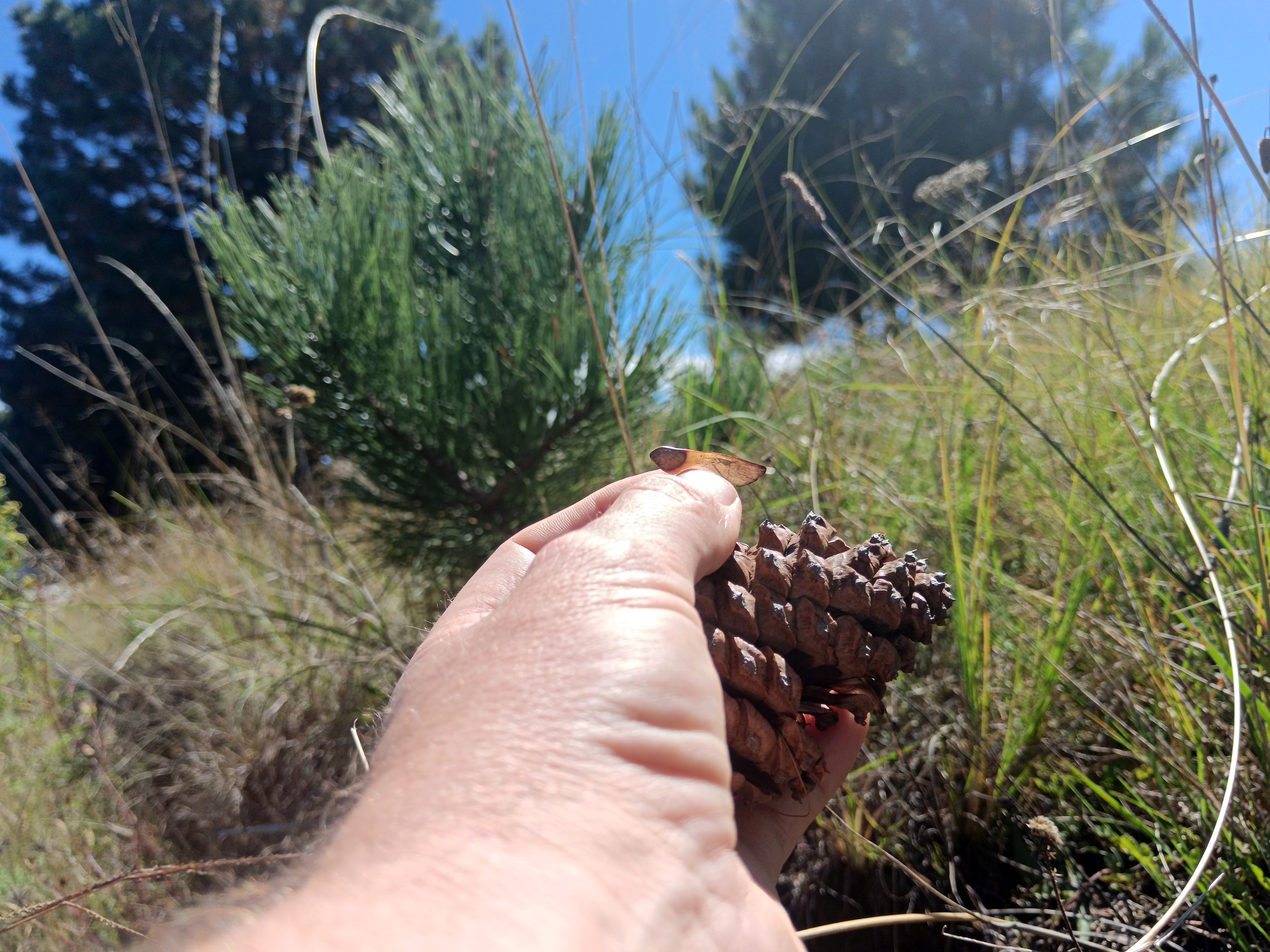
 The cone pine (Pinus pianister) is one of the most aggressive invaders in the Western Cape. (Photo: Supplied)
 If the Western Cape were showing signs of illness, it spiked a fever in 2017.
Fuelling this were the thirsty, highly flammable weedy pine trees which, in the roughly 15 years leading up to the disastrous 2017 Knysna fires and Cape Town’s looming Day Zero, had increased their footprint in the province by a third. This dramatic growth was in spite of millions spent on cutting and clearing the trees to restore the landscape.
At the same time, a treatment that could have dramatically slowed the infection had been sitting in mothballs. This, however, is about to change.
Industry insiders are calling it a groundbreaking development – scientific consensus has been reached on its safety. Conservationists, researchers and pine growers agree that it’s time to release the treatment – a weevil from a corner of the Iberian Peninsula in Portugal – into the Cape’s pine-invaded landscapes to slow the spread of this fire-prone, thirsty invader.
/file/attachments/orphans/insect-identification-weevil-lg_558907.jpg "Conservationists, researchers and pine growers agree that it’s time to release a weevil from a corner of the Iberian Peninsula in Portugal into the Cape’s pine-invaded landscapes. (Photo: Wikipedia)")
The weevil they have in mind as a biological control agent may be to the problematic cluster pine what penicillin was as an antibiotic a century ago. A small dose – little more than 20 pairs of adult weevils, released per treatment into heavily invaded parts of the province – could, in coming decades, establish themselves enough that they stabilise or even dramatically reduce the environmental pollution caused by these pines.
But while these stakeholders have broken a 15-year deadlock on concerns about its safety and are gearing up to get the necessary permits to release this novel biological control agent, the government is the one party missing in action. State funding cuts and changes in budget priorities for critical ecosystem restoration work continue to hold back research and innovation in this area.
/file/attachments/orphans/941876090_157051.jpg "In the roughly 15 years leading up to Cape Town’s Day Zero crisis in 2018, when Theewaterskloof Dam was at 10% capacity, weedy pines increased their footprint in the province by a third. (Photo: John Snelling / Gallo Images)<br>")
Invasive plant management sidelined
Daily Maverick reported last year on funding cuts to the Working for Water (WfW) initiative, which had, for the previous three decades, prioritised government funding to restore the country’s imperilled water catchments through grassland, wetland and river recovery efforts.
The initiative has been funded by the Department of Forestry, Fisheries and the Environment (DFFE), and its predecessors. Some of the WfW funding has gone towards research and implementation of biological control agents, which are regarded by many as the most viable and sustainable way to reduce the spread of invasive species in the longterm.
/file/attachments/orphans/Map7pinedistributionmapGrantMartin_889769.jpg "Since the first non-native trees were planted in the Cape in the late 1600s to meet the timber
<br>shortfall, many of these have become aggressive self-seeding weeds.
<br>Invasive plants use roughly 20 percent more water than the indigenous fynbos vegetation and dial
<br>up the intensity of wildfires dramatically. Number crunching in the aftermath of the Day Zero crisis
<br>found that forestry plantations and wild-growing alien trees in Cape Town’s main water catchments
<br>were using the equivalent of two months’ supply of city water every year , according to the Council
<br>for Scientific and Industrial Research (CSIR) and resource economists at the University of Cape
<br>Town’s Environmental Policy Research Unit 39. (EPRU).")
shortfall, many of these have become aggressive self-seeding weeds.
Invasive plants use roughly 20 percent more water than the indigenous fynbos vegetation and dial
up the intensity of wildfires dramatically. Number crunching in the aftermath of the Day Zero crisis
found that forestry plantations and wild-growing alien trees in Cape Town’s main water catchments
were using the equivalent of two months’ supply of city water every year , according to the Council
for Scientific and Industrial Research (CSIR) and resource economists at the University of Cape
Town’s Environmental Policy Research Unit 39. (EPRU).
The DFFE maintains that its budget cuts to WfW and related biocontrol work, which happened under minister Barbara Creecy in 2020, was in response to post-Covid budget belt-tightening by the Treasury.
The department’s financial records tell a different story, though. As Daily Maverick reported, this was a change in spending priorities under the Creecy administration, rather than a shortage of cash. The total budget for the DFFE’s environmental programmes, from which WfW draws its money, remained relatively constant from 2020 to 2024 – R2.6-billion for 2020/21 and 2021/22, R3.2-billion for 2022/23 and R2.9-billion for 2023/24 – but WfW saw a 78% decrease in its funding.
The Centre for Biological Control (CBC) reported being hit hard by this shift in budgeting priorities. The research group – headquartered at Rhodes University, with affiliate organisations at various universities – can no longer look for and test new biocontrol agents, run mass-rearing facilities, manage the agents’ release or monitor effectiveness.
The CBC’s work continues to be hamstrung by these ongoing cuts, according to its director Professor Martin Hill, who has asked to meet with the ministry to discuss the matter.
“We have (also) put forward a proposal to DFFE to mass-rear biological control agents,” says Hill. “We’re pushing, but nothing yet. The take-home message is that there is no funding from DFFE.”
/file/attachments/orphans/Pic8conesAlainRoquescopy_224109.jpg "Biocontrol agents are natural pests and diseases from the home country of an invading species
<br>that are collected and tested here for safety, before being released into an invaded area to control
<br>the spread of the target weed. (Photo: Alain Roques)")
that are collected and tested here for safety, before being released into an invaded area to control
the spread of the target weed. (Photo: Alain Roques)
The Agricultural Research Council (ARC) also does biocontrol research on certain weedy species. But funding shortfalls are reportedly also holding back studies on the cone weevil in its Plant Protection Research Institute. Neither the ARC nor the Department of Agriculture (DoA) responded to repeated requests for clarity on whether there are funds available for cone weevil research, or how the budget is prioritised for biocontrol studies.
DFFE confirmed that the new minister, Willie Aucamp, will not revisit this budget allocation, although the department recognises the impact it has had on the biocontrol sector.
This has left CBC researchers passing the hat around in the hope of raising enough funds for the next steps: last-round screening, collecting adult weevils from their native territory in Portugal, rearing them here in South Africa, and releasing them at targeted sites across the Cape.
The non-profit The Nature Conservancy (TNC), which prioritises water catchment restoration as part of its mandate in the Cape, has worked closely with the CBC to advance this biocontrol solution and invested considerably in recent research.
/file/attachments/orphans/Pic6pinechopperflightsuppliedbyNGObutapparentlyorginalyfromRueters_MikeHudkins_180661.jpg "As long as pines remain, they will continue to sow their polluting seeds. The only way to clear the
<br>highest peaks of the Cape Fold Mountains is to fly in skilled teams to tackle them by hand. This is
<br>extremely dangerous and expensive. CBC researchers hope one day to fly weevils in with drones,
<br>airdropping them over otherwise unreachable pine infestations. (Photo: Supplied NGO)")
highest peaks of the Cape Fold Mountains is to fly in skilled teams to tackle them by hand. This is
extremely dangerous and expensive. CBC researchers hope one day to fly weevils in with drones,
airdropping them over otherwise unreachable pine infestations. (Photo: Supplied NGO)
Associate Professor Grant Martin, who is leading the CBC’s weevil research along with Dr Kim Canavan, says a few private donors have contributed to the pot.
Delays will continue for another four years, however, even if funding shortfalls are resolved. But stakeholders are confident that the permitting application to the DoA will succeed.
Breaking the deadlock
They call it the pine pitch disease, or the wilting canker, and Fusarium circinatum is a nasty piece of work if you’re a forester. It’s also the reason that weevil biocontrol research got shelved in 2010.
/file/attachments/orphans/Pic6bpineseed_755676.jpg "The cone pine (Pinus pianister) is one of the most aggressive invaders in the Western Cape. (Photo: Supplied)")
As far back as the 1970s, researchers had identified the Iberian weevil as a likely treatment for cone pine invasions.
The insect can only complete its life cycle inside a pine’s cone. It also prefers the cone pine to other species, and will only grudgingly go for the stone and Aleppo pines (Pinus pinea and Pinus halepensis), both of which are invaders in the Cape.
“Just one larva causes enough damage to prevent a cone from opening and releasing its seeds,” says Martin. “A female weevil can lay multiple eggs per cone and across numerous cones per tree.”
This dramatically reduces each tree’s chances of self-seeding, while leaving the rest of the tree relatively unscathed, meaning it’s not a threat to farmed pines and other species.
/file/attachments/orphans/Pic2clearinggeneric_641200.jpg "In spite of millions spent over decades to clear thirsty invasive trees using mechanical and chemical clearing, invasive pines have increased their footprint in the province by a third since
<br>2008. (Photo: Supplied)")
2008. (Photo: Supplied)
Researchers were making good headway on testing the agent for safety when an outbreak of the virulent wilting canker fungus hit plantations in the 1990s. The silviculture community balked.
“The fungus disrupts the cell structures and flow of nutrients and moisture up and down the tree,” explains Dr Ronald Heath, director of research and protection at industry body Forestry South Africa (FSA). “It’s a really nasty fungus.”
Foresters were worried that if the weevil were released and established itself, it might carry the lethal fungus between populations. Lab experiments by the ARC at its Stellenbosch facility in the early 2000s had already shown that the weevil was low-risk in this regard, but that wasn’t enough to settle industry nerves, and the biocontrol work was shut down.
/file/attachments/orphans/gmail_images20260330_112241_969784.jpg "The cone pine (Pinus pianister) is one of the most aggressive invaders in the Western Cape. (Photo: Supplied)")
Since then, though, the canker has become widespread across the country.
“It is clear there are numerous other vectors at play, including wind and various other insects,” says Martin.
Against this background, and for the first time, conservationists, researchers and the timber industry were in agreement about the safety of this as a biocontrol agent and are revisiting the research.
Testimony to this meeting of the minds made it into print last year when a paper, co-authored by experts in these different sectors, was published in the South African Journal of Botany, where all parties recognise the critical role that this weevil will play in ongoing efforts to address cone pine invasions in the Cape.
/file/dailymaverick/wp-content/uploads/2022/08/0000252485.jpg "Aerial photos show what the destruction of the fires look like a week later on 17 June, 2017 in Knysna, South Africa. The fires destroyed most of Knysna including surrounding areas, leaving many people homeless. (Photo: Gallo Images / Rapport / Conrad Bornman)")
/file/dailymaverick/wp-content/uploads/2022/02/08-0000251768.jpg "Fires rage at Longmore Forest in Knysna on 7 June 2017. More than 10 000 people were forced to flee their homes overnight as fires fuelled by storm winds ripped through the Western Cape coastal town. (Photo: Gallo Images / Die Burger / Werner Hills)")
“This paper is groundbreaking,” says Heath. “We have various academics that are experts in forestry pests and diseases, experts on biological controls, environmentalists and the industry all working together to find a collective and sustainable solution.”
This is the long-term sustainable solution the industry is looking for, says Heath, as foresters endeavour to move away from chemicals for containing the invasions that result from commercial species self-seeding into and polluting surrounding landscapes.
His concerns echo others: it is government that has abdicated its role with regards to funding. DM