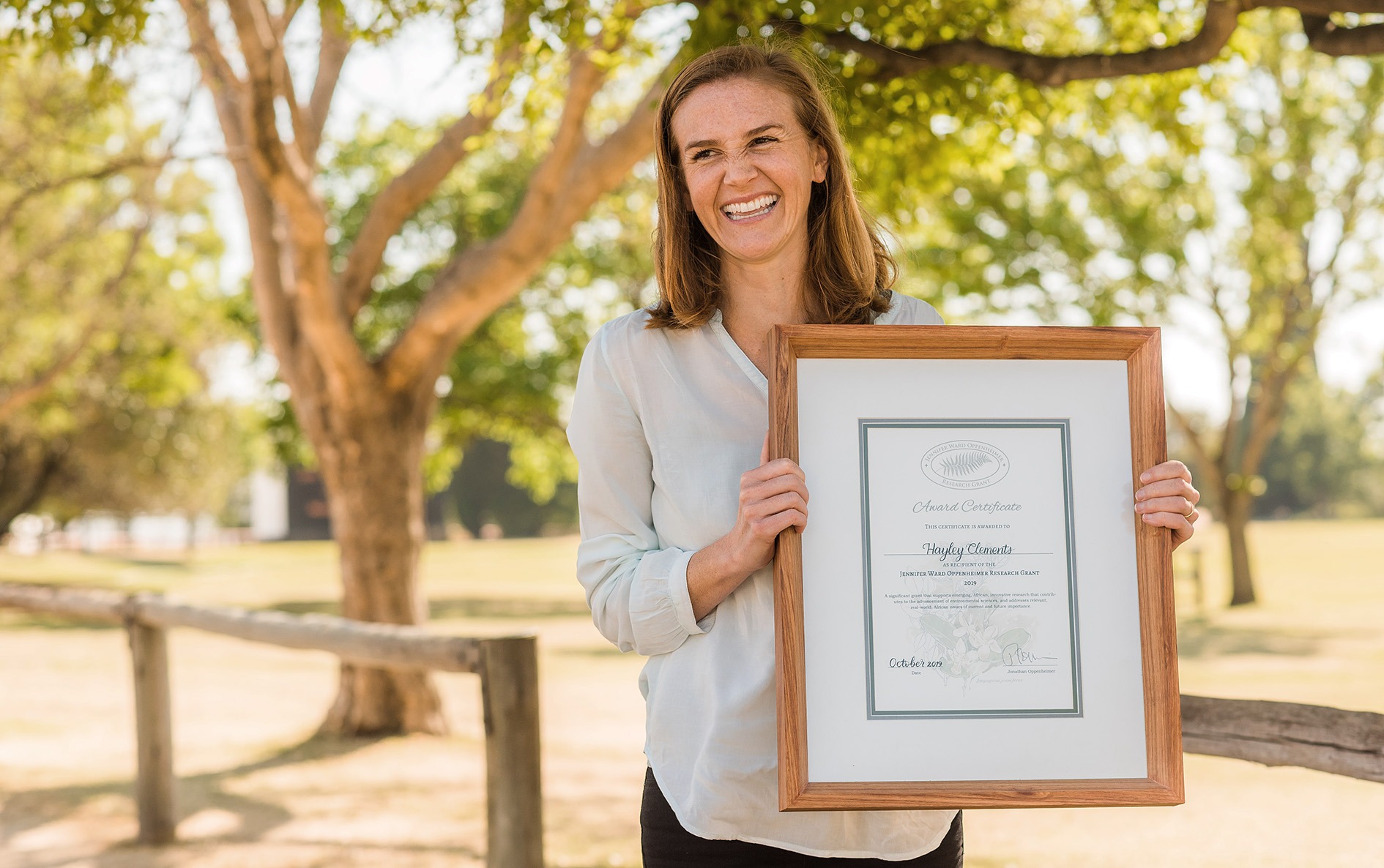
 Dr Hayley Clements was the inaugural winner of the Jennifer Ward Oppenheimer Research Grant in 2019.
(Photo: Supplied)
Dr Hayley Clements was the inaugural winner of the Jennifer Ward Oppenheimer Research Grant in 2019.
(Photo: Supplied) In 2019, Dr Hayley Clements became the inaugural recipient of the $150,000 Jennifer Ward Oppenheimer (JWO) Research Grant. Her ambitious goal was to map how intact Africa’s continent’s ecosystems truly are.
Recently, the culmination of this multi-year, continent-wide collaboration was published in the prestigious journal Nature. The project involved more than 200 researchers across Africa, who found that, on average, sub-Saharan Africa has lost around 24% of its original biodiversity, with populations of large mammals reduced to a fraction of their historical levels.
Crucially, the study also shows that more than 80% of the continent’s remaining biodiversity persists outside formally protected areas, embedded within working landscapes where people live, farm and manage natural resources.
/file/attachments/orphans/Fig1biimap_738902.jpg "Map of biodiversity intactness across sub-Saharan Africa, showing how current ecosystems compare
<br>to their pre-industrial state. The study finds an average decline of around 24%, with the highest losses
<br>in heavily transformed landscapes and much of the remaining biodiversity persisting outside formally
<br>protected areas. (Source: Clements et al., Nature)")
to their pre-industrial state. The study finds an average decline of around 24%, with the highest losses
in heavily transformed landscapes and much of the remaining biodiversity persisting outside formally
protected areas. (Source: Clements et al., Nature)
Ahead of her appearance on an upcoming Oppenheimer Generations Research and Conservation Tipping Points webinar, Clements sat down to reflect on her early life, her unexpected career path, her ecological discoveries, and why the future of African conservation relies entirely on the people living alongside it.
Q: What inspired you to become a biodiversity researcher?
A: Since as far back as I can remember, I’ve had an absolute fascination with the natural world. It’s funny because I grew up in Johannesburg, so not exactly the most biodiverse place, but I have memories of being in my back garden collecting frogs and algae out of the pond. I had a microscope, and from when I was really young, I remember my mom pricking her finger so I could look at her blood under the microscope. I would slap anything I could under that microscope. My parents bought me an ecology set when I was 10 – I didn’t know what that word meant then, but I became an ecologist!
Q: How did that childhood fascination translate into a career in conservation science?
A: I went to St Stithians in Johannesburg, which I chose specifically because of its wide-open spaces. I arrived and thought, “Johannesburg, but there’s space!” The school had a strong outdoor focus, including taking us on a trek along the Orange River, so it was a great school for my passion.
Despite my passion for nature, I always thought I would become a vet. I saw that as the obvious profession for an interest in animals. I got into vet school but decided rather to do a Bachelor of Science degree in Zoology at the University of Cape Town (UCT). I’m really glad I made that shift. My passion for animals redirected to wildlife as opposed to the domestic sort. So, I did a BSc and a BSc Honours at UCT.
Back then, biodiversity careers weren’t mainstream, and I didn’t know what I could do with the degree; I just knew it’s what I loved. After my Honours, I travelled for a year, volunteered on conservation projects, and eventually got a job running a wildlife volunteer programme on a game reserve in South Africa. It was there that I met Professor Graham Kerley, who was the director of the Centre for African Conservation Ecology, and he encouraged me to study further, leading me to a Master’s and eventually a PhD.
Q: What did winning the inaugural JWO Research Grant change for you practically?
A: It practically changed everything. I had finished a postdoc in South Africa and was wondering how I was going to stay in research, especially since the prospects during the Fees Must Fall movement were not great for mainstream academia. Getting that grant got me a research position that enabled me to stay at a university in South Africa – I don’t say this lightly, it was absolutely the launch pad for my career.
However, I won the grant at the end of 2019, so right after, Covid hit. I had this grand ambition to produce a realistic map of biodiversity intactness across the continent, but I was stuck in my Cape Town apartment for pretty much two years. Yet, that actually turned out to be quite fortuitous. Because Zoom meetings became the norm, I was able to run workshops and reach out to a much greater network of around 200 biodiversity experts across Africa than I otherwise would have been able to.
Q: Your resulting study uses the Biodiversity Intactness Index (BII). What does this measure, and how does it relate to “tipping points”?
A: At a global scale, tipping points speak to the idea of planetary boundaries. The Holocene provided stable environmental conditions that allowed complex human civilisation to build our societies and economies, but by changing the climate and eroding biosphere integrity, we are pushing the Earth outside of its safe operating space. At a more local scale, tipping points occur when you erode an ecosystem’s feedbacks – like putting too many nutrients into a lake through agriculture – until it fundamentally reconfigures into a new regime, like a eutrophied lake, that no longer provides the (ecosystems) services society needs.
The BII helps us understand this by measuring how closely ecosystems resemble their original, pre-industrial condition. It asks: if you zoomed out, looked down and counted all the wild plants and animals pre-industrialisation, how much of that is left today? We found that, on average, sub-Saharan Africa has lost a quarter, or 24%, of its original faunal and floral populations. Typically, this means we’ve lost most of the megafauna, with large mammals down to about 20%.
Q: Which countries are faring the best, and which are struggling?
A: In terms of the numbers, Nigeria and Rwanda have the lowest biodiversity intactness, sitting at around 50% or less. This is primarily because they have the most transformed land, largely characterised by extensive, wall-to-wall smallholder cropland. On the other hand, Namibia and Botswana top our list for the most biodiversity remaining, at more than 80%. Part of this is environmental – they are more arid and have lower populations – but they have also embraced a different conservation policy model. Instead of just focusing on state-protected areas, they have devolved wildlife use rights to local people, which incentivises conservation across a much broader extent of the country.
Q: One of the most striking findings in your paper is exactly where the surviving biodiversity is located. Can you elaborate?
A: Yes, this finding really floored me. We show in our paper that more than 80% of all the wild animals and plants that remain across the continent are actually outside of formally protected areas. They remain in working lands, rangelands and landscapes where people coexist. To think that we are going to stop biodiversity loss just by protecting all of that land (in protected areas) as fortresses is totally unfeasible, and it’s actually unjust and inequitable to the half a billion local people those landscapes sustain.
Q: How does this challenge the dominant global conservation narrative?
A: The dominant narrative in literature and policy arenas is that to save biodiversity, we have to protect it from people, creating fortresses that people cannot access. A major misconception is the inevitability of a “tragedy of the commons” situation – the idea that if you don’t protect wildlife from people, it will disappear. In many cases, that happens because systems have removed the benefits of wildlife, leaving local people to just bear the costs compared to other things they could be doing on that land, such as agriculture. But that tragedy is not an inevitability if you change the rules to recognise local stewards and allow local institutions to govern those resources.
Q: What does your research suggest about resolving the tension between conservation and economic development?
A: If you’re thinking about it as a tension, you’re off to a bad start. We need to reimagine how we think about the two, and wildlife economies are one way of rewriting the rules. Africa’s biggest asset is its wildlife and wild spaces, and we have to value those the same way systems value crops and livestock. If local people can meaningfully benefit from wildlife and decide how to govern those systems – such as who has access and what is sustainable – conservation and development become far less fraught.
Q: Looking ahead, what is your worst fear, and what gives you cautious optimism for Africa’s biodiversity?
A: When thinking about the combined magnifying effects of biodiversity loss and climate change in an African context, my major fears are water scarcity and the severe degradation of vast landscapes that provide us with nutrients to grow crops and graze livestock. I worry about them degrading to the point that they cannot recover without major intervention.
However, I have cautious optimism because there is a growing regional and global recognition that we have a crisis, which is translating into policy changes across scales and mainstreaming into the private sector. The societal tipping point is a narrative shift that we must conserve and restore biodiversity. If that gains enough traction to flip the dominant narrative, then we’ve reached a societal tipping point towards bending the curve on biodiversity loss.
Q: What advice would you give to emerging researchers applying for the JWO grant today?
A: First, apply, because a grant such as this is hugely enabling. Don’t be afraid to be bold and challenge a global narrative. But also be brave, because when you get the grant, you’ve got to live up to what you said you’d deliver, which is often much harder than you thought. Be prepared to have the grit and stamina to back your idea through to the very end.
/file/attachments/orphans/Sugar_Cane_in_Midlands_South_311695.jpg "Large-scale monoculture agriculture is one of the major drivers of biodiversity loss in Africa, alongside<br>habitat conversion, logging, mining, and climate change. (Photo: Wikimedia Commons)")
habitat conversion, logging, mining, and climate change. (Photo: Wikimedia Commons)
Tipping Points webinar
Clements will be a panellist on the upcoming Tipping Points webinar: From Discovery to Impact: How JWO scientists are shaping Africa’s environmental future, which takes place on 7 April .
Now entering its eighth year, the JWO Research Grant supports early-career African researchers, providing grants to the value of $150,000 (about R2.6-million) to support innovative research projects for up to three years.
Joining Clements on the panel will be two other JWO grant winners, Dr Gideon Idowu (2021 recipient) and last year’s winner, Dr Nompumelelo Baso.
Idowu’s research tackled one of the fastest-growing environmental challenges facing African waterways: microplastic pollution. His research investigated how plastic particles and associated chemical contaminants enter rivers and aquatic systems, where they can affect wildlife and potentially human health. His research also highlighted gaps in environmental regulation and monitoring, raising important questions about how African countries can strengthen policy responses to a rapidly expanding pollution problem.
Baso’s research explores how climate change and invasive species are reshaping freshwater ecosystems in southern Africa. Using stable isotope analysis, Baso tracks how energy moves through aquatic food webs — helping scientists understand how ecosystem changes affect biodiversity and water security.
Beyond her research, Baso is committed to supporting the next generation of African scientists, helping build research capacity and ensuring research can meaningfully inform policy and decisions on the ground.
The reflections of these three recipients of the JWO Research Grant offer a rare look at what it takes to transform scientific insight into practical solutions — and why supporting African scientists is essential for addressing the continent’s environmental future.
Click here to register for the webinar to find out what kind of research is eligible for the JWO funding. DM
Fred Kockott writes for Roving Reporters.