




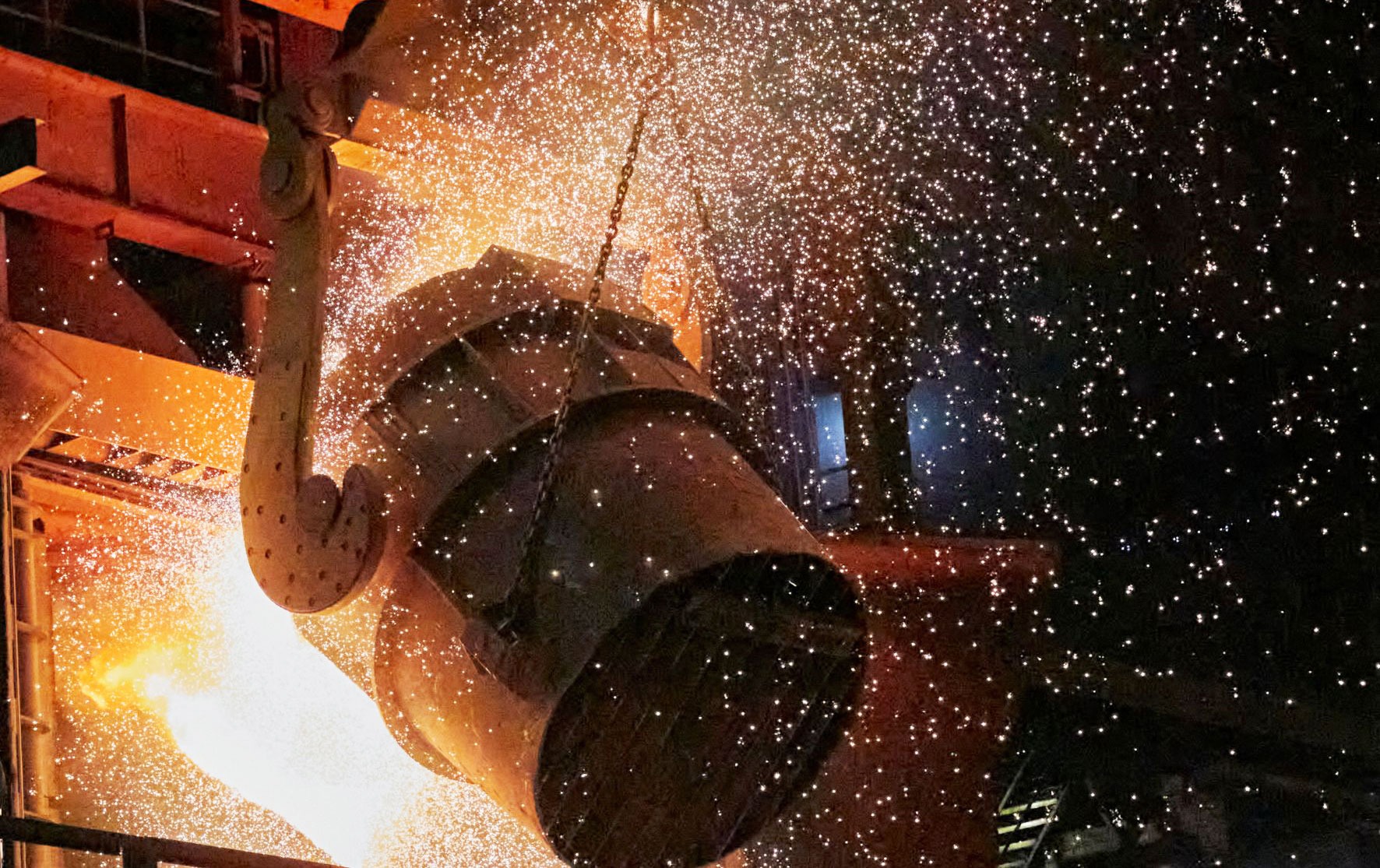
 Transalloys CEO Konstantin Sadovnik says the company’s ferrochrome smelter cannot compete against Chinese operations that use subsidised electricity at half the cost. (Photo: Supplied)
 The answer you’re looking for is: the equivalent of the combined monthly electricity use of between four and 10 households – this of course requires averaging out monthly consumption to around 450kWh. South Africa exports about 30,000 tonnes of ferrochrome alloy per week – close to half of the global supply. We should be pushing out 70,000 tonnes a week, because that’s where we were before things got crazy on the electricity tariff front.
A 2021 South African National Energy Development Institute (Sanedi ) study in partnership with the University of Cape Town got to 900kWh for average household monthly consumption, but the structures similar to what was formerly referred to as RDP houses use around 400kWh.
Why don’t we just ship raw ore out instead of arbitraging our local energy? Because that would require getting 2.5 times more volume (it takes 2.5 tonnes of ore to produce a tonne of alloy) to our ports and we would get penalised by our trading partners for passing the production costs to them instead. It’s a tough spot to be in.
So much for big endowments
Eskom tried to solve the problem with a phased approach. “As a first step, a time-bound tariff intervention of 87.74c/kWh was introduced in January 2026 for a period of 12 months,” power utility chief Dan Marokane explained.
“Eskom and the board have supported a framework towards a tariff of 62 cents per kilowatt-hour, with specific terms and conditions attached.”
Electricity tariffs are only half of the story, to be honest. The negotiations with the ferrochrome big players, Glencore-Merafe and Samancor, are more about protecting thousands of jobs and maintaining the country’s industrial standing.
That 62c temporary relief was agreed to in principle in December, but comes with conditions. Glencore-Merafe must commit to suspending its Section 189 retrenchment processes and bring roughly 40% of its furnace capacity back online.
In an internal memo seen by Daily Maverick, there seems to be a snag and Eskom’s board required more time to clarify details of a counter-proposal submitted by Glencore, resulting in the negotiation deadline being formally extended to after Easter (7 April 2026) to secure a workable and financially sustainable agreement.
A managed process
While acknowledging that “the proposed 62 cents per kilowatt-hour tariff for South Africa’s struggling ferrochrome smelters is a necessary emergency intervention to prevent mass job losses”, Merel van der Lei, CEO of workforce management company Wyzetalk, warned that cheaper power alone is insufficient.
Van der Lei advocates for frontline workers – to be fair, the company does solve communication problems between C-suite and the furnace operations – and explained to Daily Maverick that true industry recovery requires internal transformation:
“Cheaper electricity will keep the furnaces burning in the short term.”
Long-term global competitiveness requires organisations to “treat their frontline employees as an integrated, informed component of their operational strategy, capable of adapting to industry shifts in real time”.
While Van der Lei highlights the operational realities inside the plants, the macro-economic maths outside the gates is terrifying. The 62c/kWh target solution is the absolute maximum threshold required for local smelters to restart and meaningfully compete with highly subsidised international output.
Here is the friction: Eskom’s average standard cost of supply currently sits between R1.96 and R2.20 per kWh. Providing massive volumes of baseload power to heavy industry at 62c/kWh equates to selling electricity at a massive loss relative to its generation costs. Macroeconomic modelling indicates that legally and financially facilitating this deal requires an explicit state subsidy of between R5.2-billion and R10-billion.
This capital is supposed to be carved out of the broader R230-billion debt relief package previously extended to the utility by the National Treasury. If the government doesn’t eat this cost, actuaries warn that compensating for the deficit could force an immediate 11% surcharge (22c/kWh) onto all other commercial, municipal and residential users by the end of 2026.
The forgotten child
But the narrative that we are saving the smelting industry is flawed; we are saving ferrochrome. The manganese sector has been conspicuously excluded from the tariff relief framework, exposing deep regulatory inconsistencies within our industrial policy.
Transalloys, South Africa’s last remaining manganese smelter, located in eMalahleni, is bleeding out. While the ferrochrome industry negotiates its lifeline, Transalloys is being forced to pay upwards of R2.06/kWh on the standard industrial grid. This creates an insurmountable 2:1 global competitive disadvantage; Chinese facilities achieve the exact same metallurgical output paying the equivalent of about 84c to R1.18 per kWh ($0.05 to $0.07).
The economic absurdity has reached a point where shipping raw manganese ore across the ocean to China at a freight cost of $25 a tonne is actually more cost-effective than beneficiating it domestically.
Read that again: 98% of South African manganese ore is exported in its raw, un-beneficiated form. Transalloys has already issued Section 189 notices, placing 600 direct jobs at immediate risk.
Ferroglobe South Africa, the only African producer of silicon metal, critical for everything from solar panels to defence applications, issued its own non-negotiable ultimatum in late March.
CEO Marco Levi declared that unless the proposed 62c/kWh tariff relief is explicitly extended to its operations, the company will have no alternative but to permanently cease operations at all facilities.
Energy expenses now account for more than 50% of Ferroglobe’s production costs, surpassing the actual global selling prices of its commodities.
Breaking the coal curse
South Africa’s metallurgical dominance was built on the back of Hendrik van der Bijl’s 1920s vision of immense, cheap power, which eventually allowed the country’s massive direct current arc furnaces to dominate the global supply chain in the 1980s and 90s. But since 2008, electricity tariffs for large industrial users have surged by more than 900%, destroying that competitive advantage.
If South Africa cannot rely on cheap coal, two distinct paradigms emerge.
The first is aggressive virtual wheeling. Eskom’s Virtual Wheeling Platform is humming along to completion with a critical software development contract awarded to Johannesburg-based Enerweb to automate the complex financial settlements required. This theoretically allows mining conglomerates to aggregate cheap generation data from Northern Cape solar farms and seamlessly offset it against their heavy smelting consumption bills in Mpumalanga.
/file/attachments/2990/bushveldt_ast_2006297_156710.jpg "About 70% of the world’s platinum is mined in the Bushveld Igneous Complex in South Africa. The Bushveld also supplies significant quantities of palladium, rhodium, chromium and vanadium. (Source: Nasa)")
The second, far more radical, proposal is the Eskom Green scenario. This structural alternative will deploy a dedicated fleet of 8GW of solar PV coupled with 2GW of battery storage, explicitly ring-fenced for the ferrochrome sector.
While this massive infrastructure project would require a capital expenditure of approximately R157-billion, it makes rational sense. A once-off R77-billion government capital subsidy to achieve the 62c/kWh strike price would be fully recovered in avoided Eskom subsidies within four years, as structurally subsidising coal-fired tariffs over the next decade would cost the state coffers R113-billion to R261-billion.
Conversations in future will be about whether South Africa can roll the obstacles away and resurrect its vital industrial capacity. DM