




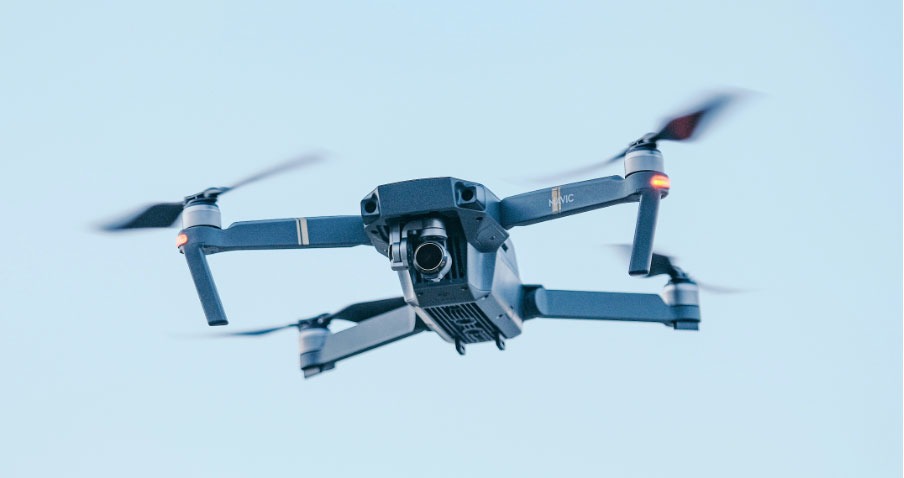
 Image: Insung Yoon for Unsplash
 It used to be that the unpleasant business of conceiving, building, testing and manufacturing weapons of war was the exclusive remit of large companies with deep and broad access to state capital. Their names are well known. They are multibillion-dollar behemoths; all part of the “military industrial complex”, a phrase coined by Dwight Eisenhower in 1961 as a cautionary description of an ill-advised future, which came to pass anyway.
But now there is a new kid in town. A gaggle of new kids, actually. And they have already redefined the calculus of war, its machines and its means. They are young Ukrainian entrepreneurs, forced into the weapons business by the circumstances of war and necessity, making the Russia-Ukraine conflict militarily distinct from all previous wars.
An article by Craig S Smith Eye on AI and published by ZeroHedge on 3 April digs deep into this new world. Smith travelled to Ukraine earlier this year and found a country that has, in the three years since Russia’s full-scale invasion, become the world’s most intense laboratory for autonomous lethal systems – a frenetic ecosystem of small companies, volunteer engineers, crowdfunded workshops and battlefield-tested iteration.
For instance, Smith found Ukrainian Oleksandr Liannyi, co-founder of NORDA Dynamics, in a battered white van at the edge of a snowy field, testing autonomous navigation algorithms that allow drones to fly the final stretch to a target in complete radio silence – making them effectively invisible to jamming equipment until the last moment.
The cast of other characters Smith found who are driving this transformation is improbable. There is Yaroslav Azhnyuk who co-founded Petcube, a Silicon Valley start-up best known for interactive pet cameras. When Russia invaded, he repurposed his expertise in motion detection, behavioural recognition and unstable-network video streaming to build AI-driven autonomous guidance systems for military drones.
Pavlo Yelizarov was a television producer who bought a smuggled agricultural drone and strapped an anti-tank mine to its undercarriage. That improvisation evolved into Lasar’s Group, one of Ukraine’s most formidable drone formations, credited with destroying more than $13-billion (R238-billion) worth of Russian military equipment.
There is Yaroslav Hryshyn, co-founder of General Cherry (named after the fruit from the founders’ home region) which is now one of two Ukrainian companies selected for the Pentagon’s Drone Dominance Programme, a $1.1-billion (R18.5bn) US initiative to mass-produce cheap, effective one-way attack drones.
The numbers are startling. From a prewar base of roughly 10 drone manufacturers, Ukraine has built an ecosystem of several hundred producers. By 2025, the country was producing an estimated 4.5 million drones annually, with targets set for seven million in 2026, according to the Council on Foreign Relations.
And now there is institutional plumbing to support the chaos of innovation. The Ukrainian government’s Brave1 was launched on 26 April 2023 as a unified coordination platform bringing together defence-tech companies, the military, investors, volunteer funds and the media. The model is designed to short-circuit the bureaucratic timelines that hobble Western procurement: Brave1 aims to turn ideas and prototypes into deployable weapons within weeks rather than months or years and has already dispensed more than 500 grants. Nataliia Kushnerska, Brave1’s CEO, has said the platform built an “entire ecosystem from scratch”, given that the Ukrainian defence-tech market had grown “practically from zero” before the invasion (there are now more than 1,500 companies in the net).
The central dynamic of this new warfare is relentless reciprocal adaptation – a hyper-accelerated arms race in which the cycles compress from years to weeks. For instance, early in the war Ukraine developed cheap FPV (first-person view) drones guided by radio signals; Russia deployed electronic jamming to blind them. Ukraine then responded with fibre-optic tethered drones – connected by cables as thin as fishing line, trailing behind them across fields which are physically immune to radio interference. Russia then began guiding its own drones via similar fibre-optic links. Now the battle has moved to drones that are radio-mute, which rely on trained AI-assisted visuals, inertial guidance and real-time lidar (laser) feedback.
The pace of innovation is dizzying. Kateryna Bezsudna, CEO of a Ukrainian defence-tech start-up accelerator, described the tempo starkly in a recent article – her companies must have products operational within six months, which is the average window before Russia introduces a countermeasure that renders the previous innovation obsolete. “If your drone hasn’t been tested in Ukraine,” Ukrainian MP Oleksandra Ustinova has said, “it’s still just a toy”.
There is no military in the world that is not racing to get a piece of this, either by joint venturing with Ukrainian entrepreneurs (US, Britain, Germany, Poland, Portugal, Rumania and the rest of Nato are already positioning) or quietly but aggressively supporting similar homegrown, inexpensive, autonomous warfare start-ups, as has happened in Israel.
One now must consider AI, particularly the recent rise of general agentic AI and deep reasoning systems. If one pairs the development of small, inexpensive, nimble and undetectable flying ordnance and the development of agentic AI, terrifying scenarios quickly emerge.
Consider this prompt (for those unfamiliar with agentic AI, this is basically how you can speak to it):
“I would like to attack and cripple Country X. Please ingest detailed geography of the country, its military competence, its political stability, its weather and any other context you think is important. Then I need you to research all their critical state services like water, electricity, transport, military and energy. Please then research weak points that would make it easy to destroy or degrade these critical services with UAV-borne explosives.
“After this task, research all the small autonomous weapon UAV manufacturers in Ukraine, specifically those accepting orders for their kit and which provide API access for training. Please set up a central server on AWS for that purpose. Calculate how many devices I would need and the best way to store them.
“Then plan 10 different mass swarm attacks on all of Country X’s critical services for the same day, considering the defensive capabilities of Country X, and how those might be evaded. Outline the pros and cons of each type of swarm attack. Calculate a budget for each and then present back to me. Wait for my approval and the funds which I will send you a Bitcoin crypto wallet that I would like you to open.
“Then place orders, pay, await and confirm delivery, and plan the attack in detail, including whether I will need any human resources. Continue to monitor Country X for any change in defence tactics and report back to me whether we need to revise plans.
“Await my approval on the attack.
“Once the attack has started, you will not need my approval for individual engagements and strikes, but you will need to keep track of hits and kills in real time. The campaign only stops when I tell you to stop. Also, please tell me what I may have left out or not thought of in this prompt.”
Yes, I know – this is a wildly stretchy and inarticulate prompt from a columnist with no military expertise, dashed off in a few minutes and without too much thought. But you get the picture. All this technology exists now – both the ordnance and AI research and reasoning and action capabilities. It requires very little effort to put it into action, besides a budget, which compared with the cost of yesterday, is negligible. All without a single soldier, pilot or military planner. All absolutely within the realm of the possible.
Or (to be brutally pessimistic) within the realm of the certain.
BTW, I didn’t enter the prompt into ChatGPT’s or Claude’s agent stack. I was a little too scared of the response I would get. DM
Steven Boykey Sidley is a professor of practice at JBS, University of Johannesburg, a partner at Bridge Capital and a columnist-at-large at Daily Maverick. His new book, It’s Mine: How the Crypto Industry is Redefining Ownership, is published by Maverick451 in South Africa and Legend Times Group in the UK/EU, available now.