



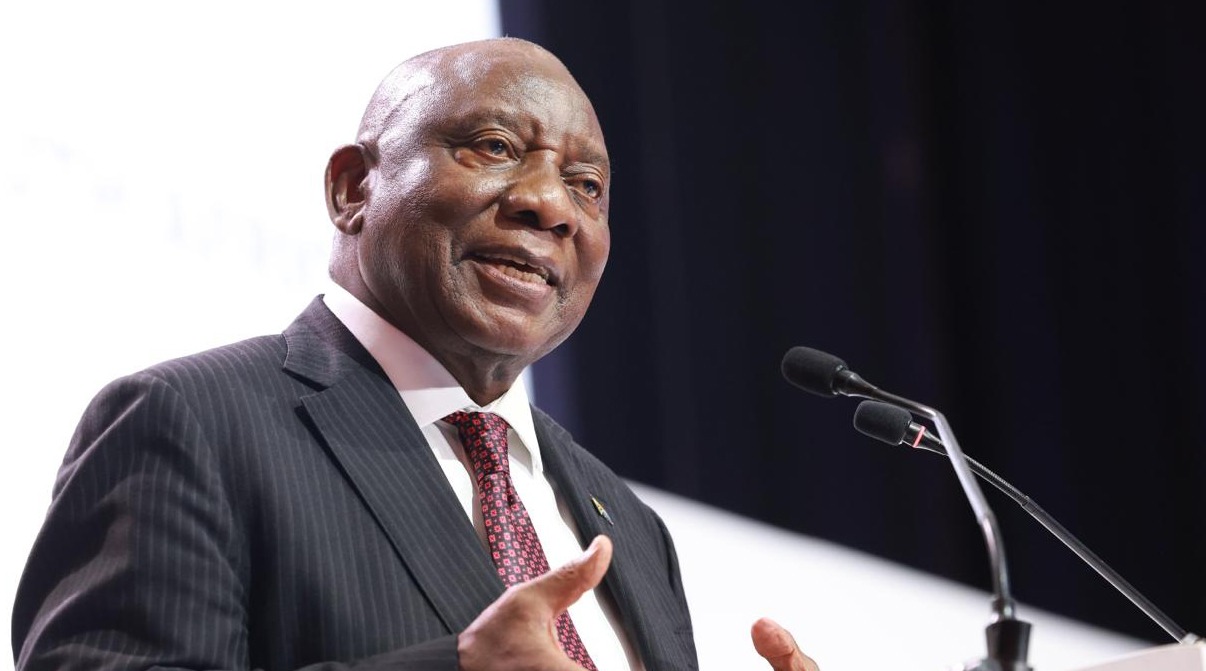
 President Cyril Ramaphosa during the Sixth South Africa Investment Conference at the Sandton Convention Centre. (Photo: Elmond Jiyane / GCIS)
The South African Revenue Service (SARS) in the last financial year hit the R2-trillion collection mark for the first time.
President Cyril Ramaphosa’s goal to reach the same amount in new investments over the next five years, unveiled at his sixth investment conference last week – which was then raised to R3-trillion – might prove more difficult.
This is not least because this annual ritual is one of smoke and mirrors, a charade that treats capital commitments long in company plans as “new” investments that have been magically conjured with the wave of a wand.
The conference and the massive amounts it claims to rake in come across as fiction when read against the facts of declining investment levels and South Africa’s woeful rates of economic growth.
The bottom line is that none of this adds up to the investment utopia portrayed by the Presidency at this annual gathering in Sandton.
To wit, these conferences have been geared to both foreign and domestic investment, and this is widely seen as critical to promoting economic growth and creating jobs. The Chinese economic miracle, for example, with its blistering rates of economic growth, was in large part spurred by massive investment inflows.
But relatively brisk rates of economic growth are widely needed in the first place to attract investment foreign investment or trigger domestic investors to deploy their capital in new ways.
And South Africa’s growth rates over the past five years have been dismal and show no signs of picking up to the levels needed to compete on the catwalk for the attention of investors.
/file/attachments/orphans/WhatsAppImage2026-03-31at205901_811766.jpeg "Deputy President Paul Mashatila, President Cyril Ramaphosa and Trade and Industry Minister Parks Tau during the Sixth South Africa Investment Conference at the Sandton Convention Centre. (Photo: Elmond Jiyane / GCIS)")
After the post-pandemic bump of almost 5% in 2021, growth has stalled and the paltry 1.1% expansion in 2025 came after a woeful 0.5% in 2024. Growth this year is forecast to be about 1.6% but such projections will almost certainly be slashed because of the mounting toll from the fallout of the Iran war.
And one reason for this is that investment rates have also been low.
Just take a look at the Stats SA data the past three years on gross fixed capital formation, which is a broad measure of investment. In 2023, it rose 4.2% but declined in 2024 and 2025 by 3.7% and 2.2% respectively.
South Africa has an interlinked growth and investment problem and the President’s annual conference is just a talk shop that has done little to address this challenge.
In his speech to the gathering last week, the President said that the new target was built “on the success of the first five conferences which collectively secured R1.5-trillion in commitments, with over R600-billion already invested in the economy”.
Smoke and mirrors
There are a couple of problems with this assertion.
First, the conferences have done no such thing. Business executives don’t show up at such events and suddenly decide on a whim to commit billions of rands in investment.
Final investment decisions on large projects takes months or years of deliberation in boardrooms which are generally careful in how they allocate capital. Some of these investments have been announced or unveiled over the years at these conferences, but the event itself had nothing to do with such decisions.
And many were announced to shareholders in advance in the companies’ projections for capital expenditure.
Sasol, for example, at the latest conference announced R60-billion in investments across its chemical and packaging operations. Revealingly, it did not make the announcement in a JSE statement, according to its website.
But Sasol, in its latest full-year results, said that its capital commitments in 2024 amounted to R50.5-billion and R45.1-billion in 2025.
/file/attachments/orphans/WhatsAppImage2026-03-31at205850_651332.jpeg "President Cyril Ramaphosa interacts with delegates during the Sixth South Africa Investment Conference. (Photo: Elmond Jiyane / GCIS)")
When Daily Maverick queried Sasol about this and asked if such capital commitments were already in the pipeline, a spokesperson replied: “Yes, it is for our existing operations, like our recently commissioned destoning plant, as well as for critical infrastructure and ensure stable energy security.”
Sasol president and chief executive Simon Baloyi told the Mail & Guardian that the R60-billion would come from “sustenance capital” – which is also known as sustaining capital to maintain and upgrade assets.
In short, this was part of the capital commitments that the board regularly gives the green light to. But Sasol did not suddenly pull R60-billion out of a hat in the past couple of weeks.
“Companies are constantly investing in their equipment and things like that to maintain their assets. The stuff announced at these conferences is seldom ‘new investments’,” George Glynos, head of research at ETM Analytics, told Daily Maverick.
/file/attachments/orphans/WhatsAppImage2026-03-31at180410_414280.jpeg "President Cyril Ramaphosa, accompanied by Trade and Industry Minister Parks Tau, holds a bilateral meeting with Charlie Zhang, vice-president of Chery Auto and executive vice-president of Chery International, during the Sixth South Africa Investment Conference in Johannesburg. (Photo: Kopano Tlape / GCIS)")
“The gross fixed capital formation figures just don’t show these new investment flows which the President speaks about. As a percent of gross domestic product (GDP) for investment we are going down, not up.”
ETM has done some number crunching on this front, drawing on data from the Reserve Bank and Stats SA. It shows that investment as a percentage of GDP has been in decline from about 23% in 2010 to 13.5% currently.
“It’s a bit of chicken and egg. You can’t get the growth picking up without the investment that precedes it and then faster growth attracts investment. And you have to start somewhere with good policies, which we don’t for the most part have,” Glynos said.
And the chickens from these egg will soon come home to roost. DM
Comments
Scroll down to load comments...