



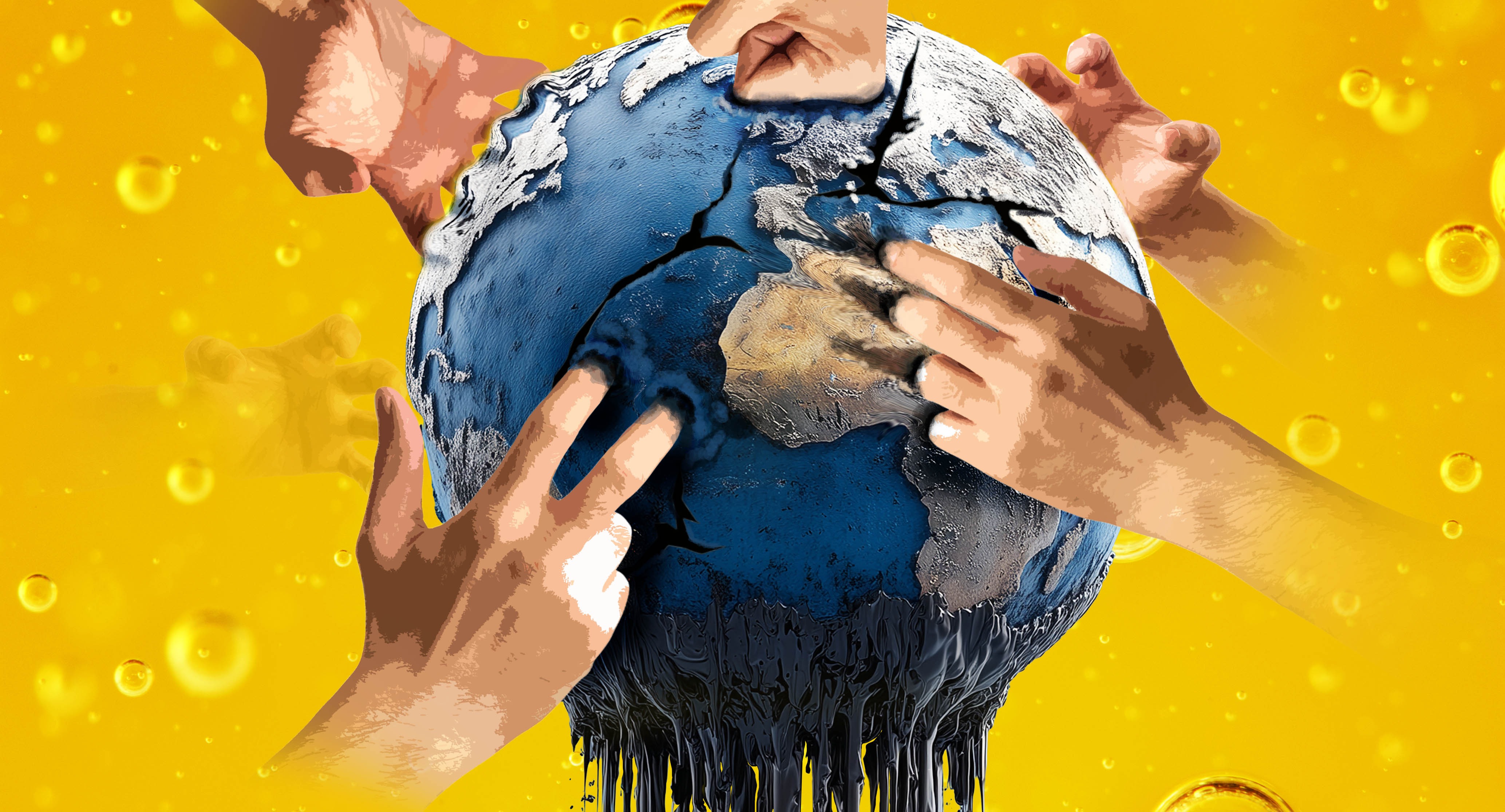
 Planet capture. World. (Midjourney AI); Hands. (iStock); Graphic: Jocelyn Adamson
 /file/dailymaverick/wp-content/uploads/2025/10/label-analysis-2.jpg)
On 23 March, during the third week of the two-day conflict in the Middle East, it was reported that traders made $580-million in bets on the oil market. These transactions occurred 15 minutes before US President Donald Trump farted a Truth Social post citing “productive” talks with the Iranians, which sent crude prices downward and other prices haywire. No one makes a bet that big on a chance that small. Describing this as fraud is laughably inadequate.
As the economist Paul Krugman noted, this is treason, which is itself a meaningless observation, given that the President of the United States of America was recently granted immunity from the law.
Corruption is the mortar that binds the Maga coalition, and increasingly the entire system of political engagement in the United States. Donald Trump’s electoral support, while both enormous and diverse, is buttressed by blood and soil ethno-nationalism. His “base” will neither abandon him, nor will the Maga movement more broadly — his coalition is animated by vibes, not policy.
But the loyalty of the elites that fund Maga is absolutely conditional. If there is no upside, they’re gone. Luckily for them, war profiteering has been optimised for the prediction market era.
/file/attachments/2990/GettyImages-2268899623_986916.jpg "United States Marines with Force Reconnaissance Platoon, 31st Marine Expeditionary Unit, conduct a simulated reconnaissance and surveillance mission as part of a simulated amphibious assault at a naval support facility on 24 March 2026 in Diego Garcia, British Indian Ocean Territories. The exercise comes as the US continues military build-up in the Middle East, nearly a month after the US-Israeli joint offensive on Iran began. (Handout photo by Lance Cpl. Victor Gurrol / US Marine Corps via Getty Images)")
Once, war bore a cost for the countries fighting it: food rationing; reduced fuel consumption; war bonds; war tax. (This is to say nothing of actually signing up to fight.) These sacrifices were bearable, at least theoretically, because they were acts of patriotism—war was a national project, a joint effort. But we no longer live in cultures in which lifestyle disruption is tolerable. Which means that war must be rendered more broadly monetisable.
In other words, no one is barred from the battlefield casino.
Genocide as portfolio management
Ever since Homo sapiens began hitting each other over the head with large objects, there have been war profiteers — after all, someone must provide the large objects. The profiteers are woven into popular culture. Recall "Daddy" Warbucks, a character in the jazz age comic strip Little Orphan Annie, who grew so wealthy from World War 1 that he was more powerful than the president. There have been many wars since he plied his trade, and little has changed.
Recent examples prove the case: the early invasions in 2000 of Afghanistan and (mostly) Iraq were old-school looting excursions, where massive industrial multinationals like Halliburton, along with kill-for-hire shops like Blackwater, paid their proxies to lobby for wars from which they earned contracts. They sent padded invoices for services rendered, and those invoices were paid. Oilfields were secured. Billions of dollars in cash changed hands. Warlords were paid off. Pure Afghan heroin was traded for arms and loyalty. Corrupt and filthy, it was nevertheless a system that the ancient Sumerians would have found recognisable.
/file/attachments/2990/GettyImages-2253961481_116934.jpg "US President Donald Trump welcomes Israeli Prime Minister Benjamin Netanyahu to his Mar-a-Lago club on 29 December 2025 in Palm Beach, Florida. The two leaders are scheduled to hold a bilateral meeting to discuss regional security in the Middle East as well as the US-Israel partnership. (Photo: Joe Raedle / Getty Images)")
What we are seeing now is part of a new phenomenon. War has become just another speculative engine: a theatre for unlimited upside. The seeds were sewn by the Russians, and it happened by happy accident.
The “special operation” in Ukraine, initiated in February 2022, was designed as a lightning strike. When Russia’s military literally became stuck in the mud, and when both sides dug in for the long haul, something extraordinary happened. Following the Biden administration-led sanctions campaign, for the first time in history a major power was entirely decoupled from the international financial system. Except it wasn’t, not entirely. Critically, even Russia’s shadow oil is priced on the global market (albeit at a slight discount). And so Russia refashioned its economy not to finance a Forever War, but to thrive from one.
And so it did, at least for a while. Russia’s staggering casualty rate on the battlefield is not a self-made atrocity. It’s an optimisation strategy. By paying a blood price for men from the Russian hinterlands, entire regions have been transformed by the regime’s cash-for-soldier campaigns. Even Forever Wars don’t last forever, and this one will resolve eventually. But in the meantime, Russians remain quiescent, and a consumption economy has spread to the farthest crannies of the federation. Putinist elites inside and outside Russia have profiteered so massively that it will take generations for their wealth to dissipate. The power that accrues to those at the top is directly tied to the money that Putin has allowed them to generate.
Successful strategies are adopted and adapted. Eighteen months after Putin’s war began, and following the Hamas-perpetrated atrocities of October 7, many options were available to the Israeli government. They chose to initiate their own Forever War, one that would ultimately “reshape” the region in their favour. Not coincidentally, these would help cement Prime Minister Benjamin Netanyahu’s grip on power, which appeared increasingly tenuous in the lead-up to the attacks.
/file/attachments/2990/GettyImages-2268922604_535105.jpg "A destroyed building at the site of a US-Israeli strike on a commercial district on 29 March 2026 in Tehran, Iran. The United States and Israel continued their joint attack on Iran that began on 28 February 2006. (Photo: Majid Saeedi / Getty Images)")
This ran in tandem with Gulf states' attempts to diversify their petro-economies – Abu Dhabi’s trillion-dollar sovereign wealth funds are all in on artificial intelligence and war, and artificial intelligence is war. While the average citizen of Tel Aviv is beleaguered by a cost of living crisis, along with an occasional trip to the neighbourhood bunker, the Middle East’s war elite have ascended to a new tier — they’re integral to the new global power matrix, and are patched into the Oval Office whenever necessary.
For Netanyahu, Putin was not a pariah, but a paradigm. In his new book, The Thirty Year War: Benjamin Netanyahu vs. Israel, the Israeli political historian Adam Raz contends that Netanyahu has forged a “a kind of quasi-democracy, or, in other words, a mafia-like state”. In this context, a flattened Gaza is not a war crime. It’s a real estate opportunity to be shared with his cronies.
The murdered will just have to move on.
This approach has been endorsed by successive American administrations who claim to be ideologically opposed to each other, but always seem to end up indulging in the same hobby: bombing the Middle East. The Forever War rationale, latent in the first Trump administration, has defined the second. Absent anything resembling a meaningful threat to the United States, Trump’s war machine has pounded multiple targets since he returned to office. Each time, movements have been detected in the markets prior to the attacks; each time, Trump Always Chickens Out his way through a conflict, doubling down before reversing course. His Truth Social posts determine how billions, if not trillions of dollars will move through the financial system in the several hours following.
/file/attachments/2990/GettyImages-2268148691_565397.jpg "Russian President Vladimir Putin and National Guard Service's Director Viktor Zolotov attend a ceremony at the State Kremlin Palace, on 27 March 2026 in Moscow, Russia. (Photo: Contributor / Getty Images)")
The Forever Warriors abroad now collaborate with the Americans on setting foreign policy. Egged on by the Saudis and the Israelis, who justifiably consider Iran a threat – although not one that required immediate attention, necessarily – Trump is now a Forever Warrior himself, despite his insistence to the contrary. We should never pretend that his aims are divergent from the mafia bosses in Russia or Israel or Saudi Arabia – they’re all members of the same multinational polycule. And we should keep in mind that the betrayal of his stay-at-home America First mandate is both meaningless and besides the point – Trump is America First, and what he wants and needs is, by extension, what America wants and needs.
His appetite is the new frontier. His stomach defines its limits.
What’s the trade-off?
If chaos and conflict are the new normal, then they must be entered into the ledger of 21st-century capital accumulation. Trump’s emblematic status as the ultimate American alpha male needs no further burnishing than this: Since his days as a real estate mogul and his pivot to politics, he has created nothing, and all of his fresh billions have been derived from, well, air. Truth Social, crypto, stock market manipulation, financialisation, breathing.
This is how to get rich in 2026.
In the United States, no longer are citizens asked to sacrifice for the greater good. They’re offered betting lines on when the Ayatollah will meet a Patriot missile. As The New Yorker recently noted: “When Saudi Arabia’s leader, Mohammed bin Salman, received a warm welcome at the White House recently, he appeared to return the favor by promoting prediction markets [Kalshi and Polymarket], noting that people could have bet on whether he would have arrived dressed in a suit, as opposed to his traditional robes.” If the everyday punter is able to buy in and profit massively off the prediction markets, imagine if he or she had inside information.
Imagine what could be done with a premeditative whisper from the Forever-Warmonger-in-chief.
In the contemporary economy we’ve devised for ourselves, the chaos of war is instantly fungible. Like digital tokens generated by a video game, the more Trump bombs, the richer his inner circle gets. According to Bloomberg, US oil refineries are enjoying the highest margins in their history, greater even than the boom that attended the Russian invasion of Ukraine in 2022. Those businesses in turn funnel money into the Republican party, which is itself a Trump-owned subsidiary.
/file/attachments/2990/GettyImages-2265886111_591321.jpg "Pumpjacks operate while others stand idle in the Belridge oil field on 10 March 2026 near McKittrick, California. A barrel of oil has passed the $100 mark amid the war in Iran for the first time since the Russian invasion of Ukraine in 2022. (Photo: Mario Tama / Getty Images)")
What we’re talking about here is a scrim of corruption that connects global elite financial networks. This is not State Capture, it’s Planet Capture.
And nor is it the idea of some quaint Illuminati involved in exploitation of the weakest. The truth is far, far sadder: It’s a result of decisions made by governments in alleged democracies, supported by cowed and propaganda-drunk electorates, which stood aside during periods of rampant technological and financial consolidation. Tech companies and warmaking are indivisible – Amazon, a good place to buy toilet paper online, shares a $9-billion contract servicing the Joint Warfighting Cloud Capability for the Pentagon, and makes a further $581-million providing additional cloud services. Microsoft, Alphabet and Oracle also get a slice, while Oracle’s Larry Ellison, easily one of the richest men in human history, controls a media empire that includes Paramount, TikTok, CBS News, MTV, The Free Press, BET, CMT, Simon & Schuster, Nickelodeon, Pluto TV and soon, if all goes his way, Warner Brothers, possibly including CNN.
The world’s wealth and power is pooled with a tiny elite, all of whom can fit in one room. In fact they were in one room, staring Botox-faced during Trump’s inauguration, an event for which they each donated 1 million dollars, as per the chief’s gentle insistence.
/file/attachments/2990/GettyImages-2194353566_596865.jpg "Guests including Mark Zuckerberg, Lauren Sanchez, Jeff Bezos, Sundar Pichai and Elon Musk attend the Inauguration of Donald J Trump at the US Capitol Rotunda on 20 January 2025 in Washington, DC. (Photo: Julia Demaree Nikhinson - Pool / Getty Images)")
Pay to play: the term for all of this is “oligarchy”. But the circumstances in which we now encounter it are unprecedented: the companies we’re talking about now co-control perhaps the most powerful technology ever devised. Artificial intelligence is, of course, a misnomer. These are trawling, processing and packaging machines that absorb all human knowledge, refrain from paying for it, and then spit it back as digital product, much of it slop. One such product, murder bots, are running rampant over the Middle East, providing targeting information that helps the Americans and Israelis do the same thing they did before artificial intelligence, except worse. The Iranian campaign kicked off with an American war crime — the bombing of a girls’ school and the murder of 175 people, mostly children — and will end in a humiliation that the administration will repackage as artificial intelligence snuff porn. After all, in America, it isn’t real until it’s a meme.
Make no mistake: none of this should be confused with a plan. The ancient rules of war still apply: the other guy also gets a move, and the Iranians have made theirs, with catastrophic results for many people who were barely surviving before the petroleum price surge. It’s all just a moronic dance, spasms of nihilistic short-termism that fit the contemporary ethos: whatever happens, however horrific, there’s always an upside. There’s always a trade to be made.
And, most importantly, there is no future. Just futures markets. It helps if the president of the United States tells you when and how to play. DM
This story first appeared in our weekly DM168 newspaper, available countrywide for R35.
/file/attachments/2990/DM-02042026-001_698062.jpg)