




 Photo: Marita Van der Vyver
 Last week the annual Time of the Writer festival in KwaZulu-Natal had me thinking about time and writers. I love the name of the festival, in which I was fortunate to participate in the early years, because it so neatly encapsulates what all writers’ festivals are or aim to be. Time for the Writer (with a capital W) to shine, to promote their writing in public, as opposed to all the solitary time that the writer (without a capital) needs to actually get the writing done.
For most writers the art of writing is a careful balancing act between these brief moments of public performance and ego polishing, and the countless hours, weeks and months of word polishing, of agonising about paragraphs and punctuation marks, while wandering lonely as a cloud. Or, more likely, sitting in front of a screen as lonely and unmoving as a cloud of black smoke.
However, since I’m quoting Wordsworth, I have to remind you that a few lines lower down in the same famous poem the poet also lies on his couch in vacant or pensive mood. Believe me, vacant lying around is a very important part of writing.
When asked how long it took me to write a book, I’m always slightly flummoxed, because writing a book involves an awful lot of thinking about what I’m writing. And all this thinking – planning the next scene or chapter, listening to the characters’ dialogue, figuring out what they look like, imagining the room or building or city in which the action takes place – is often done while walking or lying on a couch or simply staring vacantly out a window.
Without all the walking and lying and staring, there would be no writing. So when I say that it takes me about two to three years to write a book, it doesn’t mean that I’m nailed to a desk furiously writing for two solid years. But that’s just me.
Apparently the Belgian author Georges Simenon would lock himself in a room and write a book in 10 days, sweating profusely, in an almost trance-like flow of creation. (I can barely read a book in 10 days.) According to Simenon’s son, his father would write a whole chapter longhand in the morning and type it in the afternoon, with very little rewriting after that first draft.
Simenon was probably the exception proving the rule. For most writers, rewriting is an indispensable part of the writing process, usually far more time-consuming and painful than the initial writing. I know this not only from personal experience, but because I’ve picked the brains of authors I met at writers’ gatherings through the years, some of them more famous than I could ever aspire to be.
When I was invited to the Time of the Writer festival in 2006 – exactly 20 years ago, I now realise – most of the participants were international writers, some on the verge of celebrity, others already widely read and respected.
The most famous name in our group, at that stage, was the Indian author Amitav Ghosh, who has since grown in stature and was reportedly a serious contender for the 2025 Nobel Prize, but what I remember above all is his kindness. He attended the talks and panel discussions of all the lesser-known writers, which not everyone did.
One night a couple of South African-Indian fans from Durban invited him for dinner in a local restaurant, and because I was one of the few South African writers at hand, he made sure that I was invited along. I was a little star-struck at first, but luckily good food always loosens my tongue.
After a few bites of delicious Durban curry, I forgot that I was in the company of a Writer whose work I admired. He became simply another writer (no capital) as we chatted about writing and publishing and promoting books and stuff that would bore most non-writing people. The couple who initiated the meal managed not to look bored – maybe because they too were star-struck and charmed by Amitav.
/file/attachments/orphans/Dedications-from-Jos-Eduardo-and-Ingrid-years-after-Time-of-the-Writer-2006_Marita-Van-der-Vyver_449487.jpg "Dedications from José Eduardo and Ingrid years after Time of the Writer 2006. (Photo: Marita Van der Vyver)")
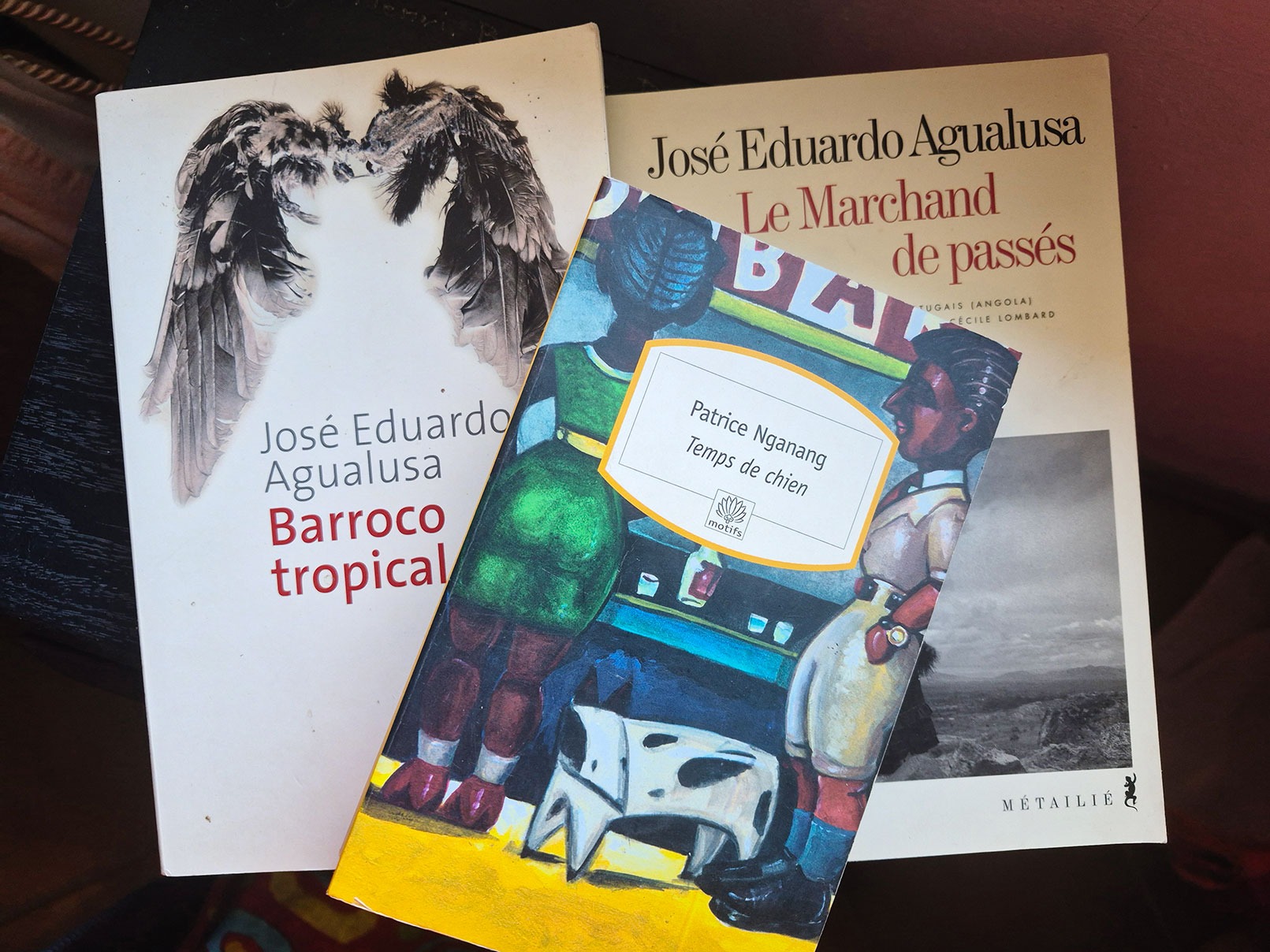
During that same Time of the Writer in 2006 I also became friends with the Angolan-Portuguese-Brazilian author José Eduardo Agualusa, whose work I didn’t know then but who has since won a number of major literary awards.
Anglophone readers might remember that he received the Independent Foreign Fiction Prize for The Book of Chameleons and the International Dublin Literary Award, shared with his translator, Daniel Hahn, for A General Theory of Oblivion. We drifted into each other’s company mainly because his French was better than his English, and I was one of the few participants who could speak French to him.
The other one of our Three “French” Musketeers who hung out together in KwaZulu-Natal was Patrice Nganang, author of the award-winning novel Temps de chien (Dog Days in the English translation), who would later be detained and deported from Cameroon for political reasons and now lives in the US.
If this sounds like shameless name-dropping, mea culpa, but I’m doing it with a purpose. One of the thrills of writers’ gatherings is exactly this chance to get to know the people behind the books we admire, to compare notes and sometimes even to become friends. The only other Afrikaans writer participating that year was Ingrid Winterbach, whom I already vaguely knew, but that week in the sultry Durban weather cemented an enduring friendship.
The fact that my luggage got lost on the flight from France and that I spent the first three days of the festival in a garish yellow Time of the Writer T-shirt – a freebie for all the participants, although I was the only one wearing mine full-time – probably helped me to stand out and make more friends than I normally would on similar occasions.
When my suitcase finally arrived at the hotel, some of my newfound friends didn’t recognise me because they’d never seen me wearing anything but the yellow T-shirt. Like you wouldn’t recognise a nun, I suppose, if you saw her without her habit for the first time.
Among the more noticeable writers in the group was an outgoing British woman with a Nigerian father, who had won acclaim for a witty verse novel titled The Emperor’s Babe a couple of years earlier. I lost contact with her, and it was only when the Booker Prize was awarded to Bernardine Evaristo for Girl, Woman, Other in 2019, that Ingrid reminded me this was the very same Bernardine from “our” group in 2006.
With hindsight it was quite an illustrious gathering – but this could be true of so many other writers’ festivals. The thing is, while you’re there, enjoying each other’s company, you are all just writers, without capitals, sharing a moment of public glory. And you all know this is not what being a writer means. It might be called Time of the Writer, but around and in between these shared times, you have to find the time to write. And to rewrite, of course.
/file/attachments/2990/2026-03-31_10-05-07_556280.jpg "Time of the Writer festival posters. (Image: Time of the Writer / Marita Van der Vyver)")
The major difference between Time of the Writer in 2006 and 2026 is that we didn’t have social media and online streaming back then. Now you no longer have to be physically present to participate or attend. This week I could listen to some of the online discussions while vacantly staring out the window of my study in France.
I was particularly interested in a conversation about how language has evolved through Afrikaans literature, with Jonathan Amid, Gaireyah Fredericks and Theo Kemp as panellists. I missed most of it due to confusion about time difference and time zones, but I did manage to catch the last bit. Hopefully all the fascinating talks that have been live-streamed will soon be available on YouTube or another platform.
Still, however grateful I am for online discussions, they remain consolation prizes. Nothing beats being there in real life, feeling the vibe between the authors on stage and the electricity flowing through the audience, eating and drinking and laughing with other participants, smelling the sea and the subtropical plants – or the dry desert, or the cool mountain air, depending on where the writers’ festival is taking place. If you can experience such a festival with all your senses, you can build up a stock of memories to carry you through the long, isolated hours of writing that, inevitably, lie ahead.
When I start a new book, I want a few months of uninterrupted writing time. I usually don’t get it, but I still want it. That is why I usually start new writing projects in the French autumn, knowing that the long, cold, dark winter months ahead could give me a head start.
Fewer visitors, fewer distractions, fewer temptations to go outside and make hay while the sun shines. During the winter months in the deserted French countryside I can lock myself up in my house and hibernate like a bear – although I have to be a disciplined, hard-working bear, not a lazy, sleeping bear.
And for this reason I usually welcome the first signs of spring with mixed feelings. Delighted about longer days and more light, but also sad that my bear-like writing period is drawing to a close. During the past winter I wrote about 30,000 words of what will hopefully become a new novel. That is all I can say about it at the moment, but it is already something.
I will continue writing as spring turns to summer, but my rhythm will change. I plan to do some travelling in the next three months, to spend more time with family and friends, perhaps even, who knows, to start eating outside if our seemingly never-ending building project finally comes to an end and we get the courtyard we’ve been waiting for throughout the winter.
But the writing will continue. Even when I’m not physically writing, pen in hand or typing on a keyboard, I’ll be “writing”. The Time of the Writer is brief, but the time of writing is ongoing, like my building project. Maybe, just maybe, I’ll even be writing in my new courtyard this summer. DM
Republished from Marita van der Vyver’s Substack.