




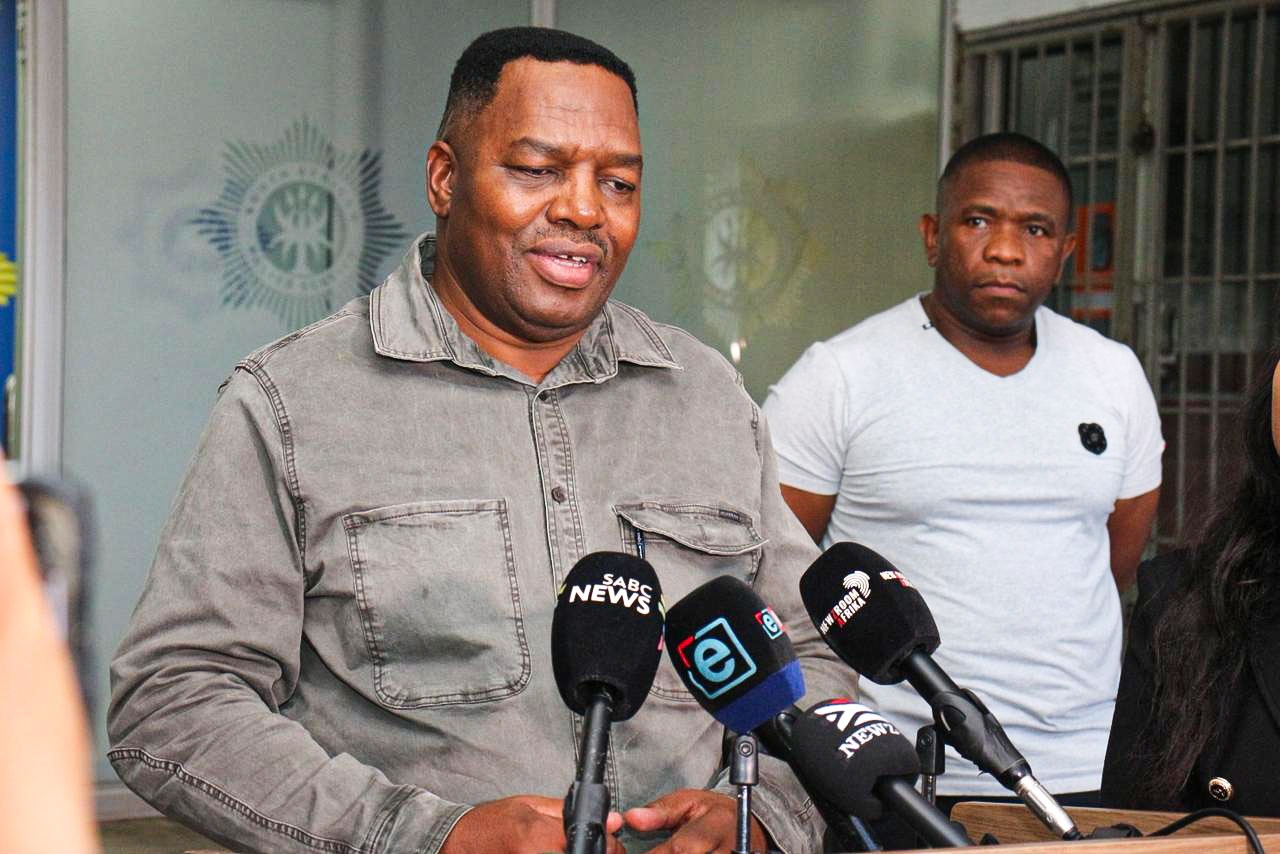
 National Commissioner of the South African Police Service General Fannie Masemola (left) and KwaZulu-Natal police boss Nhlanhla Mkhwanazi. (Photo: Facebook / SAPS)
 /file/dailymaverick/wp-content/uploads/2025/10/label-analysis-2.jpg)
South Africa’s law enforcement scandal is moving in opposite directions, with further turmoil on one side and some structure, in the form of a solid plan, on the other.
On the one hand, National Police Commissioner Fannie Masemola’s future looks uncertain while he’s embroiled in suspicions about a dodgy tender.
On the other hand, KwaZulu-Natal’s leading cop Nhlanhla Mkhwanazi has signed on the dotted line to serve for another five years.
Those supportive of Mkhwanazi will welcome his reappointment with relief that he continues in the role.
But there’s probably some resentment or unhappiness among law enforcers and others who have publicly voiced their distrust of him.
Tension versus support
This means that friction between Mkhwanazi and those who distrust him may lead to more internal skirmishes.
A police source told Daily Maverick this week that some officers were bracing themselves for what happens next, because “It’s not like those against [Mkhwanazi] will just leave him off.” The source was addressing the two main factions that have emerged in law enforcement: those for Mkhwanazi and those against him.
/file/attachments/orphans/657653324_1370240145127622_3500177300883177741_n_351406.jpg "Lieutenant General Nhlanhla Mkhwanazi. (Photo: Facebook / SAPS)")
In July last year, Mkhwanazi sparked what has become an unprecedented eight months of policing crises in South Africa when he alleged that a drug cartel had infiltrated the criminal justice sector, politics and policing.
Counterclaims subsequently emerged that he had made the staggering drug cartel accusations to distract from other criminality in the police service, such as the looting of the Crime Intelligence unit’s secret service account.
After Mkhwanazi made the accusations last year, he was not suspended, making it plain that he and Masemola were aligned.
KZN police commissioner Nhlanhla Mkhwanazi has denied allegations of abusing his power and interfering in the arrest of a senior official suspected of running a drug cartel at the Westville Maximum Security Prison.https://t.co/Npgeq74C9q
— Times LIVE (@TimesLIVE) January 14, 2025
But some people think there’s more to their apparent allegiance.
National Coloured Congress leader Fadiel Adams, who has surfaced in the overall law enforcement saga as someone opposing Mkhwanazi, even previously, in an affidavit, describing Masemola as “the man General Mkhwanazi is trying to keep out of court”.
Adams implied that Mkhwanazi was protecting Masemola from facing legal action and that the two were colluding.
Masemola is now headed for court in the dodgy tender saga, and the direction this situation takes will probably affect policing dynamics.
If he’s suspended and someone is appointed to act in his position, there will be yet another shake-up in the already fraught police service.
It could also shift the power balance of the two main policing factions – at the moment, it appears that this favours Mkhwanazi.
Duty calls
Masemola, while waiting to hear his fate in the light of the court saga, has again backed Mkhwanazi.
On Sunday, 29 March 2026, addressing KwaZulu-Natal’s police management on Mkhwanazi's new five-year term, Masemola said, “You need to support Lieutenant General Mkhwanazi, and the only support you can give to him is through taking orders and do[ing] your job.”
Mkhwanazi made his expectations clear: “To my fellow colleagues, I am expecting nothing less than full cooperation and support.”
#sapsHQ The South African Police Service (SAPS) confirms the reappointment of Lieutenant General Nhlanhla Mkhwanazi as the Provincial Commissioner of KwaZulu-Natal on a five-year fixed term contract.
— SA Police Service 🇿🇦 (@SAPoliceService) March 28, 2026
His reappointment follows consultation with the Premier of KwaZulu-Natal, Mr… pic.twitter.com/ZJMAXuznH0
He said that it hadn’t been easy to take on the role for another half-decade, as he had agreed with his family to serve only a single term.
(It was during this term that he made the cartel accusations, which altered the country’s policing landscape, led to serious concerns about his security, and saw counterclaims made against him.)
“The plan was to go on a holiday from 1 April,” Mkhwanazi said, “but when the National Commissioner emphasised the importance of service to the people of South Africa, especially [...] of KwaZulu-Natal, I reconsidered and made myself available to be of service to the nation.”
It has been a rocky policing path to Mkhwanazi’s reinstatement.
Recent ructions
Last week, in one of many offshoot scandals, 12 senior police officers were arrested over a dodgy R360-million health-related tender awarded two years ago to Vusimuzi “Cat” Matlala’s company, Medicare 24 Tshwane District.
Matlala is at the centre of the infiltration scandal.
Aside from a case involving accusations of attempted murder, Matlala now faces charges alongside the 12 police officers. (Certain officers have also alleged that he is a drug cartel member.)
/file/attachments/orphans/ED_601924_452651.jpg "Vusimuzi ‘Cat’ Matlala appears in the Pretoria Magistrates’ Court on 25 March 2026. Along with 12 senior police officers and an associate, he faces criminal charges in connection with a dodgy tender awarded to one of his companies. (Photo: Gallo Images / Frennie Shivambu)")
Last Wednesday, while the police officers appeared in a Pretoria court, News24 reported that Masemola had also been flagged in the Matlala tender scandal.
The national police chief received a summons to appear in court on 21 April.
Masemola apparently isn’t facing corruption accusations, but contraventions of the Public Finance Management Act.
‘Nothing wrong or abnormal’
On Sunday, while holding a press conference addressing Mkhwanazi’s renewed five-year contract, Masemola raised the legal issues he faced.
He said he had not done “anything wrong” in terms of the Matlala tender saga and had followed processes.
Masemola made it clear: “Yes, I’ve been served a summons to appear in court. I’m not charged.
“There’s nothing abnormal about that. It’s a process that sometimes does happen.” This means formal criminal charges have not been put to Masemola, but that could still happen.
Masemola said President Cyril Ramaphosa was in the loop about the situation, and it was up to Ramaphosa to decide what happened to him next.
“I cannot dictate processes. I think the legislation does say [...] what should happen and when,” he said.
“There’s no one [who] can change that, so we are engaging with the President.”
Masemola said Ramaphosa would indicate what process might now go ahead, but reiterated that he had not been charged.
The National Prosecuting Authority’s Investigating Directorate Against Corruption (Idac) carried out the arrests of the 12 police officers last week.
It therefore appears that the Idac is also driving the matter against Masemola.
‘False narrative’
Mkhwanazi previously outlined his take on Idac, and it is concerning.
He alleged in Parliament that sources had told him that there were two structures in Idac.
“There’s a good structure […] and there’s another structure that is malicious that is used as a weapon to further disrupt the criminal justice operations.”
Idac head Andrea Johnson later reacted, saying there was “no truth to the allegation” that the Idac was involved in a “witch-hunt” against certain police officers.
Mkhwanazi’s mention of Idac, though, suggested there were factions in Idac that mirror the policing factions, and it may have created the impression that the directorate is now targeting Masemola.
Idac issued a statement on Saturday, 28 March, to head off any such ideas.
The NPA’s IDAC dispels allegations of it targeting senior @SAPoliceService officials pic.twitter.com/MHzJCZOXWG
— NPASouthAfrica (@NPA_Prosecutes) March 28, 2026
It said the police’s risk audit unit had referred the Matlala tender saga to it for investigation in 2024.
“The Idac, like many other law enforcement agencies, is not a law unto itself, as has been portrayed by the false narratives circulated,” the statement said.
“Society should therefore be vigilant not to fall prey to false narratives created to destabilise the fight against corruption.”
Masemola had a rather diplomatic approach to this on Sunday.
He told journalists: “I cannot for a moment believe that any agency of government can be weaponised against anybody, so I won’t buy into that narrative.”
But the erosion of good governance and the weaponising of government agencies against certain state officials is precisely what happened during the State Capture surge under Jacob Zuma’s presidency.
Timing
The timing of Masemola receiving the summons to appear in court caused some concern in policing circles.
It coincided with the 12 police officers appearing in court and when the Madlanga Commission of Inquiry, one of the parallel hearings investigating Mkhwanazi’s cartel infiltration accusations, went on a break.
Some more sceptical policing sources questioned whether this was perhaps a tactic to ensure that journalists, who would otherwise have been occupied with covering the Madlanga Commission, were available to cover the arrests and summons developments.
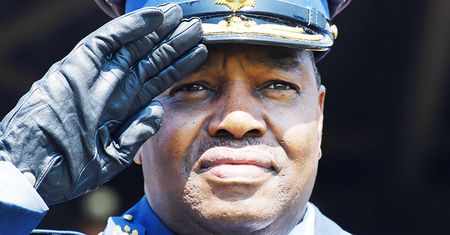
The Masemola summons was also delivered when Mkhwanazi’s five-year term as KwaZulu-Natal police boss was coming to an end.
This sparked worries among some police officers that Masemola’s pending court appearance and potential suspension would affect the renewal of Mkhwanazi’s contract.
In other words, there were worries that Masemola would not be able to sign off on Mkhwanazi’s next five-year term.
Deep distrust
But over the weekend, it became clear that Mkhwanazi would indeed remain KwaZulu-Natal’s police boss.
This essentially means that Mkhwanazi has received a governmental nod of approval, adding weight to his drug cartel infiltration accusations.
It probably hasn’t gone down well with some people, including suspended deputy national commissioner of crime detection Shadrack Sibiya.
Sibiya has said, “General Mkhwanazi is playing the country and he’s playing a mind game [with] the country… because he knows how to play with words… in such a way that the country gets moved.”
Another state official who has not sung the praises of Mkhwanazi is Robert McBride, who heads the State Security Agency’s Foreign Branch.
McBride previously alleged that Mkhwanazi “played an undue and prosecutable role in trying to disrupt and scuttle” an investigation into former acting national police commissioner Khomotso Phahlane.
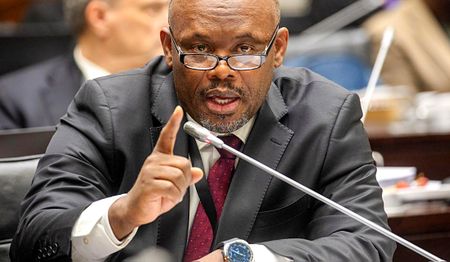
For his part, Phahlane said that the corruption accusations against him were part of an ongoing smear campaign.
These clear divisions in the state, especially involving Sibiya, McBride and Mkhwanazi, have not been smoothed over.
Earlier this year, Ramaphosa referred more than a dozen police officers and Ekurhuleni metro officials for investigation, based on what has so far emerged from the Madlanga Commission.
As these investigations progress, they will inevitably cause more law enforcement ructions.
This is just a part of the backdrop to Mkhwanazi’s new term as KwaZulu-Natal police boss and what underpins Masemola’s anticipated court appearance.
It is among all this that policing is meant to continue efficiently in the face of rampant crime, some of it clearly emanating from within law enforcement. DM