




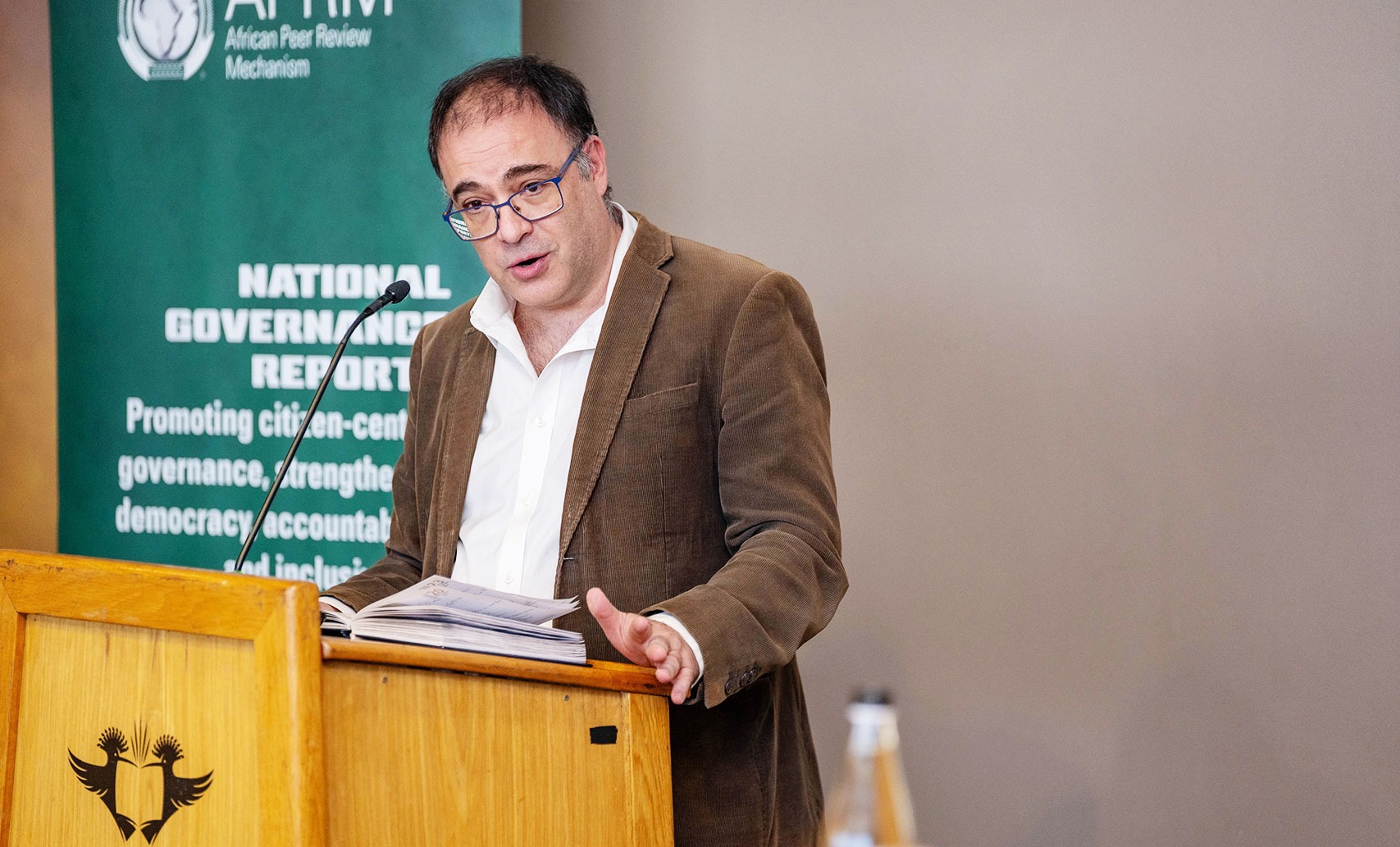
 Steven Gruzd at the APRM (African Peer Review Mechanism) (Photo: X / @APRMorg)
 As many readers already know, political scientist, commentator and friend Steven Gruzd met a sad, horrific end to his life recently. Given the warmth of his spirit as well as the quality of his analytical and writing skills, there have already been many published and broadcast encomiums of him, following his passing.
Like everyone else, I found him to be a thoughtful, nuanced thinker with a knack for delivering telling details as well as setting out the broad framework for his arguments and analyses.
I first met him back in 2004 when I had a research fellowship at the South African Institute of International Affairs, following my retirement as an American diplomat, and as I stayed on in SA. My office at the institute’s Jan Smuts House on the Wits campus (really a snug, windowless cubicle) was upstairs from the more capacious office suite where he and his colleagues were building the institute’s capabilities to measure, analyse and promote the African Peer Review Network.
Given what has happened too often on this continent, I sometimes said to myself that his peer review project could resemble Sisyphus’ legendary task with that big rock that simply would not stay uphill once Sisyphus had carried it there, thereby condemning him to do it over and over again, forever.

Nevertheless, Steven retained a positive outlook, encouraging his colleagues to keep on with efforts in researching, encouraging, badgering and judiciously wielding critiques of governments and other institutions that had failed in meeting their promises, or in achieving expectations for them.
This African Peer Review Network work was not flashy, grandstanding-style political science. Rather, it was in applying the discipline’s methodologies to the hard slog of evaluating the actual experiences of public administration and governance.
My chosen research task was not related to Steven’s project. Rather, I was trying to gauge the effectiveness of sanctions – economic, cultural, educational and sports – as a policy tool exacted against governments in order to encourage or compel political change.
Regardless, Steven was always available to chat about my work and his ideas or suggestions to me of things to examine or themes and experiences to track down. After my time with the institute drew to a close, we kept in touch.
Larger mechanisms of history
Over time, we came together over a mutual fascination with the larger mechanisms of history and the structure of international relations. As he wrote his media commentaries and analyses, increasingly he called me for a short quotation that could help summarise or amplify the complexities of an issue or the chances of a particular outcome in something he was working on.
In return, for my radio discussion programme on a local community station, I periodically relied on Steven for in-depth discussions on current global issues. I liked engaging with him on air, in part because he was never dogmatic, but also because he obviously enjoyed offering clarifying insights into the complexities of the topics we were discussing. Frankly, his participation kept me on my toes.
Once, at a conference where we were both speaking, my topic was the American political landscape leading into a presidential election. I had a full house of an audience, and when my session concluded it turned out Steven was scheduled to speak in another nearby hall about the global landscape, and, in particular, the larger implications of the Russian invasion of Ukraine.
I walked across to hear his talk and realised most of my audience had also migrated the same way. I realised the organisers should have booked us as a team since the two topics were so interrelated. It would have been great fun.
/file/dailymaverick/wp-content/uploads/2025/04/Steven-Gruzd_SAIIA.jpg "The late Steven Gruzd. (Photo: Supplied)")
Over the years, Steven and I occasionally met over coffee to discuss these and other such topics and to try out ideas and approaches to understand them. It was a pleasure to sit on our garden verandah and discuss the fate of the world with Steven.
It seems inevitable, then, that we would begin discussing possible future, joint projects. On one recent morning, we talked about what kinds of future co-authored pieces we might work on – as well as other projects. Now, suddenly, I must attempt to deliver such work, but without Steven’s ideas and insights.
One of these was to be an article – a semi-scholarly but popularly styled think piece on the future shape of international hegemony. History shows that it is in the nature of would-be hegemonic powers to change over time, especially as nations rise and fall. Major powers eventually are either reduced to also-rans, or they develop real staying power and in spite of domestic and international challenges they remain on the centre court.
Possible future outcomes
But there is room for analyses that contemplate the future and attempt to understand the likely – or possible – nature of the nations in the top tier: How will they achieve that status and maintain it through all the challenges from other rising states?
Our task would also have been to draw on the growing array of literature building up on this theme, especially the presumed rise and rise of China, and the slow decline of the US. Could we even draw from the literary canon for insights into this process?
Would the dystopian landscape in George Orwell’s Nineteen Eighty-Four be a heuristic – but terrifying – guide to the future? Orwell had described a world with three hegemonic powers – Oceana, Eurasia, and East Asia – perpetually at war with each other, but within a frequently shifting pattern of alliances. Human rights, freedom and those other so-called western values would nowhere appear — or even be remembered by most. Is that to be our future?
Further, should such a discussion focus primarily on political and economic developments, or must it necessarily also include the rise and rise of environmental disasters and climate change, the increasing intrusiveness of ultra-high tech monitoring of individual behaviour and free expression, and the possibilities of a rising tide of unemployment as a result of technological change? And how would all such variables affect government capabilities, behaviour and international arrangements.
Now, very sadly, I am left without my would-be writing partner to work through this vast field of variables and issues. I will not have Steven’s nuanced thinking to help guide me in my own contemplations of these complexities. Still, I will remember how Steven refused to accept easy dogmas on any issue he was examining.
Thank you, friend, for that, and now – farewell. DM