




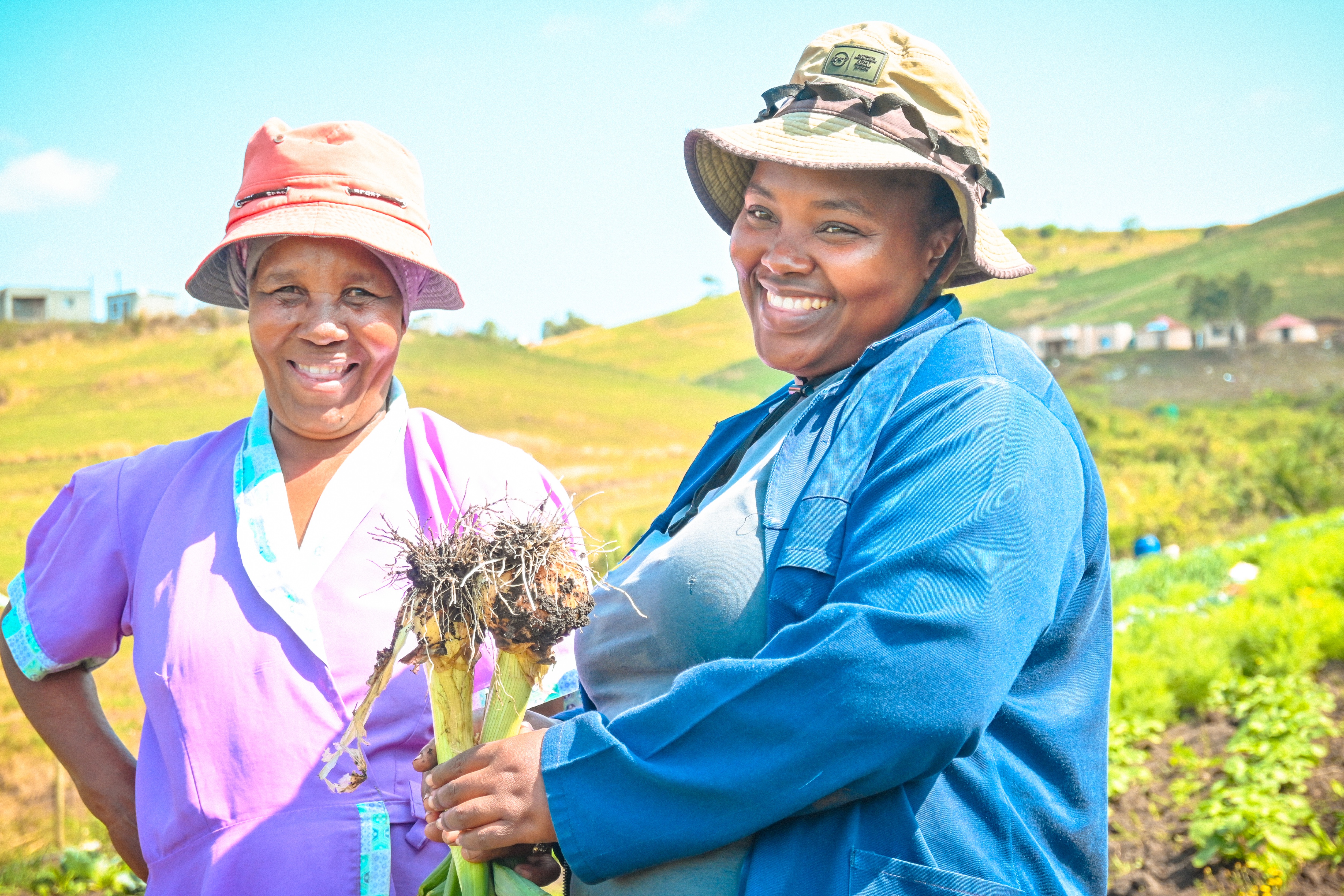
 FSED farmer Bonisile and mentor Londeka. (Photo: Supplied)
/file/dailymaverick/wp-content/uploads/2025/10/label-Op-Ed.jpg)
Bonisile Hadebe has eight people to feed. As a subsistence farmer in rural KwaZulu-Natal – and breadwinner in a multigenerational household – growing her own vegetables makes this possible. She also sells surplus produce to earn money, supplementing the social grants her family relies on.
Across South Africa, more than a fifth of households depend on social grants as their main source of income. For women like Bonisile, this support is essential. But it’s also not enough to consistently afford nutritious food. The Child Support Grant of R560 falls well short of the roughly R942 it costs to secure a basic nutritious diet for a child, even with the R20 increase coming into effect this year.
Faced with this gap, Bonisile joined other women to start a communal farm with support from the NGO Thanda. Growing their own food closes the distance between what households can afford and what their children need to eat.
Their experience points to a national problem. Since most families buy their food instead of growing it, food security is closely tied to income, particularly in a country where more than 40 million people scrape by on less than a R100 a day and 10 million are considered “food poor”. Proximity to shops or markets is another factor affecting their access to food. In rural communities, this could mean walking for an hour to the nearest spaza shop.
High stunting rate
Poverty drives food insecurity. Nationally, 63.5% of households are food insecure to some degree; the consequence of this is evident in our country’s high stunting rate. More than a quarter of children under the age of five are stunted due to chronic malnutrition, made worse by repeated infections. Stunting hampers their physical growth and brain development, severely undermining their ability to learn and earn an income later in life.
The link between income poverty and food insecurity must be broken. In this regard, the United Nations’ Food and Agriculture Organisation has called on governments to invest in women farmers, including through the declaration of 2026 as the International Year of the Woman Farmer.
This offers clear direction at a time when the South African government says it’s committed to eradicating stunting by 2030.
Supporting women like Bonisile to grow their own food must form part of our national plan to end stunting. This plan must also include adequate social protection for pregnant women and children living in poverty, and a substantial reduction in the price of protein-rich pantry staples, among other measures that support children’s growth in the first 1,000 days of life.
/file/dailymaverick/wp-content/uploads/2025/06/067A8866.jpg "Women filling up bags with mielies on a farm outside Bothaville in the Free State on 12 June 2025. (Photo: Felix Dlangamandla)")
What rural women need to grow their own food
Agricultural support and training extension services – defined as the system that facilitates and supports people doing agricultural activities through information, skills and access to tools and technology – often fail to reach women, like Bonisile, working on small plots in rural communities.
These services can easily be delivered through channels that women already access, including NGOs, farmer networks and community-based training interventions.
Until a year ago when Thanda helped Bonisile and other women in her community to establish Berea Farm, they struggled to grow a diverse array of produce because of the lack of extension services.
Environmentally friendly farming practices, known as agroecology, implemented by NGOs like Thanda, Seriti Institute and Siyavuna for instance, have equipped women farmers with practical skills to improve yields, adapt to climate shocks and manage natural resources sustainably. These interventions build confidence, resilience and economic independence.
Once support and extension services are in place, the next step is to link subsistence farmers with early childhood development centres or crèches, as Thanda has also done. It’s a win-win: young children in surrounding communities gain access to fresh, nutritious food while women farmers have a reliable market for their surplus produce.
Today, approximately 84% of Thanda’s farmers are women.
Women-focused agricultural enterprise programmes are facilitating transitions from subsistence farming to small agribusinesses. With access to mentorship, financial literacy, market linkages and cooperative development, women farmers are better able to feed their families and grow surplus produce for sale. In this way, their farming becomes a catalyst for improved nutrition, preventing child malnutrition and boosting income generation.
/file/dailymaverick/wp-content/uploads/2023/08/Photo-essay-Spinach-farm-04.jpg "Women rolling up row covers to maintain cool soil and deter pests before harvesting spinach at Costa farm in Klippoortje, Boksburg. (Photo: Felix Dlangamandla)")
Structural and policy changes
Despite their critical role in local food systems, women farmers globally are less likely than men to own land, access finance, secure insurance or benefit from extension services. In addition, because smallholder farmers are viewed simply as “subsistence” producers rather than economic players, they are excluded from formal markets and supply chains, hindering their ability to earn an income.
The International Year of the Woman Farmer coupled with the government’s stunting eradication goal must be the catalyst for policy reform and investment in rural women. We need broader structural changes. In practice, we must see equal land rights for women in ownership, inheritance and land allocation.
There must be an expansion of fit-for-purpose agricultural finance and insurance products that target smallholder farmers, agricultural extension services must reach women in rural communities through NGOs and other accessible channels, and we need to strengthen the links between subsistence farmers and early childhood development centres to improve child nutrition.
Bonisile’s approach to growing her own food has transformed, and she will pass this knowledge on to the next generation, helping to break the link between income poverty and food insecurity. DM
Sibongiseni Peacock and Rahima Essop work at the DG Murray Trust as Innovation Manager and Communications Director, respectively. Angela Larkan is the co-founder and Executive Director at Thanda.