




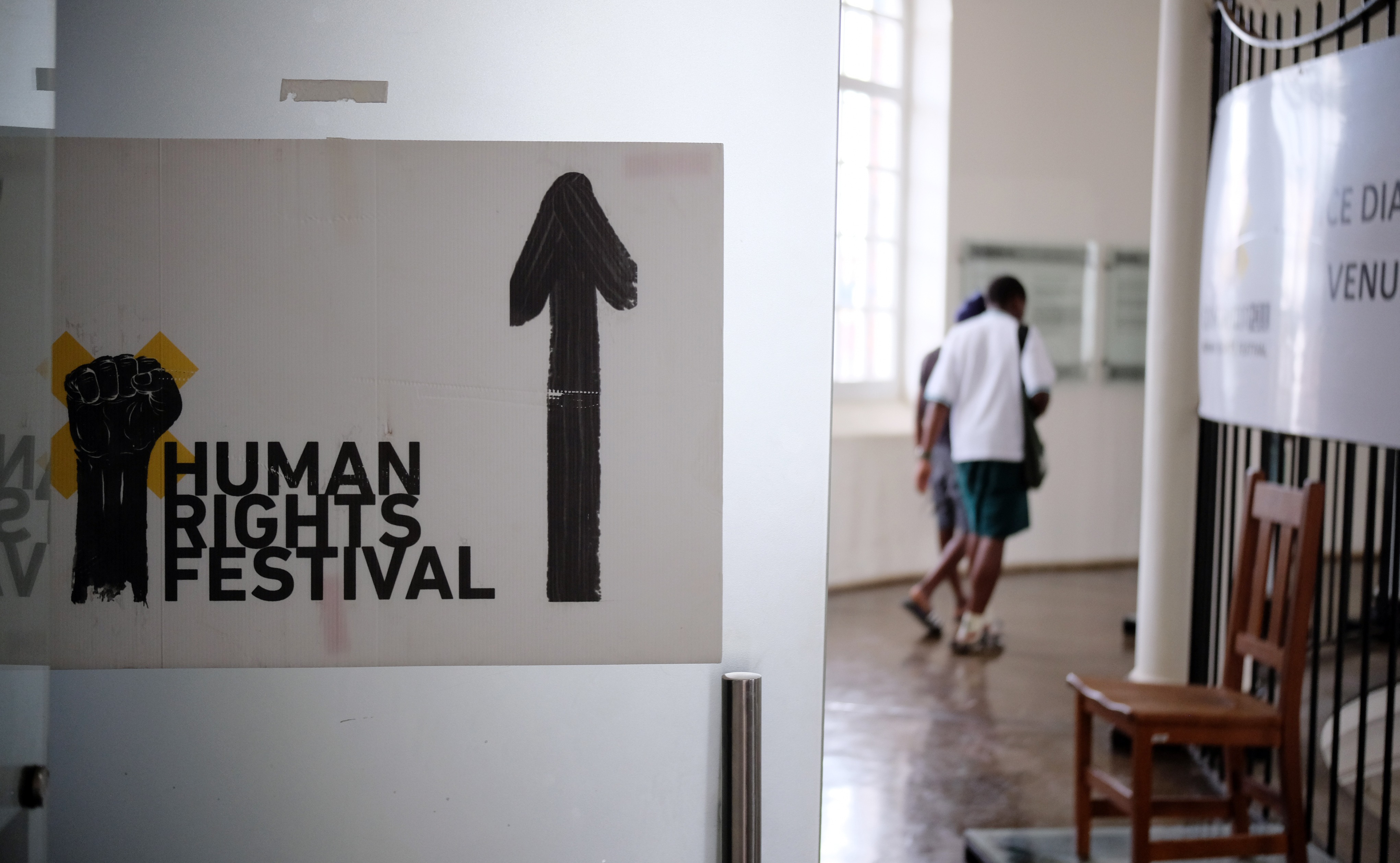
 A panel discussion on research on gender-based violence and justice for survivors was held at the Human Rights Festival at Constitution Hill in Johannesburg on 28 March 2026. (Photo: Daniélle Schaafsma)
 What justice looks like
Ask a gender-based violence (GBV) survivor what justice means to them, and the answer is probably not what you would expect, said Itumeleng Magoai, the Programme Manager for Gender Justice and Psychosocial Support at the Foundation for Human Rights.
“When we asked survivors what justice looked like for them, the answer was mostly not about the perpetrator going to jail,” said Samantha Vilakazi of the Get Informed Youth Development Centre in Tembisa, one of 22 community-based organisations that participated in a year-long qualitative study led by the foundation.
“It was about healing. It was about the community acknowledging that what happened to them was wrong.”
The study, released in July 2025, was conducted across all nine provinces with survivors, families and community-based organisations. Taking a deliberately decolonial and survivor-centred approach, it asked a deceptively simple question: What does justice actually mean to you?
The answers pointed away from courtrooms and convictions. Survivors described justice as safety, dignity, an apology and the ability to rebuild their lives. Many reported that engaging with the criminal justice system caused further harm through corruption, indifference and secondary victimisation.
“From what I have seen, seeking justice kukuzilimaza kakhulu (it is causing harm to oneself) unless unama cent (unless you are monied),” one survivor told the focus group organisers.
/file/attachments/orphans/1_689040.jpg "A panel on research conducted on gender-based violence and justice for survivors at the Human Rights Festival, held at Constitution Hill on 28 March 2026. (From left to right) Itumeleng Magoai, session moderator and Programme Manager for Gender Justice and Psychosocial support at the Foundation for Human Rights; Duduzile Ndlovu, lead researcher on the study; DiTebogo Ncube of the Letlhabile Network Community Advice Office; Samantha Vilakazi of the Get Informed Youth Development Centre; and Lulama Shongwe, an attorney at Access Chapter 2. (Photo: Daniélle Schaafsma)")
At a panel discussion on 28 March at the Human Rights Festival at Constitution Hill, discussing the research done by the Foundation for Human Rights, lead researcher Duduzile Ndlovu said that survivors navigated plural systems simultaneously –criminal, customary, religious and community-based – making strategic choices based on what felt safe and possible, not what the formal system expected.
Through the research, they found that “when something had to do with traditional leadership, there was an immediate assumption that they are patriarchal, [and that] we are not going to have anything progressive about GBV from that”, she said. “And yet there were spaces, and in certain locations where that’s the closest justice system to people, and it’s actually effective for what people want to achieve [at] that point.”
The assumptions we held about what justice meant were not always accurate, she said.
“I wouldn’t underestimate the importance of an effective justice system and how it facilitates healing and restorative justice for survivors,” said Kgahliso Mangoale, Project Lead for GBV Sukuthula at the DG Murray Trust. “However, the justice that survivors need should not be understood in a linear way.”
The research highlighted that justice preceded legal outcomes and that survivors considered dignity, being believed, receiving protection from future harm, and regaining agency as part of “relational justice”, she said.
The declaration
In November 2025, during the 16 Days of Activism, the National Disaster Management Centre declared GBVF a national disaster – the first time SA had formally classified the crisis in those terms.
/file/attachments/orphans/ED_587037_886945.jpg "More than a thousand students and staff lay down for 15 minutes in protest against gender-based violence and femicide (GBVF) at the University Of Cape Town on 21 November 2025. (Photo: Gallo Images / Brenton Geach)")
It followed sustained civil society pressure, most visibly the Purple Movement led by Women For Change, which saw more than 700,000 people turn their social media profiles purple. The organisation delivered a petition signed by over one million people to the government, calling for exactly this classification.
“This call was not symbolic – it was strategic,” Women For Change told Daily Maverick. “We needed a mechanism that would allow us to hold the government accountable.”
In principle, the classification carries real weight: it implies urgency, coordinated action and allocated budgets. Women For Change said that more than four months on, there has been no clear implementation plan, no visible budget allocation, and no consistent public reporting on progress – though the organisation acknowledged a council structure exists and that engagement with government officials last took place on 20 December.
“A national disaster cannot exist only in name,” the organisation said. “It must translate into real, tangible change.”
The declaration did speak to something the Foundation for Human Rights research found survivors were hungry for – validation.
“At least from the president, it is validation to the fact that what we see in our communities; the magnitude of violence and femicide is real,” Magoai said.
Policy ambitions and their limits
The National Strategic Plan on GBVF, launched in 2020, set out a comprehensive 10-year framework across six pillars. Five years later, a February 2025 policy brief by the DG Murray Trust identified persistent challenges in closing the gap between what the plan sets out and what has been delivered on the ground: Thuthuzela Care Centres are being rolled out more slowly than needed, shelters remain underfunded, and the National Strategic Plan was not fully costed from the outset.
“SA has very good policies,” Magoai said. “But that doesn’t actually mean anything any more. You need things where you are able to evaluate, monitor and come back and say: ‘Are these strategies actually working?’”
According to Mangoale, the declaration has the potential to strengthen accountability for implementation of the National Strategic Plan and bring greater resourcing to both prevention and survivor support. She added that while development sector partners had individually been guided by the plan’s framework in their work, coordinated efforts across sectors remained important to enable national surveillance and monitoring of interventions.
/file/attachments/orphans/2_477310.jpg "Itumeleng Magoai (left), session moderator and Programme Manager for Gender Justice and Psychosocial Support at the Foundation for Human Rights, and Duduzile Ndlovu, lead researcher on the study, during a panel discussion on what justice means for survivors of gender-based violence and research done by foundation on the subject. (Photo: Daniélle Schaafsma)")
Something else emerged from the Foundation for Human Right’s research process itself. Participants kept asking when the next focus group would be held.
“For them it’s like, when is the next space for this kind of reflection,” Magoai said. “When is the next space that allows me to meet other people dealing with the same systemic issues, so I don’t feel so alone? The finding tells us that people are hungry for collective support, for collective validation.”
According to the chairperson of the Portfolio Committee on Social Development, Bridget Masango, in a media statement on 25 December 2025, Statistics South Africa’s most recent Governance, Public Safety and Justice Survey at the time found that only 1.9% of assault survivors received counselling. Masango highlighted this as evidence of how deeply under-resourced psychosocial support systems remain.
What needs to change
Magoai argued that for the disaster declaration to mean anything at ground level, it needed to be operationalised in communities – not administered as a single national framework.
“Communities are so different,” she said. “The disaster looks different in different communities and in different contexts.”
According to Women For Change, what is needed is a publicly accessible implementation plan with timelines, dedicated and ring-fenced funding for survivor support, regular public reporting, and a coordinating body that includes civil society and survivor voices.
Attorney Lulama Shongwe of Access Chapter 2, which provides legal services to LGBTQIA+ persons and GBV survivors, said during the panel discussion that survivors were looking for affirmation, acknowledgement and accountability – things the criminal justice system, rooted in punishment, was often not structured to provide.
“The case handling can either facilitate healing or secondary traumatisation,” said Mangoale, underscoring the importance of first responders receiving sensitivity training so that survivors were received in a safe, victim-friendly environment, both physically and emotionally.
The financial dimension ran through all of it. As one survivor put it in the Foundation for Human Rights research: “If I get this person arrested, what would I ever eat again?” For many, pursuing justice is not simply a legal decision – it is an economic one too.
Whether a national disaster declaration – with its emphasis on coordination and state response – can reach that level of complexity and speak to the justice that survivors are truly calling for, remains the question. DM