




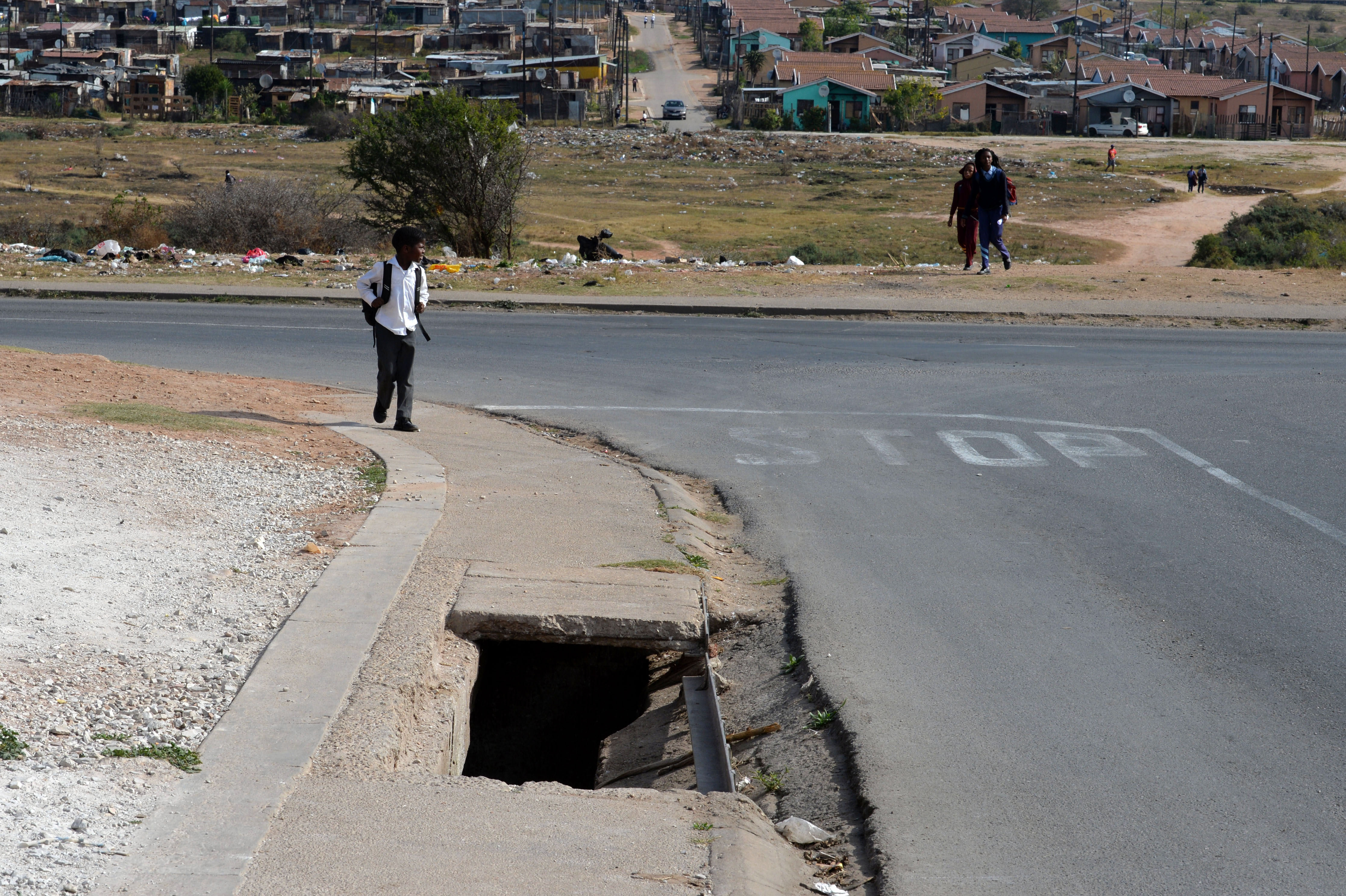
 A gaping manhole in Greenfields, Kariega, Eastern Cape. (Photo: Deon Ferreira)
 No doubt, we have all had many déjà vu moments – when we feel that we have already experienced the present situation in which we find ourselves. In most cases it is just a feeling, a sensory illusion that something is repeating itself even when it actually isn’t. But, when it comes to South Africa’s local government, the repetitive experience is not a feeling or the stuff of satire (as per the roadworks sign above) but a hard-nosed reality.
The foundational frame
Right from the beginning of the post-apartheid era, the experience of local government by large numbers of South Africans was one of disappointment, unfulfilled expectations and betrayed promise.
The main reason for this was with the transfer of much-expanded post-apartheid governance and service delivery mandates to local government. While driven by a generally positive and understandable constitutional mandate to bring the state closer to the previously excluded majority, this was paralleled by the gradual but systematic cutting off of a large chunk of national government fiscal support/subsidies.
As part of the ANC’s overarching neoliberal development ideology (in the form of the “Gear” macro-economic frame), the real “equitable share” of national revenue that should have been provided (alongside conditional grants), was consistently slashed from the mid-1990s onwards.
Over the past 30 years, this accelerated the dominant reliance on self-generated revenue to fund the delivery of an ever-expanding range of basic services. By 2020, the national average of self-generated income stood at 71% (noting the sizeable variations between metros and rural municipalities).
This foundational frame bequeathed a slowly brewing but consistently experienced recipe for institutional dysfunction, mal-governance, corruption and (class and racial) service inequality through:
- An intensified push for the privatisation and corporatisation of service entities, as well as for the outsourcing of the management and delivery of public services;
- The implementation of “cost recovery” mechanisms as a means to gain revenue (the “user pays” or “double-rent” rule), resulting in the prioritisation of delivery to those able to pay and cut-offs of basic services in poor communities for those least able to afford payment;
- A widening gap between funds spent on personnel salaries versus that of actual operations and delivery of services, fuelling competition to influence and control the allocation of jobs and thus also, the growth of factions and patronage networks;
- Increased competition for access to and control over the now much-reduced operational budget which, in turn, led to the de-prioritisation of capital-intensive projects such as service infrastructure and maintenance, further contributing to social and environmental decay; and
- Reduced capacity to professionally manage an ever-increasing service delivery mandate and expanding bureaucracy.
Harsh realities: Consistent and deepening crisis
It took more than a decade from the unveiling of the new South Africa’s ideal vision and plan for local government – as contained in the 1998 White Paper – for government to publicly recognise and acknowledge the extent of the gathering crisis. And what a crisis it had already become.
In its 2009 State of Local Government Report, the Ministry of Cooperative Governance and Traditional Affairs (CoGTA) found that there was:
- Widespread institutional and delivery “paralysis” where “proper planning is abandoned”; political factionalism, which has turned into “a battle over state resources”;
- Massive and increasing services backlogs;
- A “culture of patronage, fraud and nepotism [which] is now so widespread that formal systems of accountability are ineffective and inaccessible to most citizens”; and
- “Poor financial management” leading to huge amounts of “fruitless and wasteful expenditure”.
By the time the Local Government ‘Back to Basics’ Summit was held in 2014, many aspects of the crisis had multiplied. According to the Auditor-General’s (AG’s) 2014-2015 Local Government Audit Outcomes Report:
- “Irregular expenditure has more than doubled since 2010-11”;
- “Fruitless and wasteful expenditure was more than R1-billion higher than in 2010-11”;
- “Unauthorised expenditure has also increased threefold since 2010-11 to R15.32-billion”; and
- “The financial health of 92% of the municipalities (is) either concerning or requiring intervention”, with 26% being in a position of “material uncertainty (about) their ability to continue operating”.
And then in 2021, the conclusions of CoGTA’s State of Local Government Report were even more specifically damning. Among these were:
- “Serious staffing issues, including a high proportion of vacancies”;
- “The absence of suitably competent senior managers and CFOs”;
- “Bloated organisational structures that take up most of the budgeted expenditure”;
- “Weak budgeting capabilities (and) ineffective budget planning and implementation”;
- “Inadequate allocations for infrastructure repairs and maintenance and asset management”; and
- “Weak internal controls and supply chain management, and low revenue collection levels.”
Fast forward a few more years to the 2023-2024 AG report on local government audit outcomes and the National Treasury’s Municipal Money report for the same year, and that “frozen in time” feeling once again morphed into repetitive reality:
- Only 16% of the 257 municipalities reviewed had clean audits;
- An average of 90 “material irregularities” per year were identified at 131 municipalities;
- There was “widespread (and) inadequate procurement and contract management … poor financial management (and) lack of consequences”;
- Unauthorised expenditure for the City of Johannesburg was R2.76-billion, for the City of Tshwane (R2.15-billion) and for Nelson Mandela Bay (R1.44-billion);
- The City of Johannesburg overspent its budgeted operating expenditure by 570.4%; and
- The City of Johannesburg had 0.5 months of cash coverage (ie, the months of operating expenses that can be paid for with the cash available).
It’s about the people
While the “story” laid out above serves to confirm the objective and factual basis of this crisis, it does not fully capture the parallel reality of how most people in South Africa have experienced the crisis.
Arguably, the most negative impact has been the ever-increasing unavailability and unaffordability of basic services such as electricity, water and sanitation, waste management, public transport, as well as general property rates/taxes, alongside the rapid deterioration of public infrastructure such as water pipes and reservoirs, roads, street lights, stormwater drainage and many parks.
Just to give one example from my own city of Johannesburg: according to the National Treasury, the percentage increase in monthly bills for services between 2019-2024 for what government terms “indigent” people, was 88.22%.
At a national level, the National Treasury’s local government report for the second quarter of the 2025-26 financial year reveals that municipal consumer debt now stands at an astronomical R467.2-billion (an increase of R60-billion over the last year). Debt for residents stands at R335.3-billion, while R94.7-billion is owed by business entities.
Leaving aside the minority of residents and businesses who can pay, but consciously choose not to (with the worst offenders often being government departments/entities), the fact is that the crisis of local government is increasingly making it impossible for ever-larger numbers of people to enjoy the basics of life.
Nowhere has this “experience” become a constant lived reality than in the lives of the working class and even more so, for the more than five million people who live in informal settlements for whom any kind of public, municipal service has become rarer than honest politicians and corporate bosses.
Another crucial impact is the incessant assault on local democracy and public participation in South Africa’s already vulnerable democratic system. The flip side of the widespread corruption and mal-governance has been the narrowing/closing down of nearly all the institutional (democratic) spaces for community access to information and participation in decision-making.
As the 2009 CoGTA report profiled earlier stated (more than 17 years ago), “there is now a lack of citizen confidence and trust in the system”, with protests “largely a symptom of their alienation” from local government.
People’s experience of marginalisation and alienation has since, if anything, grown wider and deeper. A February 2026 national research study by Ipsos – The “Pulse of the People” – found that 60% are wholly dissatisfied with their municipality’s performance.
Some may argue (particularly government officials and senior ANC members) that we are beginning to witness degrees of a “turnaround”.
They might cite, as President Cyril Ramaphosa did in his replies to questions in the National Assembly in mid-March, the establishment of the National Water Crisis Committee or the Metro Trading Services Reform programme designed to overhaul electricity, water and waste services in our eight metros.
While any improvements are to be welcomed, the harsh reality once again is that there is no amount of repeated rhetoric, promise or plan that can replace or remove the lived experience of people.
If those with political and economic power continue in their generalised refusal to recognise, understand and inculcate this, then, sooner or later, their own lived experience might well be a direct reflection of President Ramaphosa’s recent words to his ANC local government councillors: “Without you doing anything, we are dead; we might as well pack up.” DM
Dr Dale T McKinley is a Johannesburg-based independent writer, researcher and lecturer focused on political economy and presently, Research and Education Officer at the International Labour, Research and Information Group.