




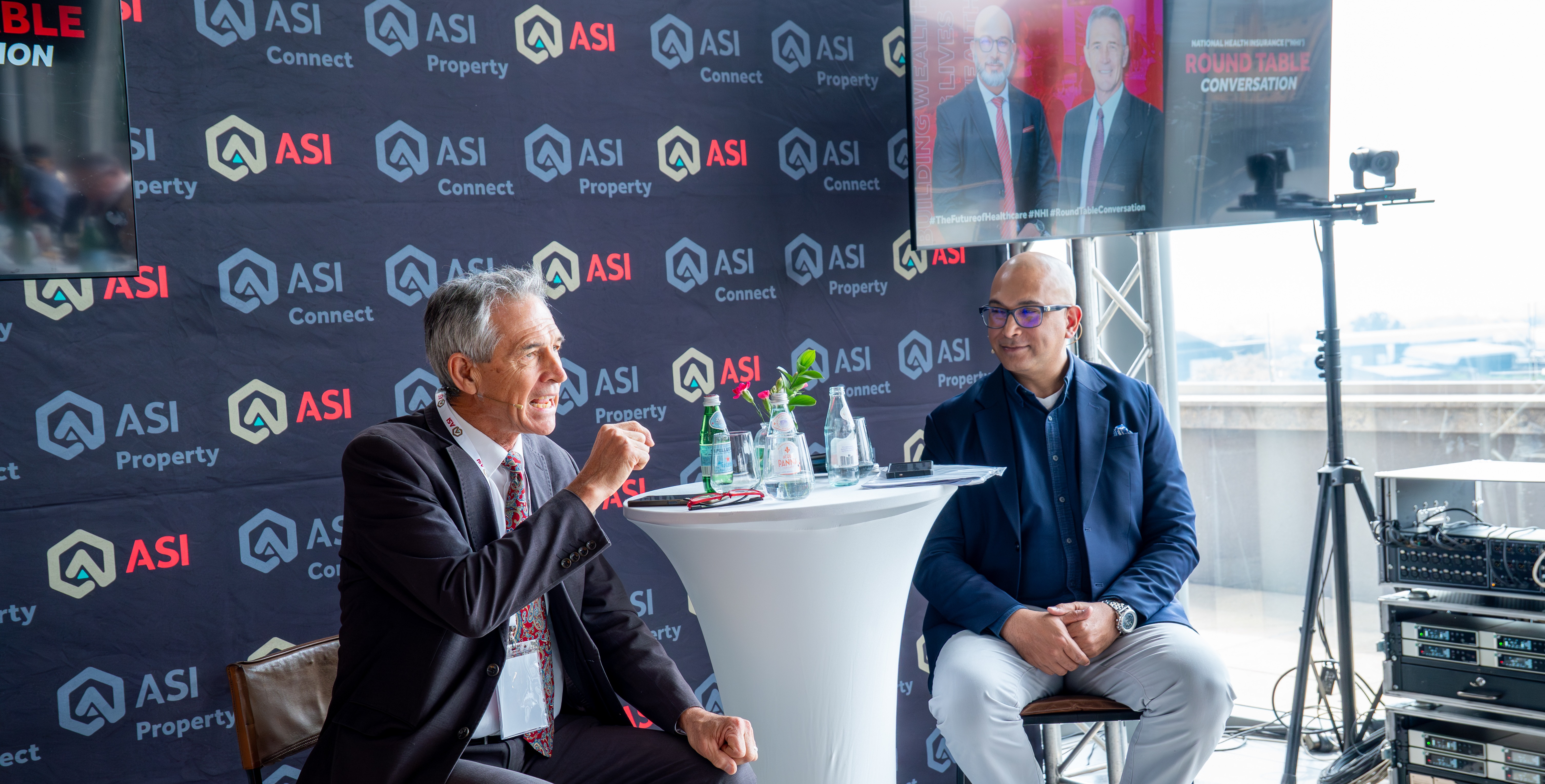
 From left to right, image 1: Prof. Nicholas Crisp, Deputy Director-General of National Health Insurance (NHI) and Founder and CEO at ASI Group, Anthony Govender.
 National Health Insurance (NHI) is the government’s answer to this crisis. At its core, NHI is a health financing system that pools the nation’s resources into a single National Health Insurance Fund, ensuring that every South African has access to quality healthcare services regardless of their income, employment status, or where they live. The ambition is bold: to dismantle a century of healthcare inequality and replace it with a system built on the principle of universal access.
But bold ambitions come with complex realities. With a Constitutional Court ruling on critical challenges to the NHI Act expected by May 2026, South African businesses are navigating one of the most consequential healthcare transitions in the country’s history. The question is no longer whether NHI will reshape the landscape, but how fast, and whether your organisation is ready.
At a recent high-level roundtable hosted by ASI Financial Services in Sandton, the air was thick with a single, pressing question: What happens next?
/file/attachments/2990/DSC0453411_216351.jpg "Naseema Ephraim, Employee Benefits Operations Director at ASI Financial Services, Kgotleletso Bodibe Manager of Employee Benefits at ASI Financials and Devlin Ross Manager of Employee Benefits at ASI Financial Services.<br>")
Joined by Dr. Nicholas Crisp, Deputy Director-General of National Health Insurance (NHI), we convened CEOs, CFOs, and HR executives to move beyond the headlines and into the mechanics of South Africa’s healthcare transition. The consensus was clear: healthcare is no longer just a "benefit line" on a payroll; it has become a strategic, financial, and workforce imperative.
To understand the urgency of this moment, we must acknowledge the legacy that brought us here. As Dr. Crisp highlighted during the dialogue, our healthcare challenges are deeply rooted in apartheid-era fragmentation. We inherited a system designed to exclude, and for three decades, we have lived with a "two-tier" reality that is both morally and economically unsustainable.
Millions of South Africans rely on a public health system that is underfunded and overstretched, while the private sector grapples with spiralling costs. The NHI is not merely a policy debate; it is an attempt to rewrite a social contract that has been broken for nearly a century. Whether the courts uphold every clause or demand revision, the intent of the NHI to pool resources for the public good is a shift that business leaders can no longer ignore.
For the C-Suite, the NHI is often viewed as a distant "government problem." This is a mistake. It is a fundamental shift in one of your fastest-growing cost lines. With a Constitutional Court ruling on critical challenges expected by May 2026, the next 60 days represent the most volatile transition period for corporate health in a generation.
Actuarial modelling suggests that "waiting for the gavel to fall" is a recipe for operational chaos. The risks of inertia are threefold:
1. Financial sustainability: As the NHI Fund moves toward pooling resources, businesses must navigate a "double-cost" danger zone, balancing rising private medical aid premiums with impending national levies.
2. The talent war: In a period of national healthcare flux, an organisation’s ability to guarantee seamless access to quality care is its strongest retention tool.
3. Benefit duplication: Without a proactive strategy, companies risk paying twice for the same primary care services once NHI elements go live.
/file/attachments/2990/DSC045751_724721.jpg "Founder and CEO at ASI Group, Anthony Govender and Prof. Nicholas Crisp, Deputy Director-General of National Health Insurance (NHI).")
The Hybrid future: not 'either/or.'
The future is not a binary choice between private and state; it is Hybrid.
In this model, the NHI provides the foundation for universal access to primary care, emergency services, and screenings. Forward-thinking employers will then "bridge the gap" with targeted private cover for specialist consultations, chronic disease management, and mental health support.
At ASI, we see our role as the architects of this bridge. We are helping South Africa’s leading organisations design a transition that protects their bottom line while honouring the national imperative for equity. This involves restructuring remuneration, rethinking tax credits, and using data-led modeling to ensure that "universal care" doesn't mean "decreased quality" for your workforce.
The "how" of NHI is deeply disputed. The "why" is not.
Business leaders face a choice: remain a spectator to this transformation and scramble to react when the legal hurdles clear or take a seat at the table now. Leading the transition means moving beyond the fear of reform and toward the opportunity of a more equitable, productive South Africa.
The system is changing. The only question is: Is your organisation positioned to lead, or are you waiting for the gavel to fall?
The healthcare landscape is shifting rapidly. For real-time updates, actuarial insights, and strategies to future-proof your organisation Follow ASI Financial Services on LinkedIn. DM