




 The food basket has decreased by R19 in March, but remains R40 more expensive than the SRD grant.
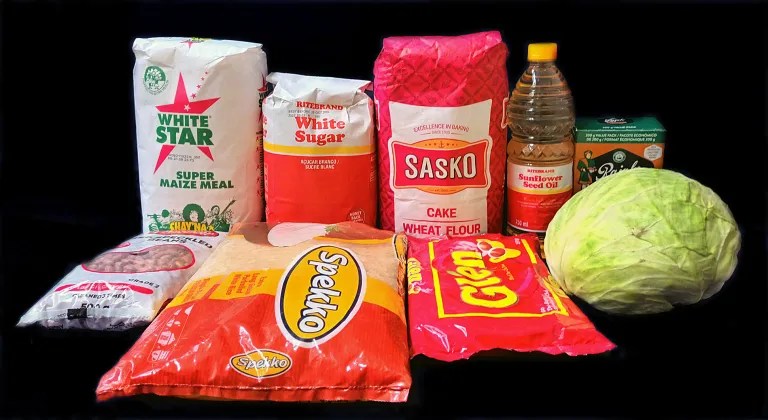
 Maverick Citizen has been tracking the prices of 14 basic food items that can be bought with the R370 Social Relief of Distress (SRD) grant. The basket decreased by R19 in March, amounting to R407,86, mainly because mielie meal and rice have decreased in cost. Cooking oil has increased by R6, a notable jump in price.
This means the food basket is almost R40 more expensive than the SRD grant, making fundamental caloric intake impossible for South Africa’s poorest.
Pietermaritzburg Economic Justice and Dignity’s Household Affordability Index tracks 44 basic food items. In March, the household food basket cost R5,328.53, and has decreased by R55,28 since February.
The basic nutritional basket, on the other hand, amounts to R6,410.74, which is R1,082.21 more expensive than the household food basket.
“It means that in March 2026, families living on low-incomes may underspend on basic nutritional food by a minimum of 17% (R1 082,21),” the PMEJD Household Affordability Index outlined.
/file/attachments/2990/Food-prices-Feb-March-2026_899040.jpg)
Child food poverty
On 27 February 2026, Dr Safura Abdool Karim and Dr Petronell Kruger at the Centre for the Aids Programme of Research in SA (Caprisa), Dr Tamryn Frank at the University of the Western Cape (UWC), and Dr Agnes Erzse at Unicef Child Nutrition and Development Practice, Center of Excellence, Nairobi, Kenya, Global Programme Division, presented on the right to food to the South African Human Rights Commission (SAHRC), with additional inputs from Gilbert Tshitaudzi, Nutrition Manager at Unicef (the UN’s children fund).
They submitted that persistent food insecurity and undernutrition coexist with rising levels of overweight and obesity and diet-related non-communicable diseases. Therefore the inquiry should not just be about not starving, but about power, governance and regulation shaping access to nutritious food.
Notably, they said that it must also focus on “child food poverty” – that is, children’s inability to access and consume a nutritious and diverse diet, and the lifelong consequences of lack of access. Unicef’s child food poverty framework shows that household income, while important, is not the sole determinant of nutritious diets: child food poverty is experienced by children in poor and non-poor households, so poor food environments, harmful marketing and poor feeding support/practices must be addressed alongside income poverty.
“Ultra-processed foods are frequently cheaper per calorie than minimally processed foods, reflecting industrial production methods, global supply chains and economies of scale. In contexts of poverty and income inequality, these pricing structures render nutritionally poor products economically rational. ‘Choice’ operates within a constrained economic architecture,” they said.
The state’s protective obligation is at the population level, they outlined, where concentrated corporate actors shape availability, pricing structures and marketing environments. So, the state cannot rely on ‘individual choice narratives’ to fulfil what is its duty, they said.
“Structural risk requires structural response. This is particularly so for children, who are more vulnerable to commercial persuasion, have limited autonomy over food environments, and bear lifelong consequences from early dietary exposures.”
/file/attachments/orphans/Safura-Abdool-Karim-web_459688.jpg "Safura Abdool Karim. (Photo: Supplied)")
The food system and grants
“A grant can be a very important tool for general poverty alleviation and harm reduction. What is so key about our social grants system is that it enables people to direct those funds to things that they consider essential,” said Dr Karim. “Not everyone will direct a grant to food, nor does a grant guarantee that people will be able to eat better, but it can serve a very important function to assist those living below the poverty line, and goes some way to ensuring basic needs are met.”
A grant cannot offer a complete solution in a broken, unhealthy food system, she said, because even if people have money, they still may not have access to healthy food, or to afford the time and costs of preparing healthy food or the means to store food.
“What we need to make a meaningful difference is structural, upstream reform of the food system. Downstream interventions, such as increasing the money people have to spend on food, becomes a very incomplete solution in a food system that doesn't deliver healthy, nutritious food,” Karim said.
Food poverty and income poverty
The Universal Basic Income Coalition in SA, which has members such as the Institute for Economic Justice, Black Sash, Alternative Information & Development Centre, the Women on Farms project, also submitted to the SAHRC hearings.
Food insecurity is related to income poverty, which is in turn highly correlated with unemployment, they submitted. In sub-Saharan Africa, about 90% of people’s livelihoods come from agricultural activities, while in SA only 17.1% of households engage in agricultural activities.
Their submission focused on the links between unemployment, insufficient income and food for people, and what can be improved with the current social assistance framework.
SA produces enough food to feed everyone a basic nutritious diet, they outlined, so the drivers of food insecurity are not scarcity, but distribution and access.
A total of 66.7% of the country (40.8 million people) live below the upper-bound poverty line, meaning they are unable to afford basic necessities. A total of 17.6% (10.8 million) live below the food poverty line, the level of income required to meet an individual’s basic caloric intake requirements if all their income is spent on food.
However, living above the food poverty line doesn’t automatically mean adequate nutrition. A total of 64.7% of all households spend on food per person below the food poverty line.
Research has shown that expanding the Older Person’s Grant and the Child Support Grant leads to positive impacts on dietary diversity and child nutrition. Research has also shown that these grants are mainly spent on food.
While social grant coverage has increased in recent years, unfortunately the impact of these grants on nutrition has levelled off – no longer protecting against malnutrition and stunting as they once did, the submission said. This is due to the cost of food, and the proportion of people without access to income.
“In 1998 after its introduction, the value of the Child Support Grant was just above the estimated cost of feeding a child. In 2026, at a value of R560, it is 35% below the food poverty line, and 40% below the cost of feeding a child as calculated by the Pietermaritzburg Economic Justice and Dignity group.”
The same goes for the SRD grant. Originally, it reduced the food poverty headcount by about four million people. However, at R370, it is only 43% of the food poverty line, compared with 60% when it was introduced in 2020.
“An estimated 17.4 million people of working-age have income below the food poverty line. However, the SRD grant is only budgeted for approximately 8 million people each month. This discrepancy predetermines a rate of exclusion of around 50%.”
The Institute for Economic Justice (IEJ) has found that between 2014 and 2015, where grant fraud was reported, that 75% was due to government officials, employees or contractors. However, anti-fraud measures by the SA Social Security Agency and the National Treasury have looked predominantly at beneficiaries, the institute reports.
New anti-fraud measures include automated credit bureaus, bank data and biometric systems, and in-person reviews. The Institute for Economic Justice said that while the intention was to protect public funds, the tools were often unreliable, resulting in grant suspensions, long queues and widespread confusion.
SRD grant vs universal income
The Universal Basic Income Coalition submitted that the most direct, evidence-based and cost-effective way to transform SA’s hunger crisis was to transform the SRD grant into a universal basic income for people aged 18-59, beginning at the value of the food poverty line and increasing over time to reach to value of the upper-bound poverty line.
It added that the Child Support Grant should be increased to the food poverty line, and keep pace with the universal basic income.
It cited basic income trials in sub-Saharan Africa showing promising nutritional outcomes; in Namibia, for example, where the pilot gave 54% of the value of the extreme poverty line to all working-age members of the community of Otjivero-Omitara.
Household food shortages went from 30% to 12% in seven months.
Before the pilot, 42% of children were undernourished and 51% stunted. After seven months, only 17% of children were undernourished.
“Narratives around social grants in SA and elsewhere often hinge on the idea of those who are “deserving” and those who are “undeserving” of support. But we don’t apply similar logic to rights like healthcare and education, which we accept should be universally available to everyone.
“Similarly, a dignified income floor which nobody can fall below should be a feature of a caring society. While many argue that this can be achieved by requiring beneficiaries to apply and pass various eligibility tests of whether they are deserving, the reality is that such approaches leave many of the most vulnerable behind,” the submission read. DM