




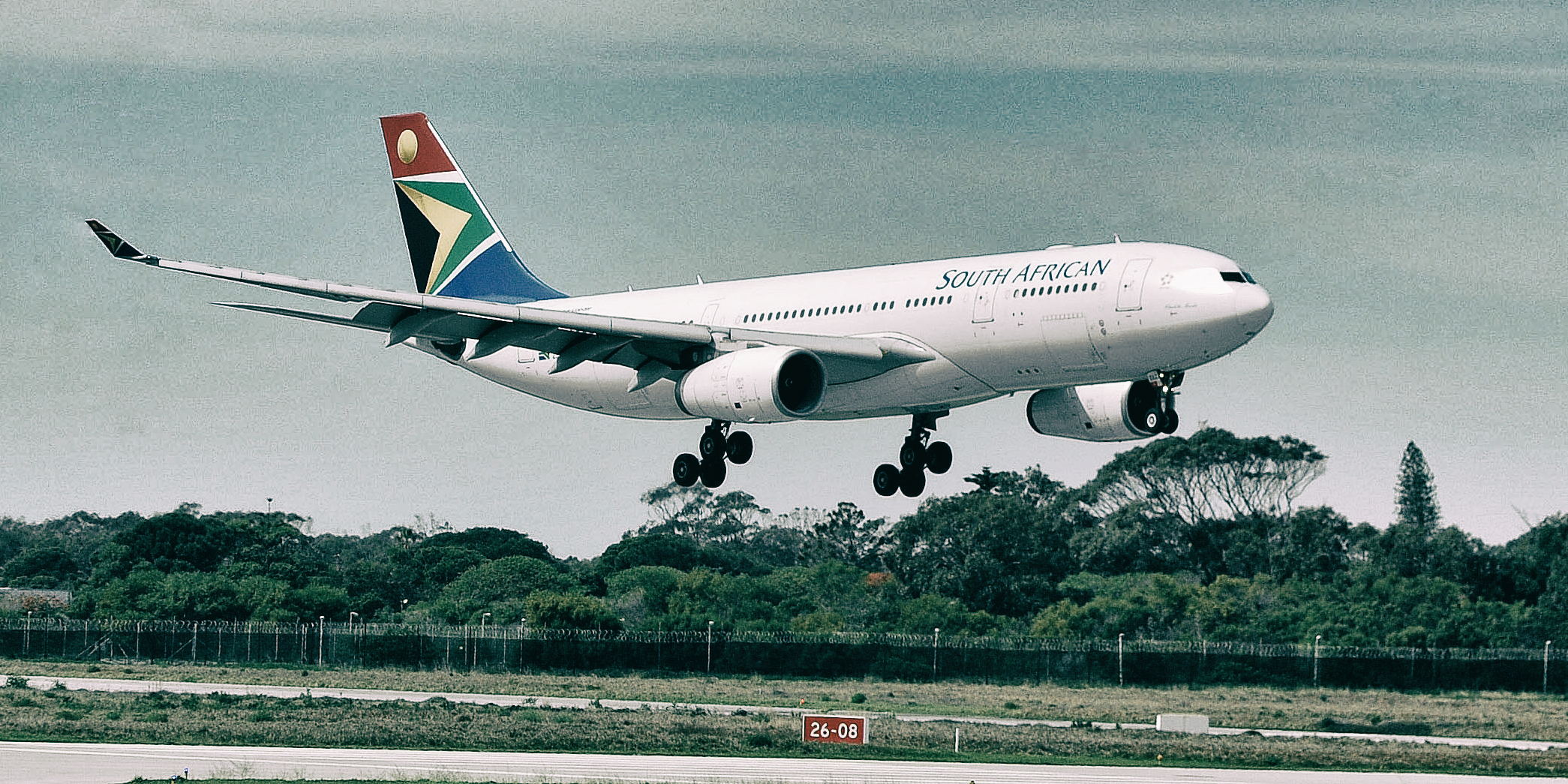
 South African Airways aircraft. (Photo: Gallo Images / Netwerk24 / Lulama Zenzile)
 Beyond its superficial claims of being profitable, SAA’s 2025 annual report is deeply disappointing and raises the fear that, like a ghoul risen from the dead, SAA V2.0 is a reincarnation of the insatiable monster that was SAA V1.1.
Peering into the 2025 report is akin to falling into Alice’s rabbit hole. A standout absurdity is that it does not provide any one number for a profit (or loss), nor any convincing evidence that the airline made the profit it claims. Further, the annual report contains so many errors that it’s tempting to suspect it aims to confuse key issues and thus hide a significant loss.
Since business rescue ended in April 2021, the airline has created the impression that it is making a profit from slow but measured growth. This is far from true.
In the 2024 financial year, the airline was forced to restate a claimed R71-million profit to show a R354-million (or larger) loss. For 2025, it claims to have made a R162-million profit after tax. Elsewhere, it claims a R336-million operating profit.
But hidden in the numbers is the hard reality that the airline had a R317-million Ebitda operating loss.
The R317-million operating loss is probably closest to the truth, as operating costs are stated as R9.583-billion, whereas revenue was just R9.266-billion.
When we asked about these seeming contradictions, SAA claimed it’s too busy with the 2026 year-end to address questions about the 2025 annual report. But a leaked internal memorandum from group CEO, Professor John Lamola, announced that the acting CFO, Lindsay Olitzki, had taken early retirement. Given the year-end timing, it seems she has been thrown under the bus.
Error-ridden
In the absence of answers from SAA, one of the key indicators as to just how appalling the 2025 annual report is, is that the Auditor-General did not just qualify the report, but issued a deep disclaimer, which included noting R505-million in irregular expenditure. Even more fantastical is that R219-million worth of costs are labelled as income, which then produces a R155-million profit after interest and tax.
There’s more. The 2024 loss is stated at R433-million, yet at the beginning of the report it was listed as 513-million. The numbers just don’t add up. So we have a profit that may be R366-million – or may be R155-million – but is probably a loss of R317-million.
If we take a deep dive into the profit and loss statement, again, we get a different number. This time it says R162-million profit (compared with the R336-million at the beginning). They accomplished this by finding a few exceptional one-off items to turn the operating loss into a R162-million “comprehensive profit”.
And so we have three different numbers for the bottom line. Nothing is as it seems.
Credibility is not helped by the most extraordinary basic blunders in the annual report. It mixes up millions and billions. And perhaps even more perturbingly, it shows a basic failing in understanding airline performance in that it states key metrics that are measured in kilometres, in rands. (What is the price of eggs? Answer: 250 litres.)
If the airline cannot get these basic metrics right, what confidence do we taxpayers have that it’s not going to revert to the bad old days of R5-billion-a-year bailouts? And even more significantly, how on Earth is it going to persuade hard-nosed banks and aircraft lessors that it is investable when it produces reports of such poor quality?
Selling the family silver
On the positive side, it would appear South African taxpayers are just relieved that in the five years since business rescue, the airline has apparently honoured Pravin Gordhan’s promises by not asking for a further bailout.
Yet even that is clouded. There are reports that in the 2025 financial year, SAA issued more than R1-billion worth of shares to its sole shareholder, the government. The government denies it was a bailout.
Further, the airline is resorting to selling the family silver to stay afloat. The 2025 annual report notes that the airline sold off a pair of highly valued slots at London’s Heathrow, with a R1.169-billion net gain from the disposal of “property, aircraft and equipment, and intangible assets”.
This must bode ill for the airline’s chances of ever successfully reopening the traditionally very profitable London-Joburg “Springbok service”.
Conveniently taking an extraordinary item of more than R1-billion onto the income statement raises the spectre of the infamous CEO Coleman Andrews famously pulling off a sale and leaseback of the 747 fleet and then taking the capital proceeds on the income statement.
Without the R1.1-billion gain, SAA would have shown a R1-billion loss. This is on par with the bad old days, which cost the taxpayer an average of about R1-billion a year.
It is worth remembering that any subsidy or bailout of the national airline is effectively a subsidy of the rich (who buy airline tickets) by the poor (who need government assistance for basic needs).
/file/dailymaverick/wp-content/uploads/2023/07/ED_203803.jpg "A South African airways plane in Cape Town. (Photo: Gallo Images / Jacques Stander)")
It is a bad portent that SAA’s CFO, Olitzki, suddenly decided to take early retirement, the day before the financial year-end. It is hard not to conclude that her departure makes her a sacrificial lamb to cover the airline’s deep structural problems.
Key among these problems is that the airline remains chronically undercapitalised and is thus unable to acquire new fuel-efficient aircraft. Without those, it cannot earn hard currency on the long-haul international routes it needs to re-establish to London, Europe and the US. And it will have to continue with its inferior in-flight entertainment offering.
The future is not bright. With sky-rocketing fuel prices and supply chain constraints, 2026 is shaping up to be yet another annus horribilis for the airline industry.
SAA version 3.0, anyone? DM
Guy Leitch is an aviation analyst and publisher of SA Flyer magazine.