




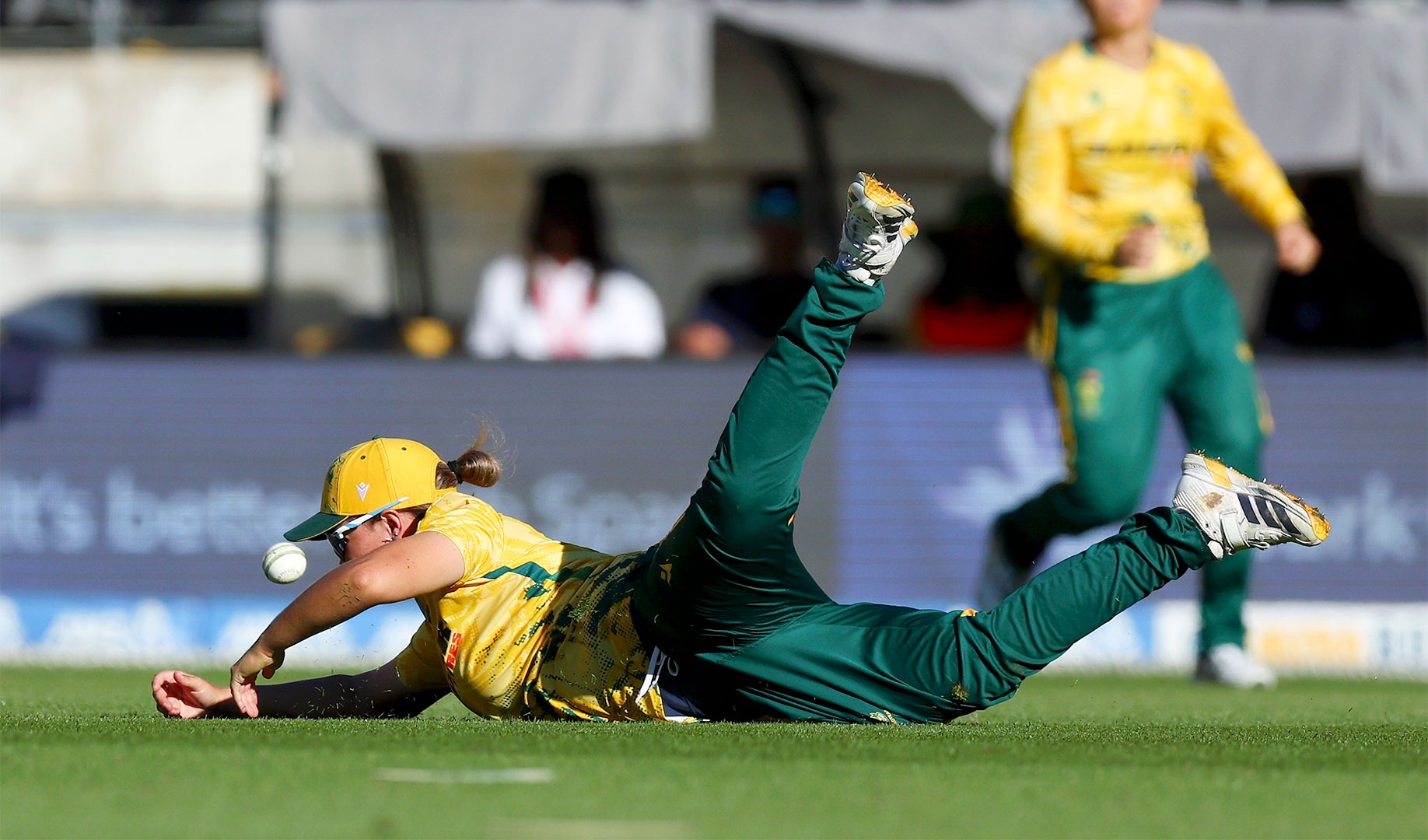
 Proteas fielder Kayla Reyneke drops a catch during game four in the Women’s T20 International series against New Zealand. (Photo: Hagen Hopkins / Getty Images)
 The Proteas Women cricket team’s persistent fielding woes were once again laid bare during their disappointing 4-1 T20 International (T20I) series defeat to New Zealand.
Both the Proteas men and women travelled to New Zealand for a five-match T20I series from 15 to 25 March.
Sloppy work in the field, paired with largely uninspired batting and bowling, left the South African women struggling to make any meaningful impact.
With the final step remaining elusive and a tough pool awaiting them, the Proteas’ latest performance raises concerns.
The same shortcomings exposed by Pakistan in February remain unresolved, and unless there is marked improvement, the squad may not even find themselves out of the group stages.
/file/attachments/orphans/2268227789_437331.jpg "Proteas skipper Laura Wolvaardt believes they will turn their fielding woes around. (Photo: Kai Schwoerer / Getty Images)")
Captain Laura Wolvaardt, however, remains optimistic.
“I feel like we’ve done well in different sections, but then, you know, one game this goes well and something else goes bad […] but I think we do have enough time to turn it around before the World Cup,” she said.
Fielding is a mindset
Despite a solid performance in the second T20I, the Proteas Women were outplayed in all departments, with their fielding once again in the spotlight.
In the fourth T20I, South Africa dropped four catches, allowing Sophie Devine and Amelia Kerr from the Black Ferns to anchor a successful chase of 160 with six wickets to spare.
Kerr, who scored a 29-ball 31, was dropped once, but the drop catches of Devine proved costly. The all-rounder was dropped twice, including a chance that could have seen her dismissed for a duck, before going on to score a blistering 64 off 34 balls.
Similarly, in the fifth match on 25 March, Kerr was given an early reprieve after being dropped on zero runs, and capitalised emphatically, scoring 105 of New Zealand’s 194.
In contrast, South Africa managed only 102 runs in their chase.
Speaking to Daily Maverick after the Pakistan series in February, head coach Mandla Mashimbyi acknowledged the need to revert to the basics.
/file/dailymaverick/wp-content/uploads/2025/10/TL_2451193.jpg "Proteas Women head coach Mandla Mashimbyi has instilled a more cohesive spirit. (Photo: Lubabalo Lesolle / Gallo Images)")
“We’re not doing the simple things well enough all the time, so we just have to have the patience in our processes and just focus on executing the simple things very well,” he said.
For Paddy Upton, fielding runs deeper than technique.
Upton, a wholly experienced, South African-born cricket coach, told Daily Maverick that fielding at the elite level is primarily psychological.
“Fielding is a mental game, possibly even more so than batting and bowling,” he said. “Every fielder at the highest level of the game pretty much knows how to stop a ball and how to catch a ball. Obviously, you get great fielders and less-good fielders, but you’re not going to make a huge amount of impact on the skill or the technique.”
/file/dailymaverick/wp-content/uploads/2023/11/GettyImages-83156827.jpg "Performance coach Paddy Upton. (Photo: Michael Steele / Getty Images)")
He identified two key impacts of fielding: the tangible impact on the scoreboard and the more subtle psychological pressure applied to opponents. In tight contests, he argued, the margins are often defined by which side takes its chances and saves crucial runs.
“So, the closely fought games often are won by the teams that have fielded better or taken their catches compared to the other team,” he said.
At an individual level, focus and engagement can wane over long periods in the field, where players might stand for hours during an innings.
“Very often, for various reasons, fielders are drifting and when they’re drifting, they’re not anticipating, they’re not really in the game, they tend to be late in the ball, and they tend to make mistakes,” Upton said.
“Fielding coaches, I think, too often are working on the strategy and the tactics and the technical side of catching and stopping a ball, where very often it’s more just a mindset.”
For the Proteas Women, then, the challenge may not be technical. Perhaps reverting to the basics is about maintaining focus and staying present.
Time: our worst enemy
Speaking after the final T20I, Wolvaardt expressed discontent over her team’s inconsistency, but took solace from the fact that there is still time before the World Cup in June.
“Tough series for us. Tough way to finish as well. I think pretty much outplayed in all three facets today,” she said. “I think a lot for us to learn out of the series, a lot for us to be a lot better at.”
The skipper admitted the Proteas fell short with the bat, as they struggled to adapt to the slower conditions in New Zealand.
Only Annerie Dercksen and young gun Kayla Reyneke were able to score more than a 100 runs across the five games.
“I think, just lost our way with the bat. I know we’re a lot better batting unit than that,” said Wolvaardt. “I think [we] just have a few batters that are out of form at the same time, which is a bit unfortunate.”
Wolvaardt herself endured an uncharacteristically lean series. She was dismissed for a duck in the opening match, and failed to pass 10 in the fourth and fifth games, with her highest score a 33-ball 41 in the second T20I.
“I think we’ll take our learnings, take our reflections, and then we’ve got to keep moving forward because there’s always more cricket to come and always more to play for.”
Following their final ODI against New Zealand on 4 April, the Proteas Women will play a five-match inbound T20I series against India from 17 to 27 April. DM