




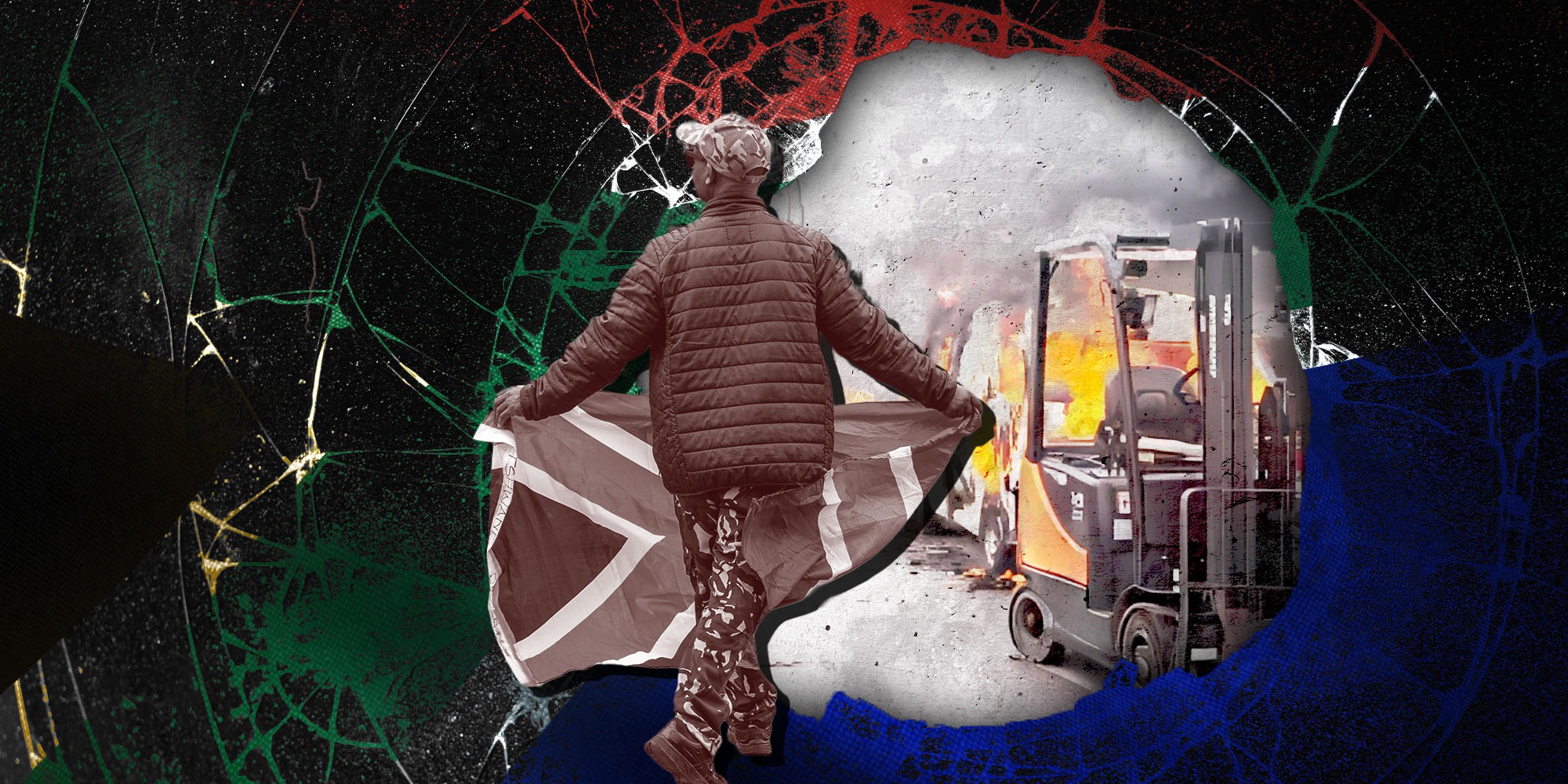
 Illustrative image: Broken glass. (Image: Freepik) | A man walks across the street with a South African flag.(Photo: Alet Pretorius / Gallo Images) | The violent protest in KuGompo. (Photo: X) | (By Daniella Lee Ming Yesca)
 /file/dailymaverick/wp-content/uploads/2025/10/label-analysis-2.jpg)
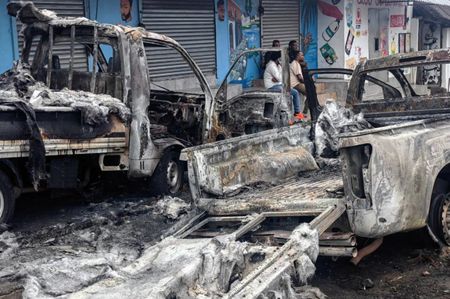
On Monday, several hundred people went on the rampage in KuGompo (formerly East London), setting cars on fire and assaulting people they believed to be illegal foreign nationals. Property was destroyed, but thankfully, no one was killed.
The violence began after members of the KZN-based March & March movement travelled to the city.
The group has been active in Durban for the last few months. In particular, they blockaded the Addington Primary School, trying to prevent foreign nationals from fetching their children.
They alleged that many pupils at the school were foreign nationals who were illegally in South Africa. However, the provincial education department confirmed that of the 12 children at the school without formal identification documents, only five were believed to be from other countries, and the rest were undocumented South Africans.
Because of the blockade, children had to leave the school guarded by heavily armed police.
When the March & March movement went to KuGompo on Monday, they said they were protesting against the actions of a Nigerian man who held what he claimed was a “coronation ceremony” in the city. He said there that he was now the “Igbo king” of the area.
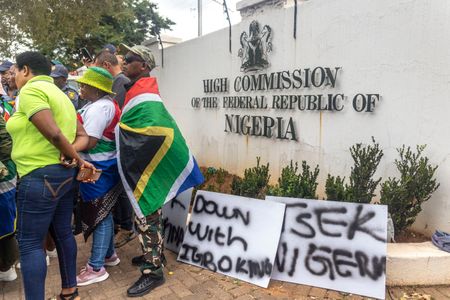
However, the Nigerian government confirmed in South African media interviews that the so-called king has no formal status as a traditional leader in that country. Nor, of course, does he hold such a status here.
This was simply a person with money who held a ceremony, had it filmed and made a nonsensical claim. He has as much claim to that title as this writer would in claiming the kingship of Nigeria. Or to be the emperor of the US.
Ripe for violence
For many people, the only response would be to laugh. But, aided and abetted by Eastern Cape ANC officials and traditional leaders, xenophobic elements clearly spotted an opportunity.
During Monday’s protest, as a traditional leader addressed the crowd, a South African man reportedly took the stage and displayed what he claimed was an injury from being stabbed by a foreign national.
Violence then broke out.
/file/attachments/orphans/01_119222.png "Vehicles burn during the protest in KuGompo on Monday. (Photo: X)")
Instead of condemning the violence, the spokesperson for the Buffalo City Metro Municipality, Bongani Fuzile, said, “We pledge our full solidarity with the people of South Africa in defence of our country, our dignity and our democratic order.”
Immediately after the violence, the deputy minister of cooperative governance and traditional affairs, Prince Zolile Burns-Ncamashe, condemned the man who crowned himself, as well as foreign nationals, for what he said were irresponsible actions. There appeared to be no full-throated condemnation of the violence perpetrated by members of March & March.
To his credit, Eastern Cape Premier Oscar Mabuyane said, “While we recognise the deep-seated frustrations within communities, no grievance justifies the destruction of property, intimidation of individuals or undermining the rule of law.”
Given their track record, it was always inevitable that a protest by March & March would end in violence. What made this more likely was the role of South African traditional leaders.
Their presence, their insistence that elements of people’s identity were under attack, the assumption that this “king” represented some kind of invasion, evoked deep feelings. It may well have reminded many in the audience of their growing sense of being besieged.
And who could blame them? The economy has passed them by. The South Africa they live in has changed fundamentally from the one in which they grew up. Their culture and traditions have been disparaged.
In the light of this, it would be easy to believe that the “coronation” in your city of a “king” from another country is a calculated insult.
Strategic blame
There was no need for any of this.
The traditional leaders and government officials did not have to agree to meet with March & March, which did not need to protest.
Everyone involved could have simply dismissed the self-crowned king as a fraud, turning the episode into a contest to see who could create the funniest meme about him.
This means there was a motivation, beyond defending a sense of identity from a non-existent attack.
The roots of this might well lie in personal advancement. As we have seen on numerous occasions, leaders sometimes look for elements of identity which they can use to garner support for themselves.
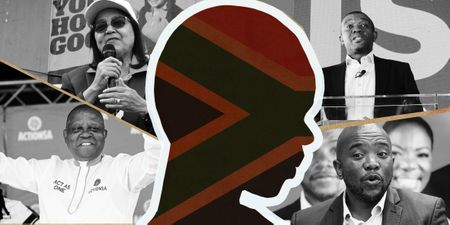
While Julius Malema’s public rhetoric often sharpens racial divisions, President Cyril Ramaphosa consciously strives to cultivate a unified South African identity. This is a tactical divide: Malema rallies a specific base, whereas Ramaphosa seeks to project the image of a leader for all.
The violence in KuGompo is a prime example of this dynamic, where the narrative was deliberately framed to make citizens feel that their identities were under siege by “foreigners”.
Unfortunately, this tactic is likely to be much more effective in the future. The percentage of South Africans who vote has been steadily declining.
Last year, Afrobarometer found that less than half of those surveyed (49%) preferred democracy to other forms of government, which indicates that a very small percentage of people will vote in the local elections this year.
Consequently, any party or group capable of mobilising its base can amass significant power by capturing a larger share of a diminished turnout.
This opens the door for extremist parties — what would normally be fringe movements — to get into councils or even Parliament.
No one was arrested after this week’s violence in KuGompo, meaning there is every incentive for leaders and groups to use tactics of violence and xenophobia to bolster their support.
The violence in KuGompo was horrific, but next time, the cost may be measured in lives. DM