



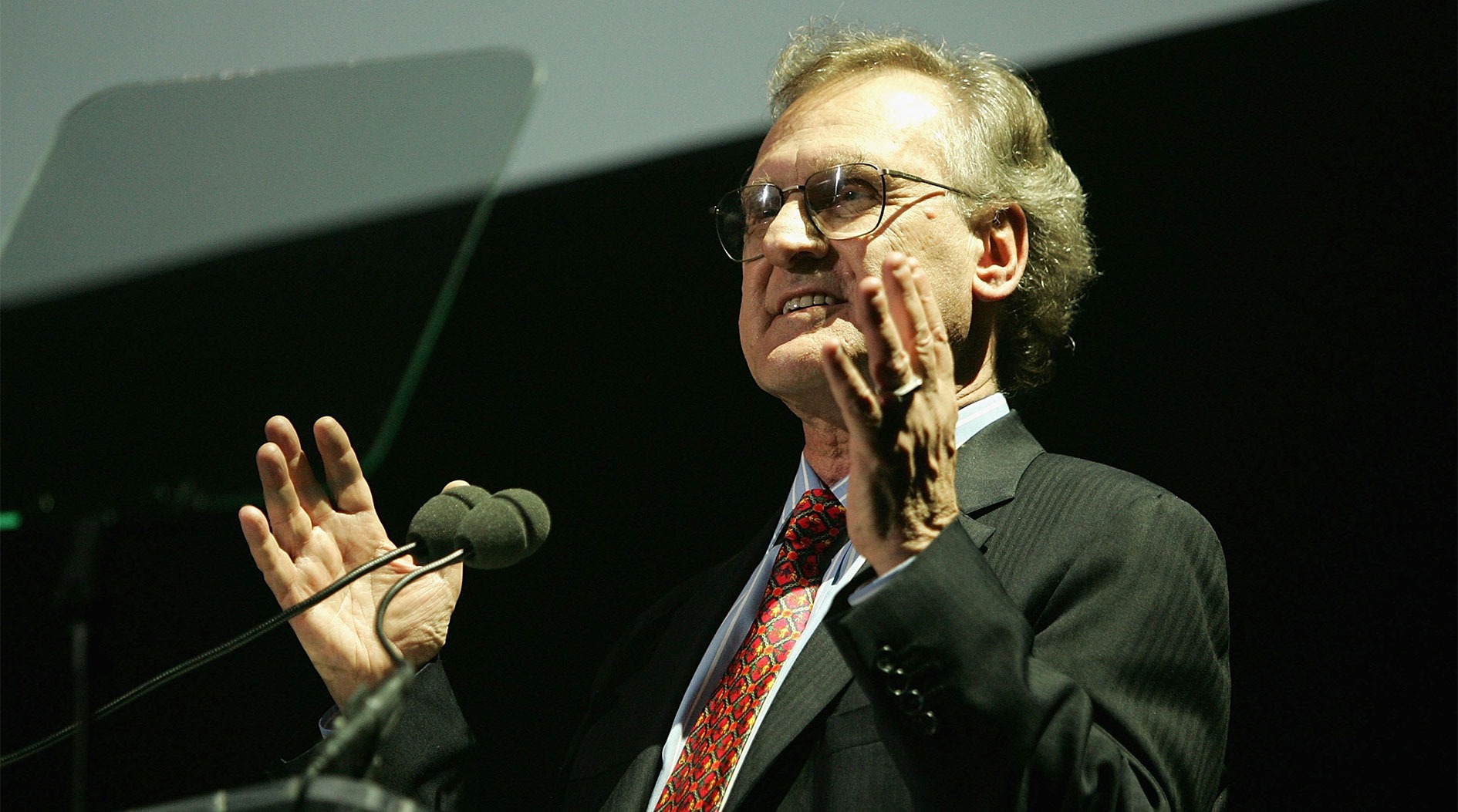
 Canadian diplomat, politician and social activist Stephen Lewis. (Photo: Evan Agostini / Getty Images)
 /file/dailymaverick/wp-content/uploads/2025/10/label-analysis-2.jpg)
There is a kind of fury that only the empathetic can endure, not the hot rage of the wronged, but the cold, enduring anger of someone who has looked at preventable suffering and refuses to be numbed. Stephen Lewis, who died on 31 March 2026 at the age of 88, carried that benign alchemical rage for much of his adult life. It was his sharp tool and his gift to the world.
He was a Canadian politician, diplomat and broadcaster who became, in the second half of his life, one of Africa’s most eloquent foreign champions. When Kofi Annan appointed him UN Special Envoy for HIV/Aids in Africa, Lewis had no formal mandate, no precedent to follow, and clue of what he would find.
“No one really knew what the job would be,” he told The Canadian Press in an interview. “I certainly did not know how grim the circumstances were. I had a sense that things were bad, but I did not at the time have a sense of the carnage on the ground, and particularly amongst women.”
/file/attachments/orphans/ED_South4403_188480.jpg "Stephen Lewis, UN Special Envoy for HIV/Aids, visits a community dam-building project in Rothe. (Photo: Graeme Williams / Gallo Images)<br>")
The making of a voice
He came from a family for whom injustice was a personal affront. His father David Lewis led the federal New Democratic Party; his grandfather Moishe had been an activist in the Jewish Labour Committee in Montreal. Stephen absorbed the tradition early, honing his oratory at the Hart House debating club, where in 1957 a young Massachusetts senator named John F Kennedy narrowly defeated Lewis’ team by 204 votes to 194. Lewis remembered the loss all his life, less as a defeat than as an early education in the weight that the right words, delivered with conviction, could carry.
He never finished his degree, attempted law school twice without completing it, and drifted toward Africa after university, where he taught English and fell permanently in love with the continent. He married the journalist and social activist Michele Landsberg.
Their son Avi Lewis was elected leader of the federal NDP on the day before his father died, a dynastic arc spanning three generations that Stephen, receiving daily updates in his hospital bed, followed with what his son described, in his victory speech in Winnipeg, as “a veritable IV drip of campaign data”. At 88, Avi told the convention, that he was “more passionate about the promise of democratic socialism than he has ever been in his life”.
Charlie Angus, the former MP and author, remembered being nine years old when his grandmother called him in from the street to watch a young Lewis speak in the Ontario legislature about industrial illness in the northern mines.
“You listen to this man,” she told him. “He speaks for us wee wifies. Nobody ever spoke for us before.”
/file/attachments/orphans/GM1E78S0CUU01_690881.jpg "Stephen Lewis delivers the eulogy during the state funeral for NDP opposition leader Jack Layton in Toronto on 27 August 2011. (Photo: Reuters / Mike Cassese)")
Into the epicentre
Canada’s then prime minister Brian Mulroney had appointed Lewis Canada’s ambassador to the United Nations, where he campaigned against apartheid South Africa, helping to position Canada as what Prime Minister Mark Carney later called “a principled leader” in the international campaign to isolate the regime. The posting gave Lewis an education in the moral geography of a world divided between those who acted, and those did nothing.
The epicentre, when Lewis arrived as Special Envoy, was SA. More than six million people were living with HIV, the highest number of any country on Earth, and the president, Thabo Mbeki, had descended into a denialism so lethal that Lewis would eventually wonder, aloud and in public, why it did not meet the threshold for crimes against humanity.
He did not choose cautious language. Speaking at a public forum later broadcast widely, Lewis described Mbeki as having “succumbed to a combination of intellectual sophistry and scientific mysticism”, sustaining a minister of health who believed “beetroots and garlic were the answer”. When the Thabo Mbeki Foundation later published what Lewis called a “self-justifying” document defending that record, he was unsparing: “I have read more serious and substantial material in graffiti on the walls of a urinal.”
Three-hundred-and-thirty-thousand people had died unnecessarily, according to a Harvard School of Public Health study. Lewis drew the comparison directly: “President Assad of Syria can be indicted for crimes against humanity for all of the Syrians he has killed. Why is it that Thabo Mbeki is exempt from indictment by the International Criminal Court?”
At the International Aids Conference in Toronto, the address that would define his public legacy, he named the failure bluntly. SA, he said, was “the only country in Africa whose government continues to propound theories more worthy of a lunatic fringe than of a concerned and compassionate state.
“Between six and eight hundred people a day die of Aids in SA. The government has a lot to atone for. I’m of the opinion that they can never achieve redemption.” And then, pre-empting the inevitable protest: “It is not my job to be silenced by a government when I know that what it is doing is wrong, immoral, indefensible.”
Mark Heywood, the South African human rights activist who helped found the Treatment Action Campaign and SECTION27, was in that audience. Writing after Lewis’ death, he recalled that the speech “helped shame our government into sidelining Mbeki. The first thing they did was seek to speak to the TAC.”
Negotiations followed; by 2007, for the first time, SA had a National Strategic Plan on HIV that included access to antiretrovirals as a central pillar.
“His work on Aids was game-changing and without doubt helped save millions of lives,” Heywood wrote. “His body stayed alive literally just long enough to see his son, Avi Lewis, elected on Sunday night as leader of Canada’s New Democratic Party.”
/file/attachments/orphans/GW1794_867400.jpg "Stephen Lewis, UN Special Envoy for HIV/Aids in Africa at Mafeteng Hospital. He is with locally trained Aids councillors. (Photo: Graeme Williams / Gallo Images)")
/file/attachments/orphans/GW1795_841388.jpg "Lewis visits a community dam-building project in Rothe. (Photo: Graeme Williams / Gallo Images)")
The grandmothers of Africa
If there was a single image that crystallised the moral horror Lewis encountered in southern Africa, it was the grandmother (gogo). As the epidemic tore through the generation of young adults, older women – already in their fifties, sixties, seventies, eighties – gathered the orphaned grandchildren and began again. Lewis spoke of them with an anguish.
“It is impossible to talk about orphans without talking about grandmothers,” he told the Aids conference. “Who would ever have imagined it would come to this? In Africa, the grandmothers are the unsung heroes of the continent: these extraordinary, resilient, courageous women, fighting through the inconsolable grief of the loss of their own adult children, becoming parents again in their fifties, sixties, seventies, and eighties. I attended a grandmother’s gathering last weekend: the grandmothers were magnificent, but they’re all struggling with the same anguished nightmare: What happens to my grandchildren when I die?”
He co-founded the Stephen Lewis Foundation with his daughter Ilana Landsberg-Lewis, directing funding to community-based organisations in 15 African countries. He argued that these women deserved not charity but recognition: social welfare programmes, sustainable incomes, formal acknowledgement of what their labour meant.
/file/attachments/orphans/WhatsApp-Image-2026-04-01-at-10_403653.jpg "The late Stephen Lewis and Vuyiseka Dubula. (Photo: Supplied)")
Women at the centre
Lewis had understood from his earliest encounters with the epidemic that it was, at its core, a story about gender. He supported the establishment of UN Women. He co-founded Aids-Free World, explicitly linking the pandemic to human rights and culpability. And in his speeches, he returned again and again to a simple insistence: that the suffering of women was not a footnote to the larger story, but its central chapter.
Vuyiseka Dubula, former General Secretary of the Treatment Action Campaign, who had known and worked with Lewis for years, wrote in her tribute.
“He walked with us in Africa not ahead of us, not above us, but alongside us. He was an ethical leader who understood his privilege as a white male from Canada and chose, consistently and deliberately, to use it in service of humanity. He understood that solidarity is not charity. It is accountability. It is shared struggle.” She called him a “feminist male”.
/file/attachments/orphans/GettyImages-51812033_819423.jpg "Ambassador Stephen Lewis speaks onstage at The Pusher’s Ball to benefit the Keep A Child Alive charity at the Angel Orensanz Foundation Center for the Arts on 1 December 2004 in New York City. (Photo: Matthew Peyton / Getty Images)")
Final reckoning
In the last years of his life, Lewis turned towards a conflict that divided his own Jewish community. His son Avi, in a public post that Stephen had read and approved before publication, described the evolution. As Canada’s UN ambassador, Lewis had been “truly shocked by the regularity of open, vitriolic ‘antisemitism’” at diplomatic gatherings, and had for years been the family member most sympathetic to Israel as a refuge. “This is no longer the case,” Avi wrote. His father “now regards Israel as a rogue state, committing genocide and other crimes against humankind, which ought to be opposed by every tool and tactic in Canada’s diplomatic arsenal.”
Even in his final months, Avi recounted, his father had spent an hour standing at the roadside in his old riding of Scarborough West: “Standing up as a Jew against genocide. Standing up for justice for Palestine. Standing up on the right side of history, where the vast majority of humanity currently stands.”
A legacy measured in lives
His family’s statement, released by The Canadian Press on the day of his death, was simple and precise: “Stephen spent the last eight years of his life [living with] cancer with the same indomitable energy he brought to his lifelong work: the unending struggle for justice and dignity for every human life. The world has lost a voice of unmatched eloquence and integrity.”
Prime Minister Mark Carney said Lewis had “pressed the world to see the human toll of this horrific epidemic not as a distant tragedy, but as a shared responsibility that demanded global action”. Meg French, executive director of the Stephen Lewis Foundation, said: “No words can do justice to Stephen’s incredible impact. He was an unstoppable champion for equality and a force for good.”
The Guardian noted that Lewis held 33 honorary degrees, among the highest of any Canadian, and that two schools in Toronto bear his name. Lesotho’s King Letsie III invested him as Knight Commander of the Most Dignified Order of Moshoeshoe, the country’s highest honour. He wore these distinctions lightly, aware that they were proxies for something more important.
His wife Michele Landsberg survives him; as well as his children Ilana Landsberg-Lewis, Avi Lewis and Jenny Leah Lewis; four grandchildren, Zev, Yoav, Zimri and Toma; and his siblings Michael Lewis, Janet Solberg and Nina Libeskind.
He is also survived, in the sense that matters to the history he helped make, by the movements he strengthened, the lives his foundation prolonged, and the grandmothers of Africa whose labour he refused to let the world ignore. DM
Sources: The Canadian Press; The Guardian; Daily Maverick; Stephen Lewis’ address to the XVI International Aids Conference, Toronto, 2006; tributes from Vuyiseka Dubula (former General Secretary, Treatment Action Campaign); Mark Heywood (co-founder, Treatment Action Campaign and SECTION27, former Editor Maverick Citizen); Charlie Angus (former MP, Timmins–James Bay); Meg French (Executive Director, Stephen Lewis Foundation); Prime Minister Mark Carney.