



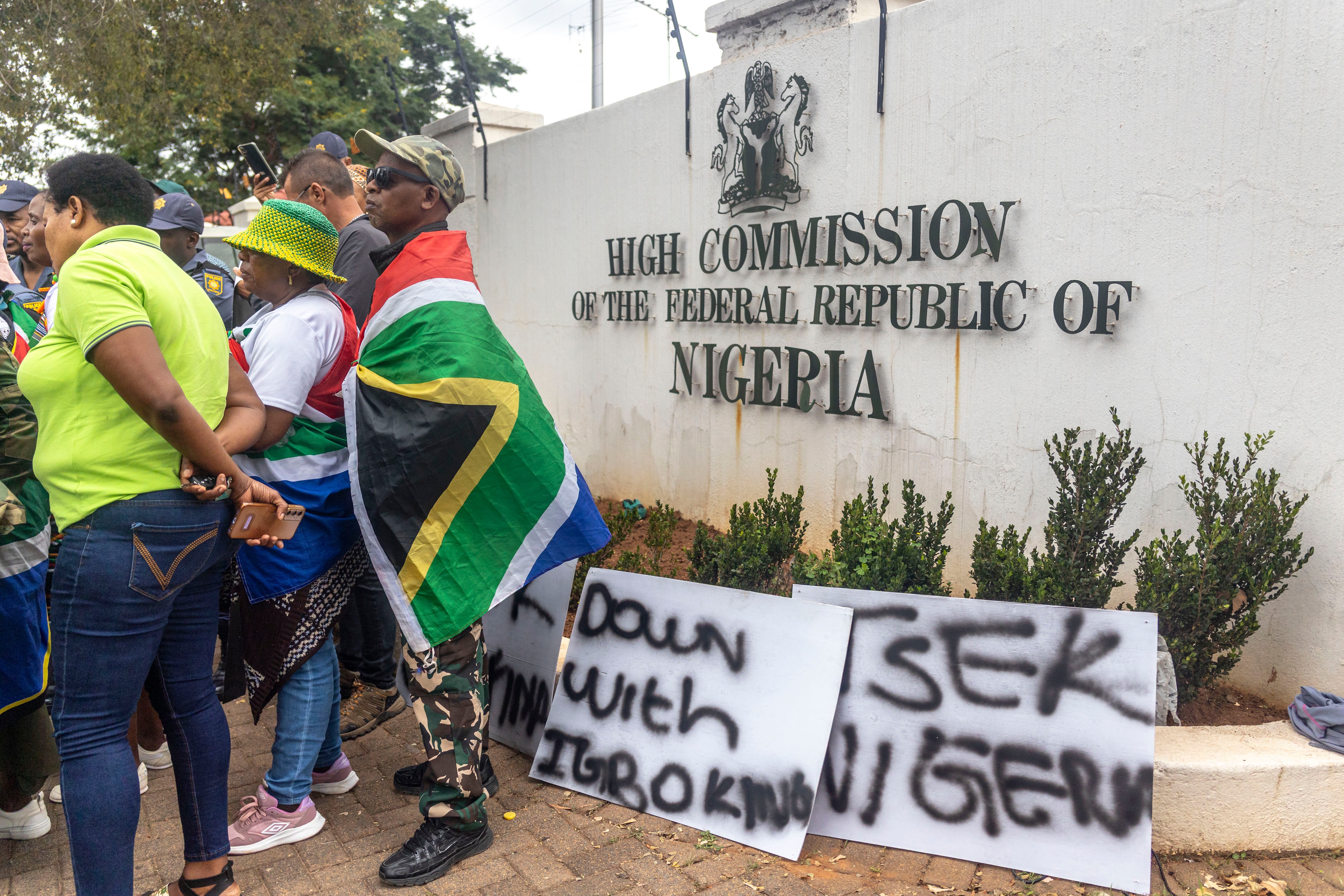
 The protest at the Nigerian Embassy on 31 March 2026 in Pretoria, South Africa. This protest follows reports of the installation of Nigerian national Solomon Ogbonna Eziko as an ‘Igbo king’ in KuGompo in the Eastern Cape. (Photo: Gallo Images / Alet Pretorius)
 /file/dailymaverick/wp-content/uploads/2025/10/label-analysis-2.jpg)
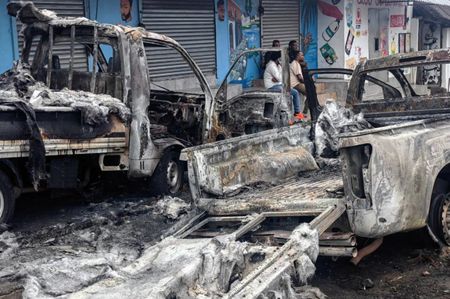
KuGompo (formerly East London) was rocked by unrest earlier this week after a protest against the alleged coronation of an Igbo ‘king’ took a violent turn. It led to businesses being looted and at least 10 cars being torched.
ActionSA, one of the organisations leading the protest, has since condemned violent action and reports of divisive and tribalistic language used in a statement published on 31 March.
“What should have been a peaceful and lawful expression of public concern was compromised by conduct that weakens both message and cause. Violence undermines a legitimate call for order,” read the statement.
But questions still remain about what exactly happened. Did an Igbo king really get crowned in Eastern Cape? And is this an attempt to establish a new sovereign kingdom within South Africa’s borders, or is something else going on?
We unpack the situation.
What happened in KuGompo?
In mid-March, videos and photos depicting a group of people gathering in traditional Igbo dress, appointing a man named Chief Solomon Ogbonna Eziko as the ‘Igwe Ndigbo’ (Igbo king) of KuGompo, went viral on social media.
/file/attachments/2990/653712202_926568236651585_2018409513065120418_n_697128.jpg "Chief Solomon Ogbonna Eziko, left, was appointed the ‘Igwe Ndigbo’ in KuGompo. (Photo: Supplied)")
The coronation attracted widespread condemnation from ordinary citizens, government officials, and local traditional authorities, like Prince Xhanti Sigcawu, the chairperson of Amathole Local House of Traditional and Khoi-San Leaders, who called it a “flagrant violation” of local laws and an attempt to establish a parallel leadership structure within SA.
ActionSA MP Athol Trollip stated that the party rejected any attempts from foreign nationals to establish kingships or parallel structures in SA, adding: “We will not allow Nigerians to form another homeland in the Eastern Cape.”
March and March, led by Jacinta Ngobese-Zuma, linked the issue to broader concerns about illegal immigration, drug trafficking and foreign-owned spaza shops.
“This is now our new-age struggle. We’re fighting against foreign nationals in our country because we need to feel like we’re South Africans again. For the longest time, they’ve used our laws against us, they’ve used our humanity against us, and they’ve used the xenophobia card against us so many times. We don’t care what they call us,” she said in an interview with SABC News, adding that the country was being “invaded” by foreigners.
/file/attachments/orphans/01_119222.png "Reports say vehicles and buildings belonging to foreign nationals were torched in a protest against the alleged installation of a Nigerian king in uGompo city. (Photo: X)")
The outrage culminated in a protest led by ActionSA, March and March, and the AmaXhosa Royal Household in KuGompo on 30 March, with some protesters travelling from as far as KwaZulu-Natal.
The march was initially peaceful but later turned violent, leading to businesses being looted and cars being torched. A report by the SAPS indicates that the violence began after participants moved away from the City Hall, where a petition was being handed over.
“It is confirmed that 10 vehicles have been damaged, and one building in the North End business area was partially torched. The area is home to a mix of foreign nationals, predominantly from Somalia and Pakistan,” the SAPS said on Monday.
“No injuries have been reported thus far, and no arrests have been made.”
/file/attachments/orphans/WhatsAppImage2026-03-30at190703_234685.jpeg "Foreign nationals stand next to their damaged vehicles after demostrations erupted in KuGompo over the alleged coronation of a Nigerian ‘Igbo king’. (Photo: Johnnie Isaac)")
Figures like Ngobese-Zuma, the leader of March and March, claimed that the violence began after a South African protester was stabbed by a foreign national linked to the Igbo community. However, there were conflicting reports.
Some reported that the foreign national was Nigerian, while others claimed he was Ethiopian. Some claimed that the protester was stabbed in the back, while others said they were stabbed and run over.
There isn’t any available information on either the attacker or the victim. We reached out to the SAPS for confirmation but did not receive a response. SAPS official statements say that no injuries were reported. At this point, there is no official confirmation on how the violence began.
How are kings recognised in SA?
The roles and powers of traditional leaders are enshrined in the Constitution and outlined in the Traditional and Khoi-San Leadership Act (2019). According to the act, traditional communities may apply to have a king or queen recognised if they meet a set of criteria. This includes:
- Recognition as a traditional community.
- Occupying a specific geographic area.
- Having an established history of existence and distinct cultural manifestations that separate them from other traditional communities.
- Observing customary law, and having an established system of senior traditional leadership that is recognised by other traditional communities.
- Having a recognised traditional council with an established hierarchy of leadership that has a defined area of jurisdiction.
A community that meets the above criteria may apply to the president for a kingship or queenship who, after consultation with the minister of the Department of Cooperative Governance and Traditional Affairs (CoGTA), the relevant provincial house and other local traditional leadership structures, may recognise the kingship by notice published in a Government Gazette.
The recognised kingdoms in the Eastern Cape include AmaXhosa, led by King Vulikhaya Sigcawu, AbaThembu, led by King Buyelekhaya Dalindyebo, and AmaMpondo, led by King Silosohlanga kaDakhile Sigcau.
In 2021, the AmaRharhabe, led by King Vululwandle Sandile, were formally recognised as a royal household by President Cyril Ramaphosa. The AmaRharhabe jurisdiction includes KuGompo.
So was a Nigerian king really appointed?
Not quite. CoGTA and the Congress of Traditional Leaders of SA have both rubbished claims that a Nigerian king has been recognised, and CoGTA Deputy Minister Prince Zolile Burns-Ncamashe has called the coronation “illegal”.
Nigerian authorities have also disputed the claims. In a press release published on 26 March, the Nigerian High Commissioner stated that “no coronation took place and none was intended to”, adding that what took place was a cultural festive event. The statement explained that in Igbo culture, chieftaincy titles are conferred to recognise personal achievements and services to the community.
“These events are marked with grandeur, with recipients adorned in traditional regalia accompanied by cultural displays and communal acknowledgement of their new status,” the statement said.
/file/attachments/orphans/ED_602495_426351.jpg "Members of the Progressive Forces during the protest at the Nigerian Embassy on 31 March 2026 in Pretoria, SA. This protest follows reports of the installation of Nigerian national, Solomon Ogbonna Eziko as an ‘Igbo king’ in KuGompo in the Eastern Cape. (Photo: Gallo Images / Alet Pretorius)")
We reached out to Frank Onyekwelu, the president-general of the Nigerian Citizens Association South Africa, to find out exactly what the title Igwe means. He explained that the term “Igwe” referred to a community leader who was chosen by a group of people to be their cultural custodian – not their sovereign leader.
“It was just a title given to say ‘we appoint you a leader of this group of our people’. For the singular purpose of teaching the younger ones that are born outside the borders of the Igbo community back in Nigeria to understand where they are coming from, their origin, their culture, their history, their ancestral language,” he said.
He emphasised that the title was not political, did not come with any claims to land, and that the community was not trying to establish a sovereign kingdom within SA.
“There is no sovereignty, power or government established. They don’t have a kingdom. They don’t have a land. In the real essence of it, there was no coronation,” he added.
What else did the Nigerian High Commission say?
Olajide Ogunmadeji, the Nigerian deputy to the Acting High Commissioner, condemned the alleged installation of an Igbo “King” to a group of protesters who gathered outside the Pretoria embassy on Tuesday, 31 March.
Speaking to the protesters, Ogunmadeji stated that the Nigerian government did not support “irresponsibility” and gave his apologies to the protesters who had gathered to hand over a memorandum.
/file/attachments/orphans/ED_602500_528738.jpg "Members of the Progressive Forces during the protest at the Nigerian Embassy on 31 March 2026 in Pretoria. (Photo: Gallo Images / Alet Pretorius)")
“The Embassy of the Federal Republic of Nigeria, the High Commission here, does not support any irresponsibility. So please, I am, on behalf of the high commissioner, on behalf of the embassy, and on behalf of the Federal Republic of Nigeria, I am tendering our apology to the traditional institutions of SA,” Ogunmadeji said.
In a separate notice published on 30 March addressed to the Nigerian community living in SA, the high commissioner warned the community to keep a low profile, pay respect to local laws and customs, limit interactions with strangers, and avoid any protests.
What’s the situation now?
KuGompo has been calm since Tuesday morning. SA Police Service National Commissioner Fannie Masemola has said that more officers have been deployed to the area. No arrests had been made and a manhunt was under way for those involved in the violence.
“We cannot allow a situation where vehicles are torched and buildings damaged. Such actions will not be tolerated by law enforcement, and as such, those who involved themselves in these acts are being investigated and sought by the police,” Masemola said.
Burns-Ncamashe said in a later interview with SABC that the department would meet with the Nigerian high commissioner next week to “look at the entirety of the incident”, and that the high commissioner had already expressed a desire to apologise directly to the AmaRharhabe Royal Household.
The Nigerian high commissioner has also stated that they have written to the group in the Eastern Cape and are involved in “high-level engagements” with local traditional authorities to resolve the situation. DM