




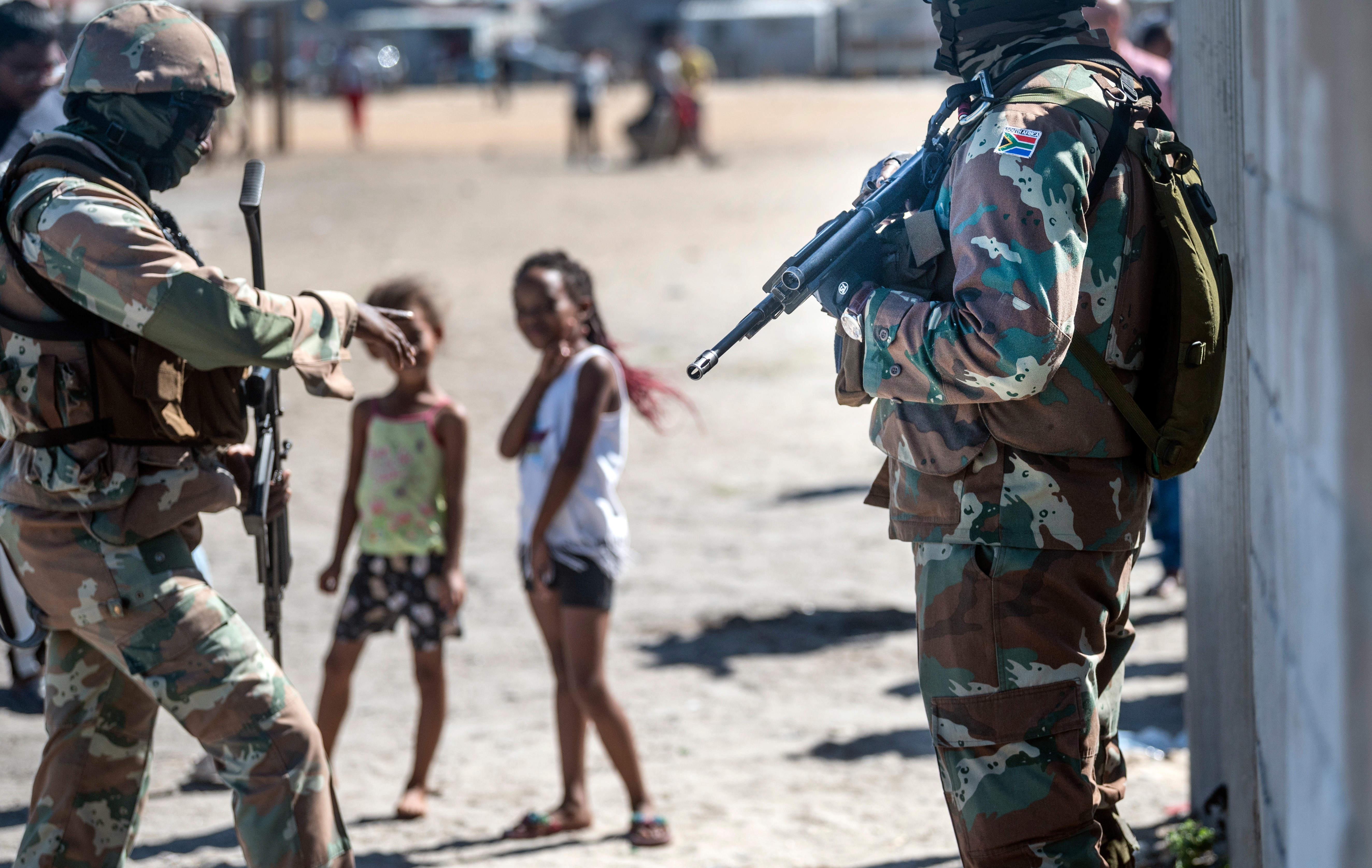
 The Defence Force is deployed with the SAPS in gang-infested Tafelsig, Mitchells Plain, Cape Town, as the year-long Operation Prosper begins on 1 April 2026. (Photo: Gallo Images/Brenton Geach)
 On Wednesday, 1 April, grandmother Asa Galant (70) walked to the pavement outside her home for the first time in months after she had been too afraid to step beyond her burglar gate in Netball Street, Beacon Valley.
That fear seemed to melt away as she heard members of the South African National Defence Force (SANDF) approaching. Galant made her way down the path, each step measured but determined.
The relief and joy on her face as the army passed was unmistakable, a quiet, powerful expression of what the deployment means for some residents on the Cape Flats.
/file/attachments/orphans/AsaGalantgate_483415.jpg "Asa Galant (70), who for months had been too afraid to step beyond her burglar gate on Netball Street, Beacon Valley, finally ventured out, walking about 30m to the pavement outside her home after the army arrived in the area on Wednesday, 1 April. (Photo: Vincent Cruywagen)")
Wednesday marked the first day of Operation Prosper, a joint initiative between the SANDF and SAPS aimed at stabilising communities experiencing high levels of violent crime.
Before deploying to Beacon Valley, Tafelsig and Eastridge, members gathered at Rocklands Sportsfield to pray for protection as they entered some of the Cape Flats’ most volatile areas.
Because of continuing gun violence in the area, Galant was forced to send her grandchildren to live with relatives outside Mitchells Plain so they could continue their schooling.
Her story echoes that of many parents in gang-affected communities, who have had to make similar sacrifices and are now pinning their hopes on the army’s deployment to help turn the tide.
“I’m scared, but I’m not going to pull out of my place because of the gangsters. We moved in here and not for gangsters. I remain closed behind my burglar gates.
“Today, I hope the place will get better because of the army. The army should clean Mitchells Plain and when they go away, violence and drugs should be something of the past,” she said.
/file/attachments/orphans/KidsinPark_104184.jpg "Children in Beacon Valley followed the army operations, with some settling in a nearby park for a good view as they watched proceedings unfold. (Photo: Vincent Cruywagen)")
Targeted interventions
The operation traces back to the 2026 State of the Nation Address in February, when President Cyril Ramaphosa announced the deployment of the SANDF to help the police fight crime – gang violence in the Western Cape and illegal mining in Gauteng.
Amid growing pressure from residents of Gqeberha’s Northern Areas, acting Police Minister Firoz Cachalia announced that the deployment had been extended to the Eastern Cape. (Residents in the Northern Areas were left disappointed on Wednesday because of apparent delays in the deployment of the army, particularly as troops have already been sent to parts of the Western Cape.)
Major General Luyanda Damoyi, the Western Cape deputy provincial commissioner responsible for policing, said the operation formed part of a broader strategy to reduce serious and violent crime in hotspot areas.
“We are here in Mitchells Plain conducting operations aimed at reducing serious violent crime and gangsterism. We will be deploying across all areas of Mitchells Plain, as well as other hotspots on the Cape Flats, including Manenberg, Hanover Park and Philippi, to ensure communities are safer,” he said.
/file/attachments/orphans/Kidsmeetarmy_116736.jpg "Children in Beacon Valley climbed on to electricity boxes to catch a glimpse and chat with the soldiers. (Photo: Vincent Cruywagen)")
Damoyi said the focus would include targeted interventions at so-called problematic houses, where illegal firearms were believed to be stored and used in the commission of crimes.
He emphasised that building trust with residents remained central to the operation’s success.
“We are encouraging our members to foster positive relationships with communities. Without community cooperation, we will not achieve our objectives as law enforcement agencies.
“What we are saying to our members… when they are interacting with communities, [it] should actually be [for] good relationships with our communities. That is how we can get assistance from our communities. We believe ourselves alone as law enforcement agents, without working together with communities, we are not going to achieve what we hope for,” he said.
In July last year, a Human Sciences Research Council survey found a significant decline in trust for the SAPS, the lowest in 27 years.
Addressing concerns about operational readiness, Damoyi was confident in the joint deployment.
“We are fully prepared. SAPS and SANDF members have trained together and share a common goal, to tackle gangsterism, extortion, taxi violence and broader violent crime in the Western Cape,” he said.
For the children
During the first day of the operation in Cape Town, children waved, saluted and climbed on to electricity boxes for a better view.
SANDF members were split into teams and moved through Beacon Valley, Tafelsig and Eastridge, entering areas long plagued by violence between rival gangs. In Beacon Valley, widely regarded as a stronghold of the 28s gang, armed teams, working off targeted addresses, pounced on identified houses.
Yet, amid the raids, it was the children who captured the moment. “Mummy, there’s the army… Can I take a photo with the man with the rifle?” asked one, as children trailed behind the soldiers from street to street, with mothers reminding them that the soldiers were there to work.
/file/attachments/orphans/ED_602653_980851.jpg "The SANDF was deployed alongside police in gang-riddled Tafelsig, Mitchells Plain, Cape Town, at the launch of Operation Prosper on 1 April 2026. (Photo: Gallo Images/Brenton Geach)")
Joely Manuel, 42, a teacher at a crèche in Beacon Valley, said ongoing gang violence had been deeply disruptive, particularly given the responsibility of caring for young children.
“We work with children’s lives every day, and the violence makes us fear for our safety, especially for the children. I just want the army and the police to create peace so we can live our lives, and for our children to walk safely to school and educare centres,” she said.

In Leadwood Street, Beacon Valley, while police were searching a house, Kathuma Ismail, 60, got wind of it and ran out of her house. Ismail, a mother who was noticeably fed up with the ongoing violence, said she was not scared to speak out.
“I am so traumatised by the shooting. I can’t even leave my doors open. I can’t even send my children to the store. When I heard the army was on the way, I ran out of my house. They must please help us to stop the killings and bodies lying in our streets. We are tired of this,” she said.
/file/attachments/orphans/KathumaIsmail_722793.jpg "Kuthama Ismail, a mother from Leadwood Street in Beacon Valley, says ongoing shootings have traumatised her. She hopes the army’s presence will bring peace to the area. (Photo: Vincent Cruywagen)")
Against this backdrop, activist Norman Jantjies said the deployment had been met with a sense of cautious enthusiasm in the community, reflecting both the desperation for safety and the hope that the intervention might bring relief.
“Our people have been desperate and, at one stage, even called on Pagad to help stem the tide of gang violence and drugs. That is why we welcome the joint deployment of SAPS and the SANDF in our communities. We are, however, aware that the results and impact will not be realised overnight,” Jantjies said.
/file/attachments/orphans/ED_602669_794652.jpg "The SANDF was deployed with police in gang-infested Tafelsig, Mitchells Plain, Cape Town, during Operation Prosper on 1 April 2026. (Photo: Gallo Images / Brenton Geach)")
Questions over court’s capacity
DA MP Ian Cameron, chairperson of the parliamentary police committee, visited the Rocklands Sportfields, where the army, police, traffic officials and metro police officers were briefed.
“I absolutely understand the need for the communities affected by gang violence to experience stabilisation. You can’t go to sleep at night and are woken up every night by shots,” he said.
/file/attachments/orphans/ED_602733_999613.jpg "Ian Cameron, chairperson of the parliamentary police committee, observes Operation Prosper in Mitchells Plain. (Photo: Gallo Images / Brenton Geach)")
Addressing the media, Cameron raised concerns about the system’s capacity to process arrests arising from the deployment. He said that since engagements with both SAPS and the SANDF in Parliament last week, there had been no clarity from the minister or officials on whether additional court capacity had been established to handle the expected increased caseload.
Cameron also questioned inconsistencies in the reported number of deployed troops.
“On Monday, we were told there were about 200 soldiers in the province. Initially, the figure was 800, then on Tuesday, 31 March, it was revised to 547, and on Wednesday, 1 April, in Mitchells Plain, there were only 90 deployed. So what is the actual number, and where are the other soldiers?” he asked.
Under-resourced SAPS
In a statement on Wednesday, Western Cape Premier Alan Winde and MEC for Police Oversight and Community Safety Anroux Marais said that while the deployment of the army to support police might offer short-term stabilisation in gang-affected areas, it could not be seen as a comprehensive or lasting solution to the deeply entrenched problem of gangsterism and organised crime in the province and across South Africa.
Marais pointed out that the current crisis was the result of years of systemic under-resourcing, inadequate recruitment and the steady erosion of critical policing capabilities within the SAPS, factors she said had significantly weakened the state’s ability to respond effectively to violent crime.
“The reality is that SAPS has been stretched beyond its limits. Chronic underfunding, insufficient personnel numbers and the neglect of specialised units have significantly weakened the state’s ability to respond effectively to organised crime and gang violence,” said Marais.
She stressed that key units such as Crime Intelligence, the Anti-Gang Unit and Detective Services had not been adequately prioritised or capacitated, undermining efforts to dismantle sophisticated criminal networks and secure successful prosecutions.
Winde called for policing reform and the proper resourcing of the SAPS
“Our communities deserve more than temporary interventions. They deserve a policing system that is capable, credible and equipped to dismantle criminal networks and uphold the rule of law,” he said.
The deployment will continue on Thursday. Operation Prosper is scheduled to last a year. DM
Additional reporting by Kyran Blaauw.