




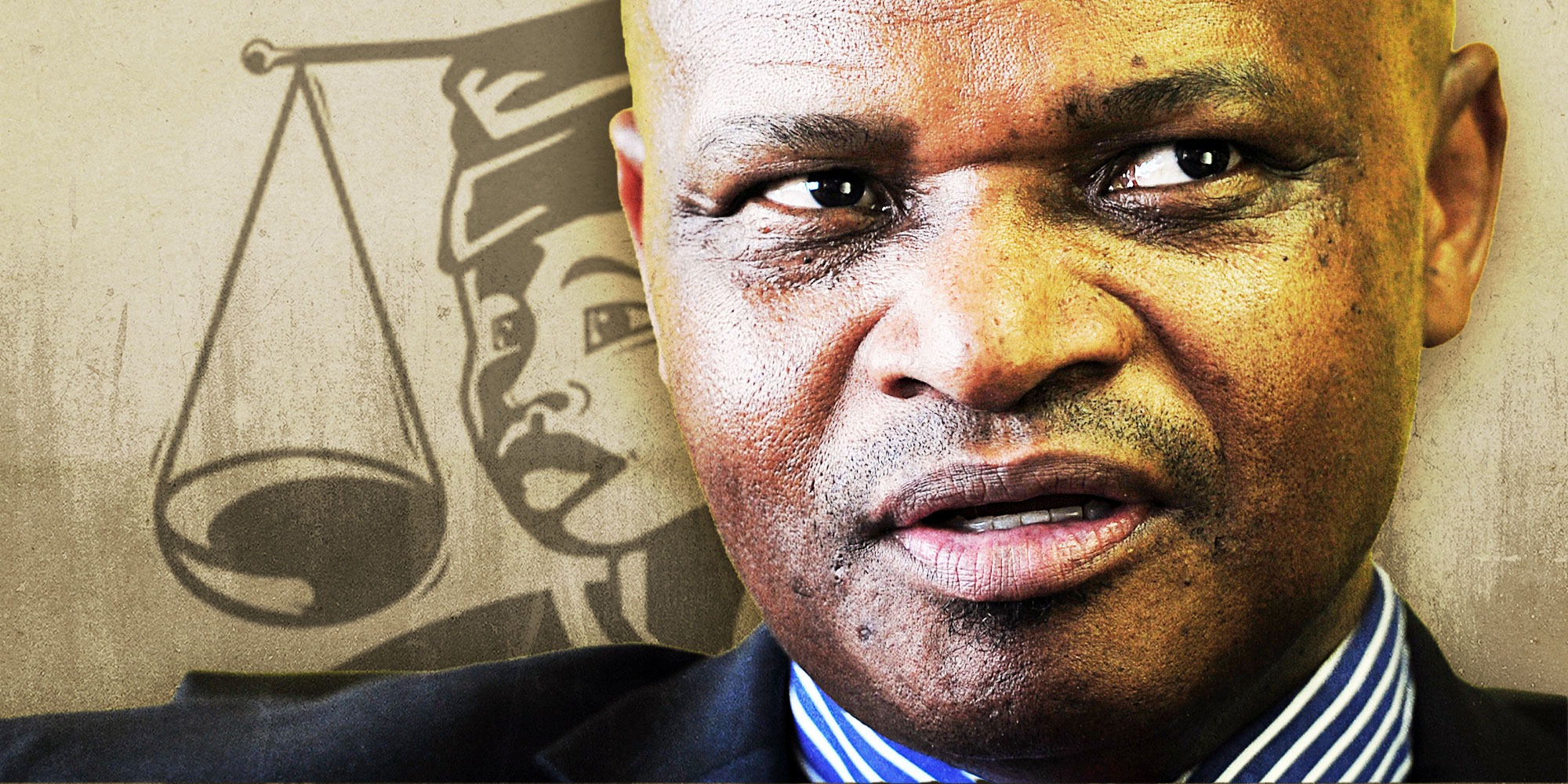
 Illustrative image: Advocate Andy Mothibi. (Photo: Gallo Images / City Press / Leon Sadiki) | National Prosecuting Authority logo. (Image: Wikicommons) | (By Daniella Lee Ming Yesca)
 The Prosecutions Project, a national civil society initiative for the reform of the National Prosecuting Authority Act (NPA Act), was launched on Wednesday to urgently address the constitutional and structural independence of the authority, which has been eroded over years.
Without Fear, Favour or Prejudice is the Prosecutions Project’s national call to strengthen legislation for the prosecution authority and restore a system which is currently “constrained by outdated law”.
Lukas Muntingh, head of the University of the Western Cape’s (UWC) Dullah Omar Institute and head of the African Criminal Reform Project, introduced the Prosecutions Project, aimed at building a network of organisations, researchers, practitioners and civil society leaders concerned about the future of South Africa’s prosecution service.
“We are facing an unprecedented set of circumstances, a very sophisticated mafia system which requires specialised skills,” said Corruption Watch CEO Lebo Ramafoko.
Various commissions of inquiry, most notably the Madlanga Commission investigating police collusion with organised crime, have exposed the breadth, depth and complexity of corruption and the need for legal reform.
The Idac mandate
Speakers on Wednesday were Jean Redpath of the Dullah Omar Institute, Lawson Naidoo of the Council for the Advancement of the South African Constitution (Casac), Mbekezeli Benjamin of Judges Matter, Nicole Fritz of the Campaign for Free Expression and the New South Institute and Suhayfa Bhamjee of the University of KwaZulu-Natal.
Bhamjee said one of the most pressing issues was the clarification of the role of the Investigating Directorate Against Corruption (Idac), established in 2024 as a permanent, specialised, prosecution-led unit within the NPA to investigate and prosecute high-level corruption and complex commercial crimes.
“There is a need for a mandate for Idac and the clarification of its role and the allocation of resources,” she said. New bodies had been created and laws had been amended, but there was no coordinated system. The scope of Idac was “broad on paper but unclear in practice”.
This applied also to the lists of categories of offences, as there was currently “a statutory vacuum with regard to a section on specific offences which had been deleted”.
“How does Idac interact with the Hawks (the Directorate for Priority Crime Investigation) and what is its relationship to individual deputy directors of public prosecution? Who signs the indictments, who determines the prosecutions?”
Idac, Bhamjee said, needed “ring-fenced funding” to attract the kind of staff who had the skills needed to investigate complicated crimes, including crypto corruption and organised crime. These were long-term projects that needed experts to go the distance.
“Parliament must clarify Idac’s mandate and clearly locate its authority to prosecute.”
The downward graph
Dr Jean Redpath, a senior researcher, has been watching the graphs and said that “since 1998, the choices we made then and the amendments have not given us the modern prosecuting authority we need”.
While there were other problems in the criminal justice system, the NPA was the easiest to fix, as it was a relatively small institution.
“Changing the law will be a big part,” she said.
From 1996 to 1998, the period before the NPA Act, 200,000 convictions were secured. SAPS provided data showing that over that initial period, there was “a large increase “to above 300,000 a year”.
This was accomplished by the addition of Saturday courts between 2002 and 2005, and this had a huge effect “in an unsustainable way”, which “pushed up figures”, said Redpath.
Many of these convictions, however, had been for the possession of small amounts of cannabis, from around 2006. After the Constitutional Court ruling on cannabis in 2018, “we see a huge drop in the total number of convictions”. Today, conviction rates are below those of 1996, Redpath said.
Casac
Casac’s Lawson Naidoo said that the certification judgment by the Constitutional Court stated that the NPA was not part of the judiciary, but separate.
“The provision that NPA acts without fear, favour or prejudice has not been carried over to the NPA Act. Final responsibility is not defined,” he said.
The appointment of the head of the NPA, currently by the President, was set aside by the Constitutional Court. In 2018, President Cyril Ramaphosa introduced two panels for the appointment of the two National Directors of Public Prosecution.
“This process is to be welcomed, but has not been legislated and therefore a future president would not be bound by that,” said Naidoo.
Mothibi appointment
Lawson noted that the appointment of advocate Andy Mothibi by the President as the new head of the NPA was lawful, although he did not go through the interview process. Mothibi was appointed by Ramaphosa in January 2026.
Meanwhile, on Tuesday, the Gauteng high court dismissed a legal bid by controversial lawyer Barnabas Xulu and his firm, B Xulu and Partners Incorporated, to have Mothibi removed from the position.
Xulu, a serial litigant who has represented former president Jacob Zuma and impeached former Western Cape Judge President John Hlophe, was informed by the court that he lacked legal standing to pursue the application.
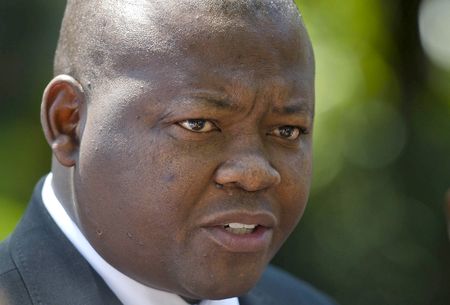
On Wednesday, Naidoo said that public prosecutors were also appointed by the President in consultation with the Minister of Justice, and that this process was neither open nor transparent.
Terms of office, Naidoo said, should also be extended for those who were older than 65, the current retirement age.
“This is an alive issue with Andy Mothibi at the age of 63, [who] will probably only serve another two years”.
Judicial symbiosis
Mbekezeli Benjamin of Judges Matter said the judiciary was a key pillar in the structure and that it could not function if the NPA was dysfunctional.
“There is a symbiotic relationship,” he said. This triangle consisted of the courts, the Judicial Service Commission and the NPA.
The fact that the NPA was housed in Chapter 8 of the Constitution recognised this, said Benjamin, who added that laws needed to be written that would strengthen the NPA and enable the types of specialised skills required.
“We have career prosecutors who are State advocates, and they are people who are admitted as advocates, but through old legislation, pre-2018. The Legal Practitioners Act did not apply to those individuals who chose to be career prosecutors”.
All that was required, said Benjamin, was an LLB to be a “fit and proper person”.
“You do not need to be a member of the bar. You do not need to have gone under pupillage or written exams.”
The NPA needed the type of prosecutor who could go into private practice and meet the same standards as those in private practice.
“We need reform in the laws that govern the admission of prosecutors.”
Urgent and overdue
Nicole Fritz, of the Campaign for Free Expression, said greater transparency in decisions to prosecute was needed as these were, at present, “invisible”.
“Prosecutions must be made public. We have seen this in the State Capture cases, the failures and withdrawals. In two ongoing commissions of inquiry, the Khampepe and Nkabinde inquiries, a common pattern has emerged of where decisions are taken and the framework is not visible or accountable”. DM
For further information, visit The Dullah Omar Institute or the African Criminal Justice Reform websites.