
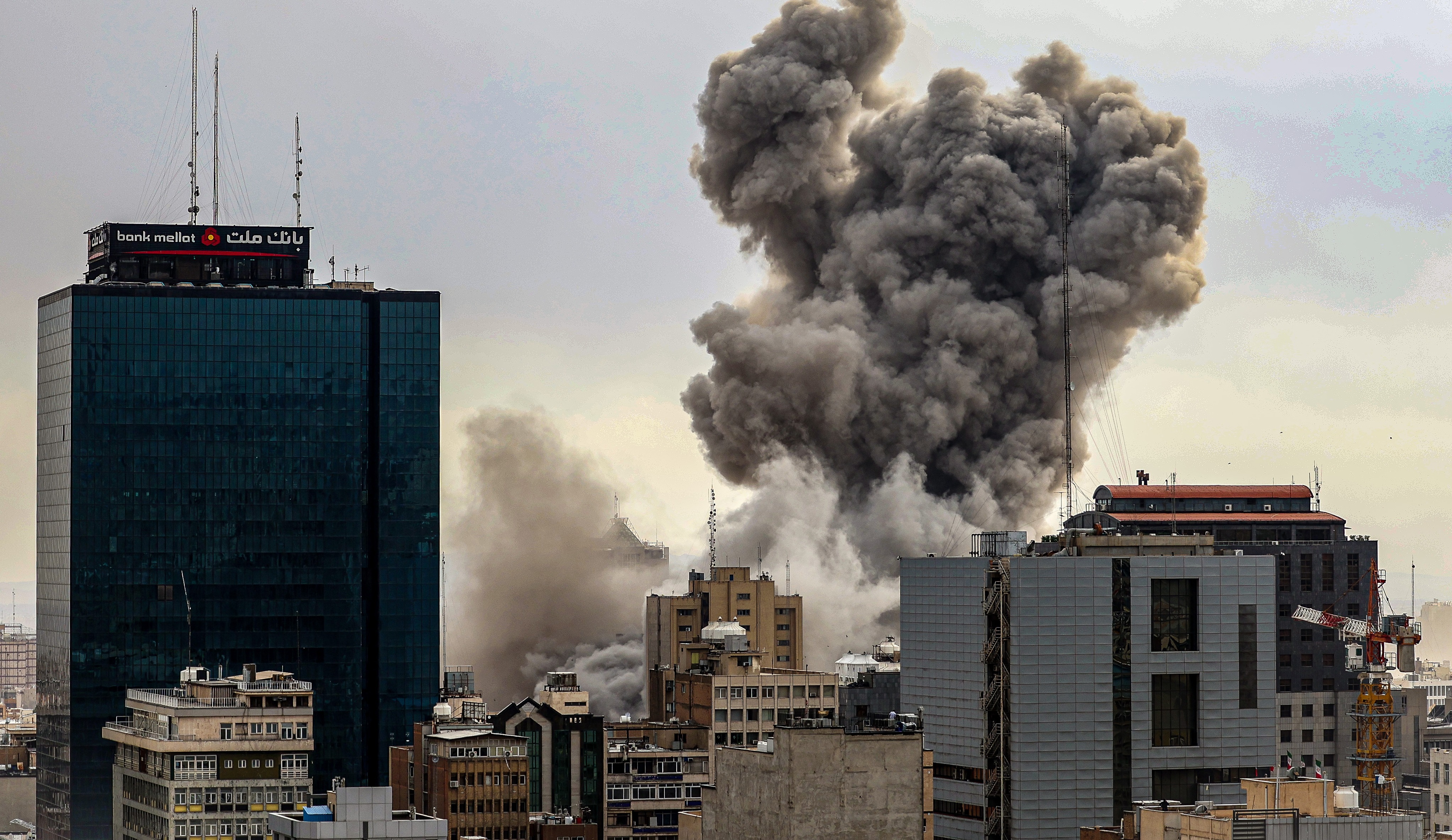
 A general view of Tehran with smoke visible in the distance after explosions were reported in the city, on 2 March 2026 in Iran. (Photo: Contributor / Getty Images)
 “War,” says Dr Pauline Heinrichs of King’s College London, “is the devastation of life and the most intensive, concentrated form of human activity. Environmental harms and war are so closely related you could say they’re in a symbiotic relationship.”
War compresses fuel use, industrial destruction, logistics and reconstruction into a single, accelerated moment. It’s not just violence – it is an energy event.
Heinrichs, a lecturer in War Studies specialising in climate and energy, is calibrating the seemingly endless wars and armed conflicts from a platform different to the politicians and generals who lead them.
Modern war is dirty. It produces emissions at extraordinary speed, which is bad news on a planet hovering on climate disaster.
“It’s not just how much is emitted,” Heinrichs says. “It’s the intensity. War condenses into days processes that would normally unfold over years.”
The 1991 Gulf War, she points out, required about 10,000 firefighters to diminish the oil fires that emitted the equivalent of about 46 million diesel trucks worth of soot.
A system operating at full capacity
The environmental consequences of war are often treated as secondary – damage to be addressed after the fact. But Heinrichs argues this misses something fundamental. War’s not an interruption to systems of energy and production; it is their most extreme expression.
Militaries are already among the largest consumers of fossil fuels. The US Department of Defense, for example, is the world’s leading institutional user of petroleum and a major source of greenhouse gas emissions. Fossil fuels are not incidental to modern warfare – they are their foundation.
When conflict begins, that system intensifies. Aircraft sorties, troop movements, naval operations and supply chains all depend on high volumes of fossil fuel. In major conflicts, these activities are layered with fires, explosions and the destruction of infrastructure that releases stored carbon.
/file/attachments/orphans/Screenshot-2026-03-30-at-1026_177812.jpg "Total emissions during 24 months of Russia’s war against Ukraine (Image: European Climate Foundation)")
According to the United Nations, militaries collectively account for an estimated 5.5% of global greenhouse gas emissions, a figure probably understated due to weak reporting.
The problem is not only scale, but visibility. Military emissions, Heinrichs says, are often exempt from reporting frameworks or obscured within national inventories.
A recent analysis found that major powers either fail to report military emissions or report them incompletely, creating what researchers describe as a widening “military emissions gap”.
“We’re dealing with partial data. But even the partial picture is enough to show that this is a significant and under-acknowledged source of emissions.”
Iran and the anatomy of a modern conflict
The early phases of the Iran conflict illustrate her point with uncomfortable clarity. Within days, hundreds of environmentally relevant incidents were recorded across the region – airstrikes on military bases, oil storage facilities, refineries, ports and transport infrastructure. Many of these sites generated fires and pollution plumes containing particulate matter, heavy metals and toxic compounds.
In Tehran, pollution was intensified by geography. The city’s basin-like setting and surrounding mountains trapped airborne contaminants, exposing millions to degraded air quality. In some instances, observers reported “black rain” as soot and pollutants fell from smoke clouds.
/file/attachments/orphans/assault-CO2_394615.jpg "Emissions in two weeks of the US and Israeli bombing of Iran. (Image: Climate and Community Institute)")
At sea, damaged vessels and port infrastructure increased the risk of oil spills. Along the Persian Gulf, attacks on shipping and energy facilities created overlapping environmental risks – spills, fires and disrupted containment systems.
These incidents are not anomalies. They’re characteristic of modern conflict where civilians are seen as unavoidable collateral damage. As Heinrichs notes, “war interacts with existing energy systems. Where fossil fuel infrastructure exists, it becomes both a target and a source of emissions.”
The three phases of war emissions
Recent research, including work associated with Heinrichs’ field, increasingly frames war emissions in three phases:
1. The initial spike
The opening phase of conflict is marked by intense fuel use and large-scale destruction. Air campaigns, missile strikes and troop mobilisation generate immediate emissions, while fires release stored carbon from infrastructure and fuel reserves.
Historical precedents underline this effect. During the 1991 Gulf War, more than 600 oil wells were set ablaze, releasing vast quantities of pollutants and affecting air quality far beyond the immediate region.
2. The sustained baseline
As conflict continues, emissions stabilise at a high level. Military operations remain fuel-intensive, while civilian systems degrade. Power outages lead to diesel generator use; supply chains fragment; environmental regulation collapses.
At the same time, ecosystems are damaged or destroyed. Forests are cleared, soils contaminated and water systems polluted. These effects, says Heinrichs, reduce the environment’s capacity to absorb carbon, compounding the impact.
The UN notes that conflicts “disrupt ecosystems, deplete natural resources and pollute the environment”, often with consequences that last decades.
3. The reconstruction surge
When conflict ends – or stabilises – emissions rise again. Rebuilding infrastructure requires energy-intensive materials such as cement and steel. In many cases, reconstruction becomes one of the largest sources of emissions associated with war.
“This is the phase that is most often ignored,” Heinrichs says. “But it is central. Destruction is followed by rebuilding, and both are carbon-intensive.”
Why crises reinforce the problem
Heinrichs’ research focuses not only on emissions themselves, but on the political dynamics that sustain them.
Her work describes what she calls “maladaptive politics”: the tendency of crisis responses to reproduce the conditions that caused the crisis.
Crises, she argues, are framed in short-term thinking. Immediate security concerns – often understood as fossil fuel energy supply, economic stability and military capability – take precedence over long-term economic, security or environmental considerations. As a result, decisions made during crises often reinforce fossil fuel dependence. Many of the short-term responses directly contradict long-term security strategies.
/file/attachments/orphans/Russia_Ukraine-war-emissions_207397.jpg "Growth of war emissions in Russia/Ukraine war. (Image: European Climate Foundation)")
/file/attachments/orphans/Screenshot-2026-03-26-at-934_346402.jpg "Emissions during 24 months of the Russia / Ukraine war . (Image: European Climate Foundation)")
“Crises are not neutral,” she says. “They’re interpreted in ways that prioritise certain timescales over others.”
In practical terms, this can be seen in the response to energy disruptions during conflicts. Attacks on oil infrastructure or shipping routes often trigger efforts to stabilise supply – sometimes by increasing production elsewhere or reverting to more carbon-intensive fuels.
These responses are rooted in what Heinrichs describes as “routines” – established patterns of behaviour that are repeatedly invoked in times of crisis.
“These routines feel like the obvious response,” she says. “But they’re choices. And they often reproduce the problem.”
The problem of time
A key element of Heinrichs’ argument is that environmental damage from war operates on multiple timescales. Some effects are immediate and visible – fires, smoke, contamination. Others unfold slowly: soil degradation, groundwater pollution, ecosystem collapse.
Political decision-making, however, tends to focus on the immediate.
“The language of crisis compresses time,” Heinrichs explains. “It makes the present urgent and the future abstract.” The result is a systematic bias: short-term actions that generate long-term harm.
A global blind spot
The lack of transparency around military emissions compounds the problem.
International agreements have historically allowed countries to exclude certain military emissions from reporting, particularly those related to international operations. This has created a persistent gap in global climate accounting.
/file/attachments/orphans/GettyImages-2266154747_779082.jpg "Smoke from a building in the centre of Beirut which was hit by the IDF after an evacuation order on 12 March 2026 in Lebanon. (Photo: Adri Salido / Getty Images)")
/file/attachments/orphans/13862045_996890.jpg "Smoke billows after a projectile landed in an area between the West Bank and the Israeli city of Hadera, as seen from the West Bank city of Nablus on 26 March 2026. (Photo: EPA / Alaa Badarneh)")
/file/attachments/orphans/GettyImages-2265402840_509939.jpg "Smoke billows after overnight airstrikes on oil depots on 8 March 2026 in Tehran, Iran. (Photo: Majid Saeedi / Getty Images)")
/file/dailymaverick/wp-content/uploads/2023/03/989_2647_LasseBranding_Germany_Professional_Environment_2023.png "Bosnia and Herzegovina has the fifth highest incidence of deaths from air pollution in the world, while rates of lung disease are also among the highest. Following the privatisation of the local steel plant and the economic decline of Bosnia after the Yugoslav war, the number of employees decreased drastically, and production never returned to its pre-war level. (Photo: Lasse Branding)")
Recent data suggests that the gap is widening. Major military powers either do not report their emissions or report them incompletely, making it difficult to assess the true scale of the sector’s impact.
Without reliable data, the role of war in driving emissions remains underexamined. And without scrutiny, there is little pressure for change.
War as part of the climate system
What emerges from Heinrichs’ work is a shift in perspective: war is not separate from the climate system. It’s embedded within it.
Conflicts damage ecosystems, release greenhouse gases and disrupt environmental governance. At the same time, the factors that exacerbate climate stress – inaction, militarisation and fossil fuel energy – contribute to instability and conflict.
“It’s not a one-way relationship,” Heinrichs says. “War contributes to climate change, and inaction in the face of climate change contributes to the conditions in which war becomes more likely.”
An uncomfortable implication
The implication is difficult to avoid. Efforts to address climate change often focus on energy, transport and industry. But one of the most energy-intensive sectors – military activity – remains only partially accounted for.
At the same time, the political dynamics of crisis response tend to reinforce the very systems that need to change.
If we continue to respond to crises in the same way, Heinrichs says, we are likely to reproduce the same outcomes. That includes the environmental footprint of war.
What would change look like? Heinrichs is cautious about prescribing solutions. The constraints are real: national security, political priorities and institutional inertia all shape decision-making. But she’s clear about what would need to shift.
- First, greater transparency around military emissions. Without data, the problem cannot be fully understood or addressed.
- Second, the integration of environmental considerations into crisis decision-making – not as an afterthought, but as a central factor. Security needs to be understood through the environment as a condition for life and livelihoods.
- And third, a rethinking of the routines that govern responses to crisis.
Change is possible, she says. But it requires recognising that what we treat as inevitable responses are, in fact, choices.
A different way of seeing conflict
The environmental cost of war has long been acknowledged in fragments – oil fires, polluted rivers, damaged landscapes. What Heinrichs’ work offers is a framework that connects those fragments into a system.
War is not only destructive, it’s generative – in the sense that it generates emissions, pollution and long-term environmental change. And once that is understood, it becomes harder to treat it as peripheral.
“War is part of the climate story,” Heinrichs says. “We just haven’t been telling it that way.” DM